Question 15 Marks
An eye can distinguish between two points of an object if they are separated by more than $0.22\ mm$ when the object is placed at $25\ cm$ from the eye. The object is now seen by a compound microscope having a $20D$ objective and $10D$ eyepiece separated by a distance of $20\ cm$. The final image is formed at $25\ cm$ from the eye. What is the minimum separation between two points of the object which can now be distinguished?
Answer
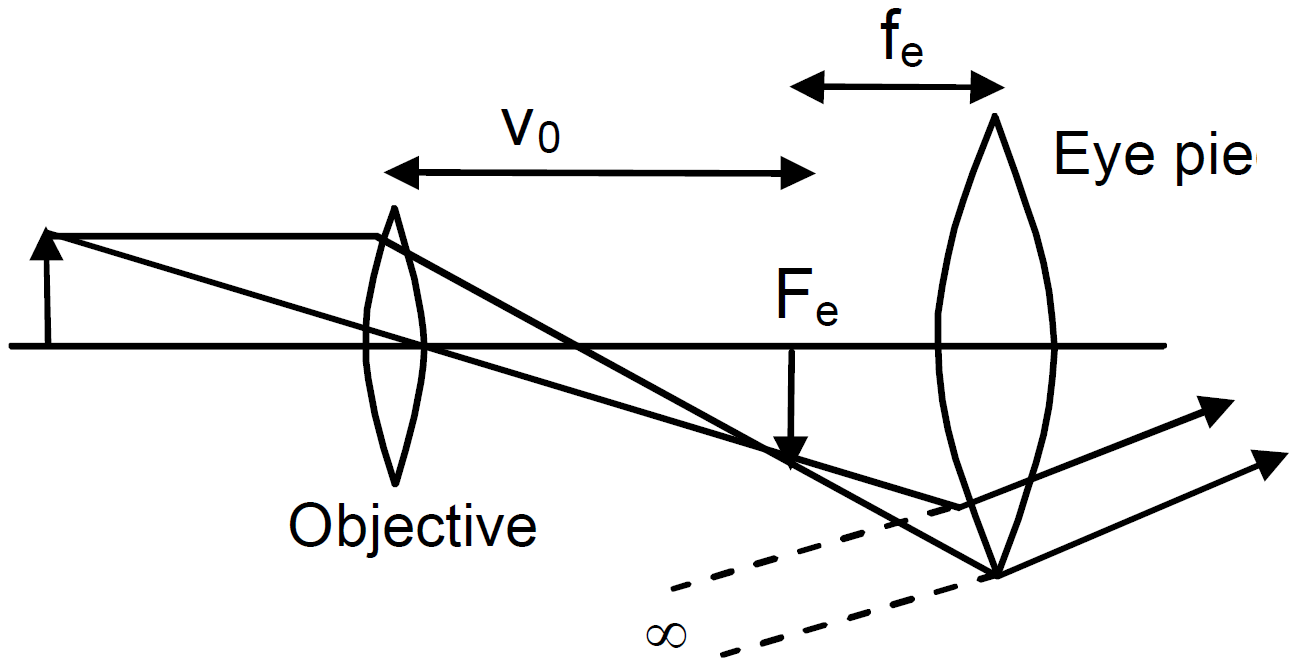
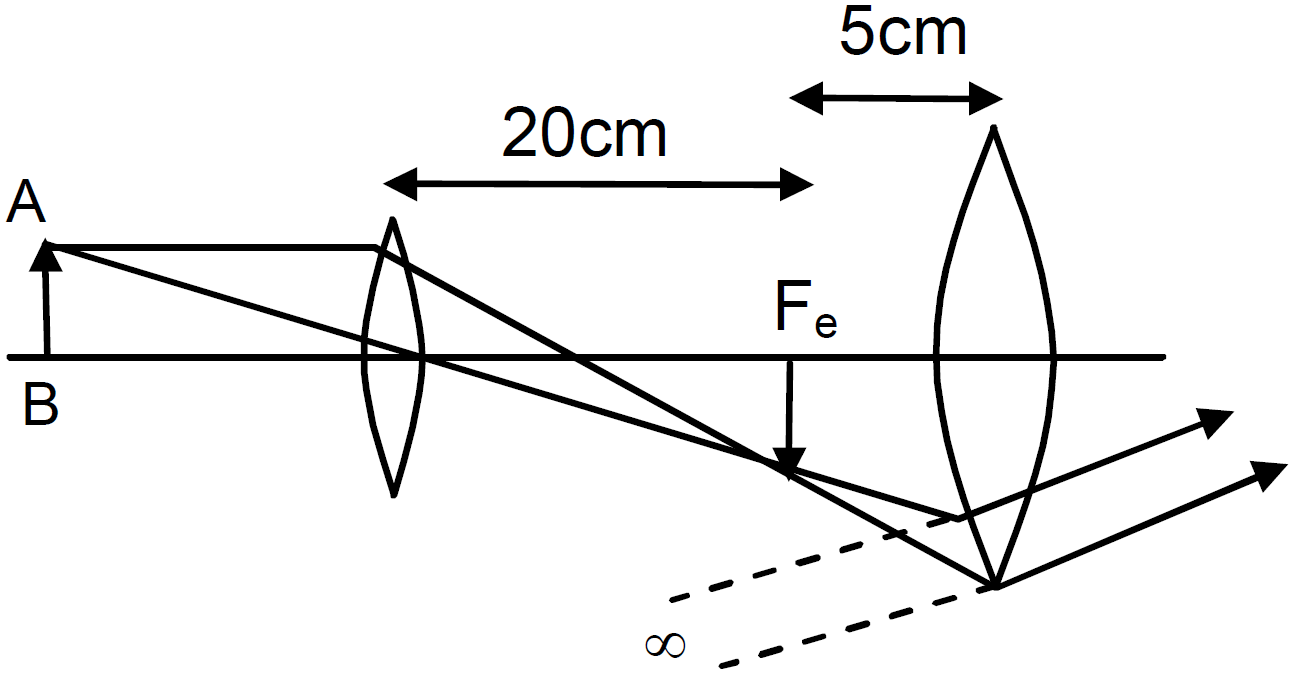
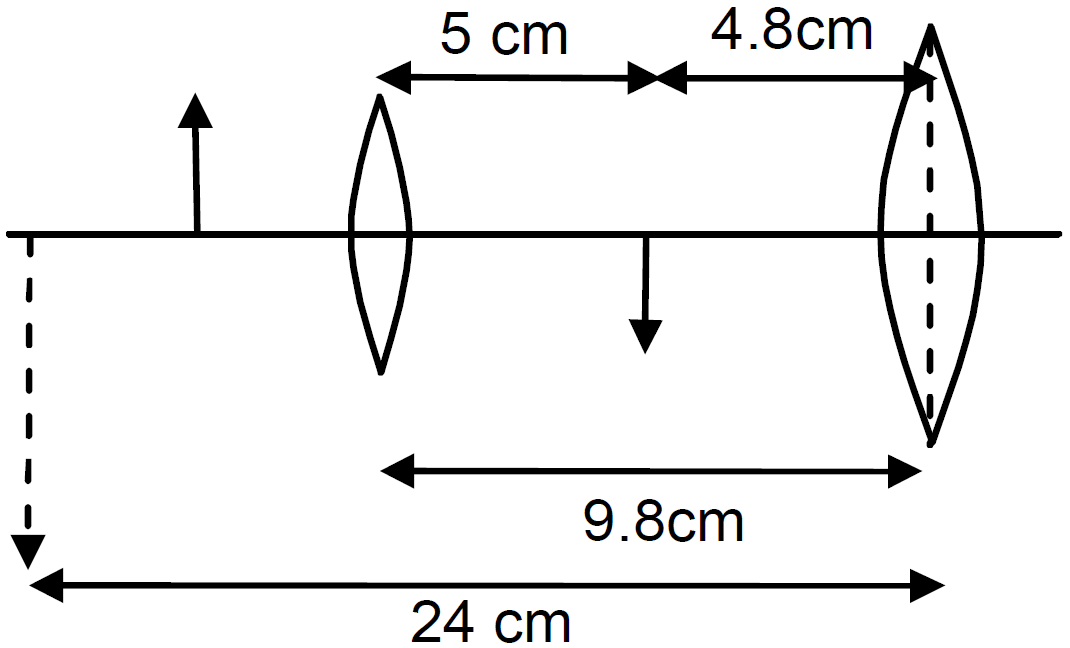
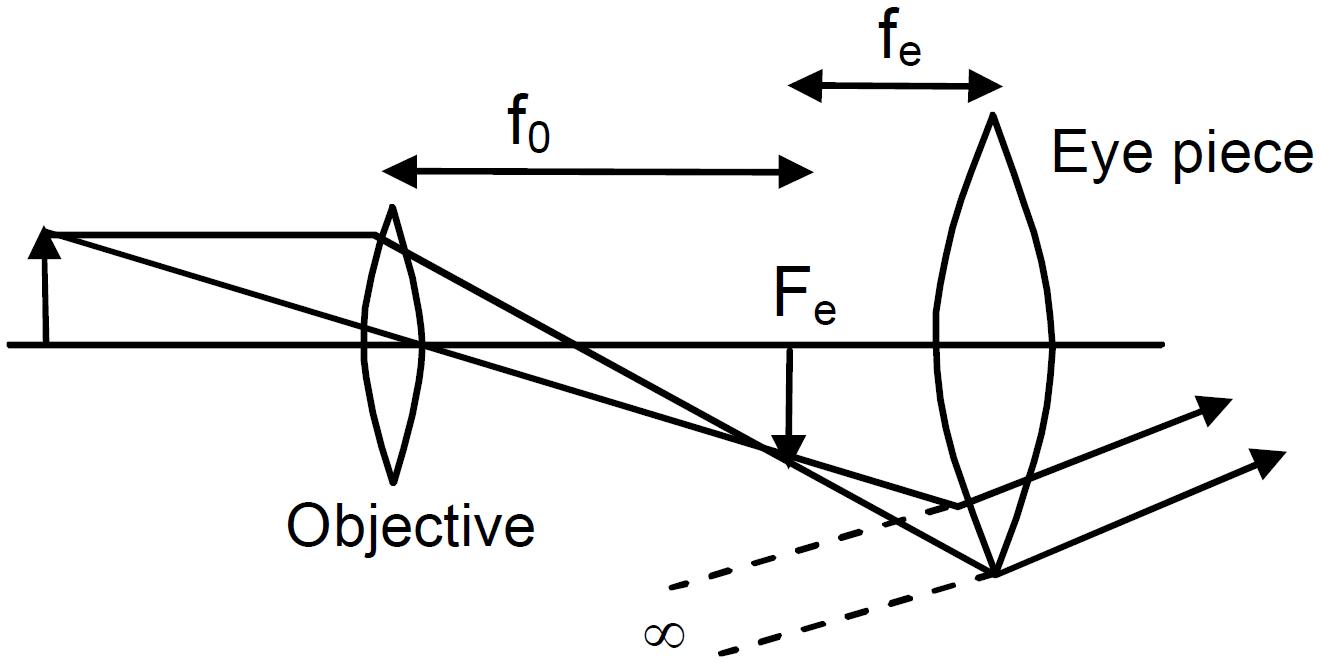
View full question & answer→For the given compound microscope $\text{f}_0=\frac{1}{20\text{D}}=0.05\text{m}=5\ \text{cm},$
$\text{f}_\text{e}=\frac{1}{10\text{D}}=0.1\text{m}=10\ \text{cm.}$
$D = 25\ cm,$ separation between objective eyepiece $= 20\ cm$
For the minimum separation between two points which can be distinguished by eye using the microscope, the magnifying power should be maximum.
For the eyepiece$, v_0 = -25\ cm, f_e = 10\ cm$
So, $\frac{1}{\text{u}_\text{e}}=\frac{1}{\text{v}_\text{e}}-\frac{1}{\text{f}_\text{e}}=\frac{1}{-25}-\frac{1}{10}$
$=-\Big[\frac{2+5}{50}\Big]$
$\Rightarrow\text{u}_\text{e}=-\frac{50}{7}\text{cm}$
So, the image distance for the objective lens should be,
$\text{v}_0=20-\frac{50}{7}=\frac{90}{7}\text{cm}$
Now, for the objective lens,
$\frac{1}{\text{u}_0}=\frac{1}{\text{v}_0}-\frac{1}{\text{f}_0}=\frac{7}{90}-\frac{1}{5}=-\frac{11}{90}$
$\Rightarrow\text{u}_\text{o}=-\frac{90}{11}\text{cm}$
So, the maximum magnifying power is given by,
$\text{m}=\frac{-\text{V}_0}{\text{u}_0}\Big[1+\frac{\text{D}}{\text{f}_\text{e}}\Big]$
$=\frac{\big(\frac{90}{7}\big)}{\big(-\frac{90}{11}\big)}\Big[1+\frac{25}{10}\Big]$
$=\frac{11}{7}\times3.5=5.5$
Thus, minimum separation eye can distinguish $=\frac{0.22}{5.5}\ \text{mm}=0.04\ \text{mm}$
$\text{f}_\text{e}=\frac{1}{10\text{D}}=0.1\text{m}=10\ \text{cm.}$
$D = 25\ cm,$ separation between objective eyepiece $= 20\ cm$
For the minimum separation between two points which can be distinguished by eye using the microscope, the magnifying power should be maximum.
For the eyepiece$, v_0 = -25\ cm, f_e = 10\ cm$
So, $\frac{1}{\text{u}_\text{e}}=\frac{1}{\text{v}_\text{e}}-\frac{1}{\text{f}_\text{e}}=\frac{1}{-25}-\frac{1}{10}$
$=-\Big[\frac{2+5}{50}\Big]$
$\Rightarrow\text{u}_\text{e}=-\frac{50}{7}\text{cm}$
So, the image distance for the objective lens should be,
$\text{v}_0=20-\frac{50}{7}=\frac{90}{7}\text{cm}$
Now, for the objective lens,
$\frac{1}{\text{u}_0}=\frac{1}{\text{v}_0}-\frac{1}{\text{f}_0}=\frac{7}{90}-\frac{1}{5}=-\frac{11}{90}$
$\Rightarrow\text{u}_\text{o}=-\frac{90}{11}\text{cm}$
So, the maximum magnifying power is given by,
$\text{m}=\frac{-\text{V}_0}{\text{u}_0}\Big[1+\frac{\text{D}}{\text{f}_\text{e}}\Big]$
$=\frac{\big(\frac{90}{7}\big)}{\big(-\frac{90}{11}\big)}\Big[1+\frac{25}{10}\Big]$
$=\frac{11}{7}\times3.5=5.5$
Thus, minimum separation eye can distinguish $=\frac{0.22}{5.5}\ \text{mm}=0.04\ \text{mm}$