Question
An optical instrument used for angular magnification has a 25D objective and a 20D eyepiece. The tube length is 25cm when the eye is least strained.
  1. Whether it is a microscope or a telescope?
  2. What is the angular magnification produced?

Answer

The optical instrument has

$\text{f}_0=\frac{1}{25\text{D}}=0.04\text{m}=4\text{cm}$

$\text{f}_\text{e}=\frac{1}{20\text{D}}=0.05\text{m}=5\text{cm}$

tube length = 25cm (normal adjustment)

  1. The instrument must be a microscope as f0 < fe
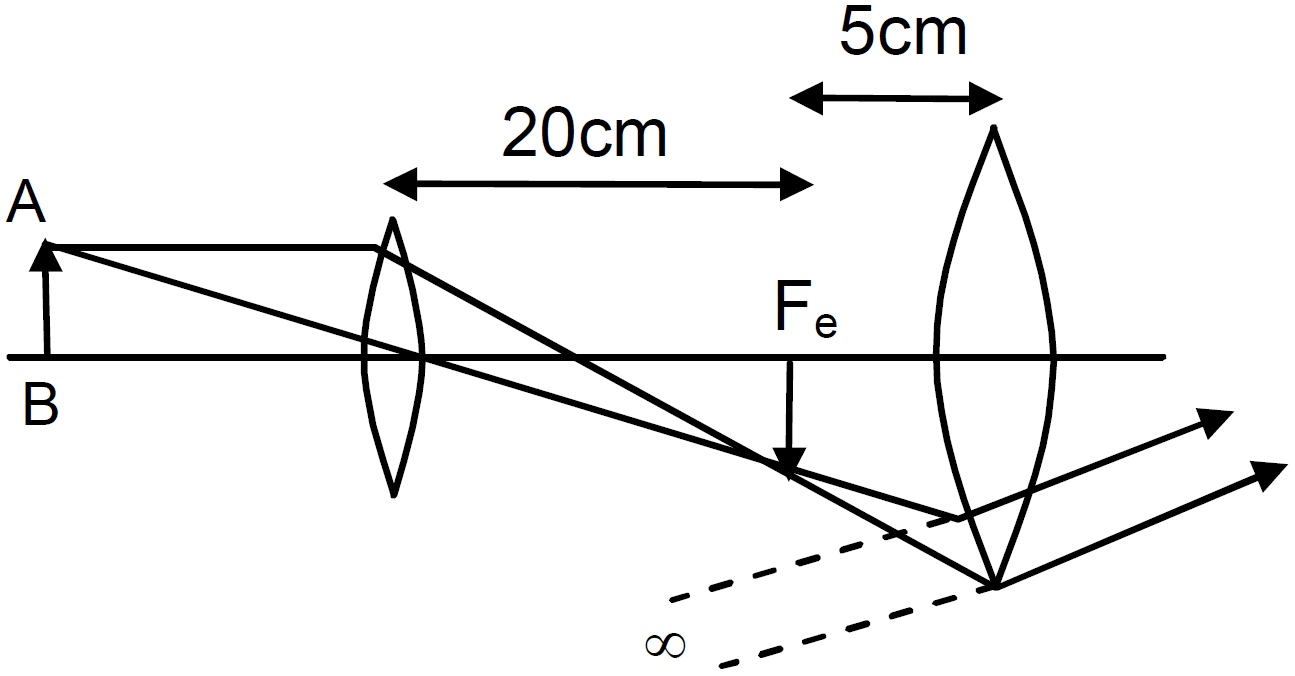
  2. Since the final image is formed at infinity, the image produced by the objective should lie on the focal plane of the eye piece.

So, image distance for objective = v0 = 25 – 5 = 20cm

Now, using lens formula.

$\frac{1}{\text{v}_0}-\frac{1}{\text{u}_0}=\frac{1}{\text{f}_0}$

$\Rightarrow\frac{1}{\text{u}_0}=\frac{1}{\text{v}_0}-\frac{1}{\text{f}_0}=\frac{1}{20}-\frac{1}{4}$

$=\frac{-4}{20}=\frac{-1}{5}\Rightarrow\text{u}_0=-5\text{cm}$

So, angular magnification $\text{m}=-\frac{\text{v}_0}{\text{u}_0}\times\frac{\text{D}}{\text{f}_\text{e}}$[Taking D = 25cm]

$=-\frac{20}{-5}\times\frac{25}{5}=20$
Need a full question paper?

Generate a complete, print-ready paper with questions like this in minutes — across 16+ boards, with answer keys.

Start Generating Free

Similar questions

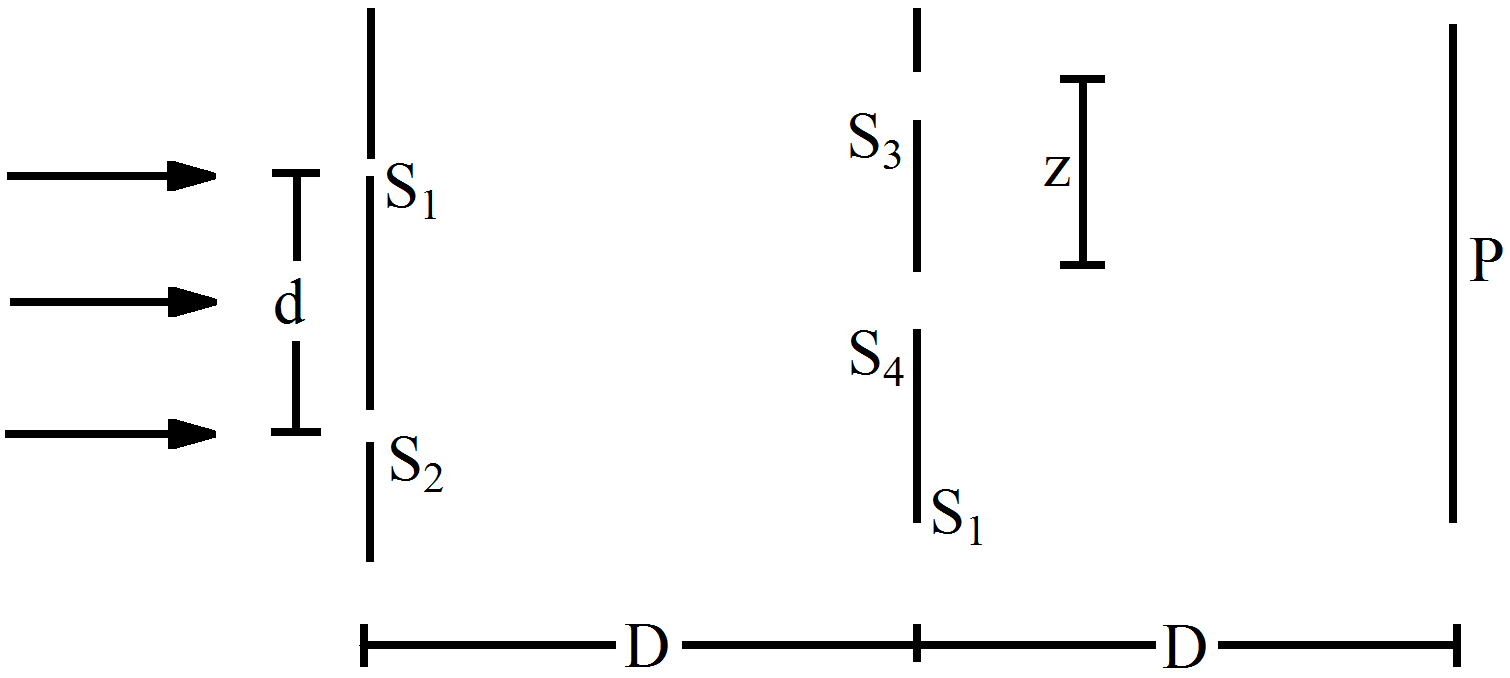
Consider the arrangement shown in figure. By some mechanism, the separation between the slits S3 and S4 can be changed. The intensity is measured at the point P which is at the common perpendicular bisector

of S1S2 and S3S4. When $\text{z}=\frac{\text{D}\lambda}{2\text{d}},$ intensity measured at P is I. Find this intensity when z is equal to:

  1. $\frac{\text{D}\lambda}{\text{d}}$

  2. $\frac{3\text{D}\lambda}{2\text{d}}$

  3. $\frac{2\text{D}\lambda}{\text{d}}$

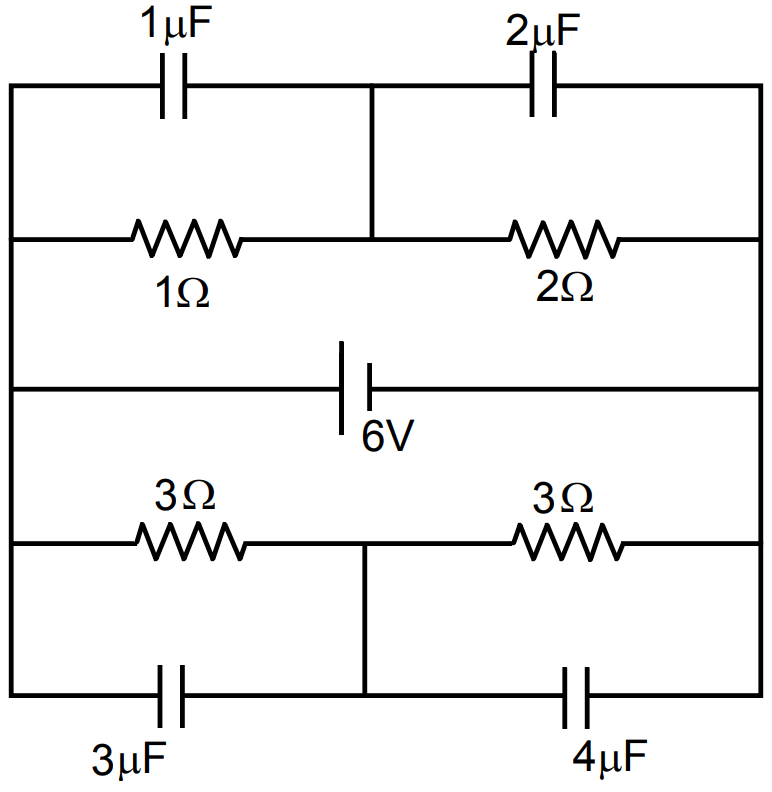
Find the charges on the four capacitors of capacitances $1\mu\text{F},2\mu\text{F},3\mu\text{F}$ and $4\mu\text{F}$ shown in the figure.

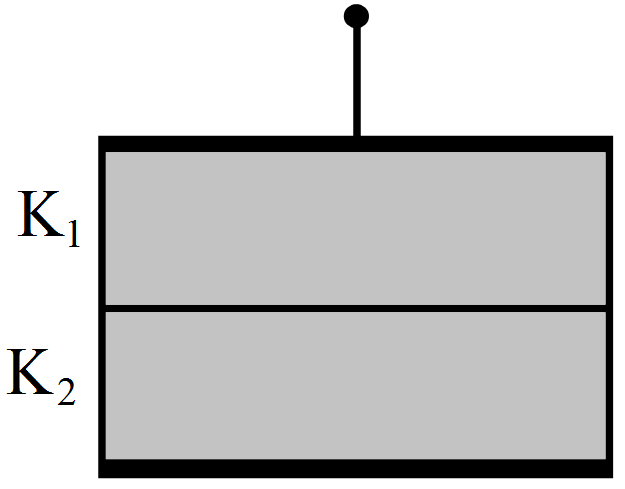
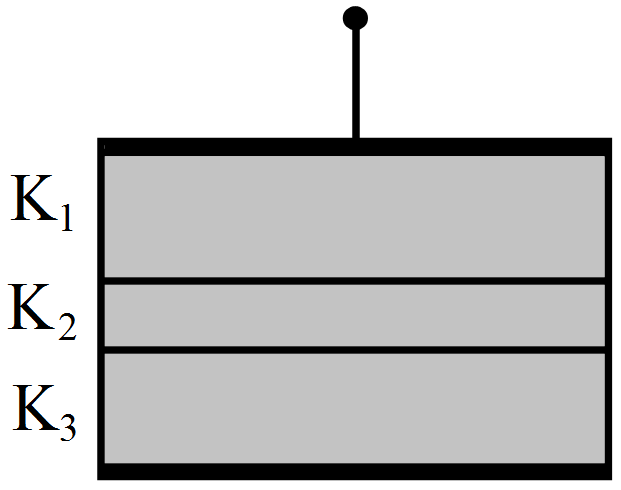
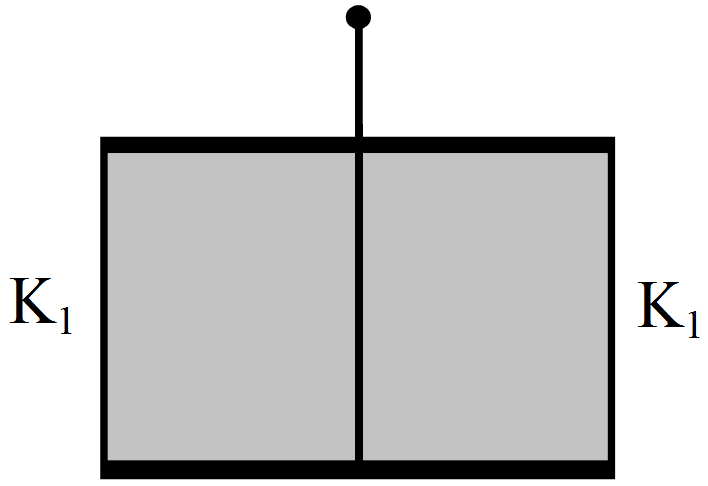
Find the capacitances of the capacitors shown in figure. The plate area is A and the separation between the plates is d. Different dielectric slabs in a particular part of the figure are of the same thickness and the entire gap between the plates is filled with the dielectric slabs.


Answer the following question:
If the earth did not have an atmosphere, would its average surface temperature be higher or lower than what it is now?
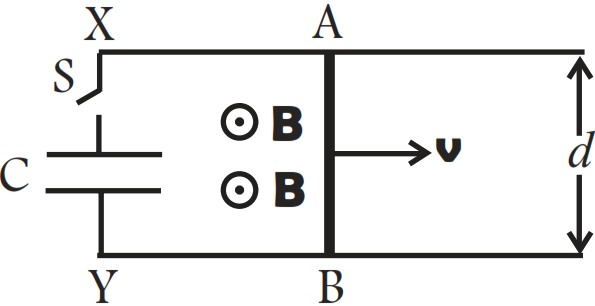
Find the current in the sliding rod AB (resistance = R) for the arrangement shown in Fig. B is constant and is out of the paper. Parallel wires have no resistance. v is constant. Switch S is closed at time t = 0.

What are the dimensions of $\chi$, the magnetic susceptibility? Consider an H-atom. Guess an expression for $\chi$, upto a constant by constructing a quantity of dimensions of $\chi$, out of parameters of the atom: e, m, v, R and μ0 . Here, m is the electronic mass, v is electronic velocity, R is Bohr radius. Estimate the number so obtained and compare with the value of $|\chi|\sim10^{-5}$ for many solid materials.
  1. Derive an expression for the average power consumed in a series LCR circuit connected to a.c. source in which the phase difference between the voltage and the current in the circuit is $\phi$.
  2. Define the quality factor in an a.c. circuit. Why should the quality factor have high value in receiving circuits? Name the factors on which it depends.
Define total internal reflection. Establish the relation between $u, v$ and $f$ for a spherical mirror. Draw the necessary ray diagram. ### Define lateral displacement. Derive the lens maker formula.
$
\frac{1}{f}=\left(n_{21}-1\right)\left(\frac{1}{R_1}-\frac{1}{R_2}\right)
$
Draw the necessary ray diagram. (Where the signs have their usual meanings.)
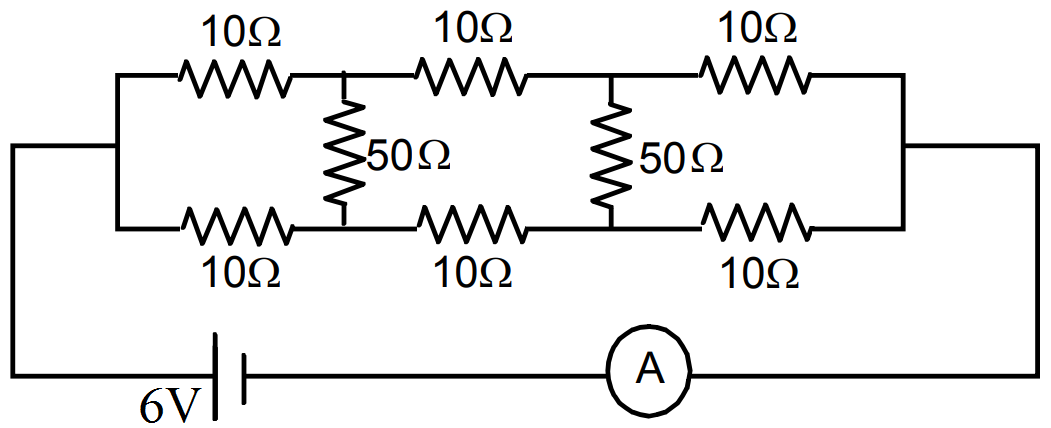
Find the current measured by the ammeter in the circuit shown in the figure.

A horizontal cesium plate ($\phi$ = l.9 eV) is moved vertically downward at a constant speed u in a room full of radiation of wavelength 250 run and above. What should be the minimum value of u so that the vertically upward component of velocity is nonpositive for each photoelectron?