Question
An optical instrument used for angular magnification has a 25D objective and a 20D eyepiece. The tube length is 25cm when the eye is least strained.
  1. Whether it is a microscope or a telescope?
  2. What is the angular magnification produced?

Answer

The optical instrument has

$\text{f}_0=\frac{1}{25\text{D}}=0.04\text{m}=4\text{cm}$

$\text{f}_\text{e}=\frac{1}{20\text{D}}=0.05\text{m}=5\text{cm}$

tube length = 25cm (normal adjustment)

  1. The instrument must be a microscope as f0 < fe
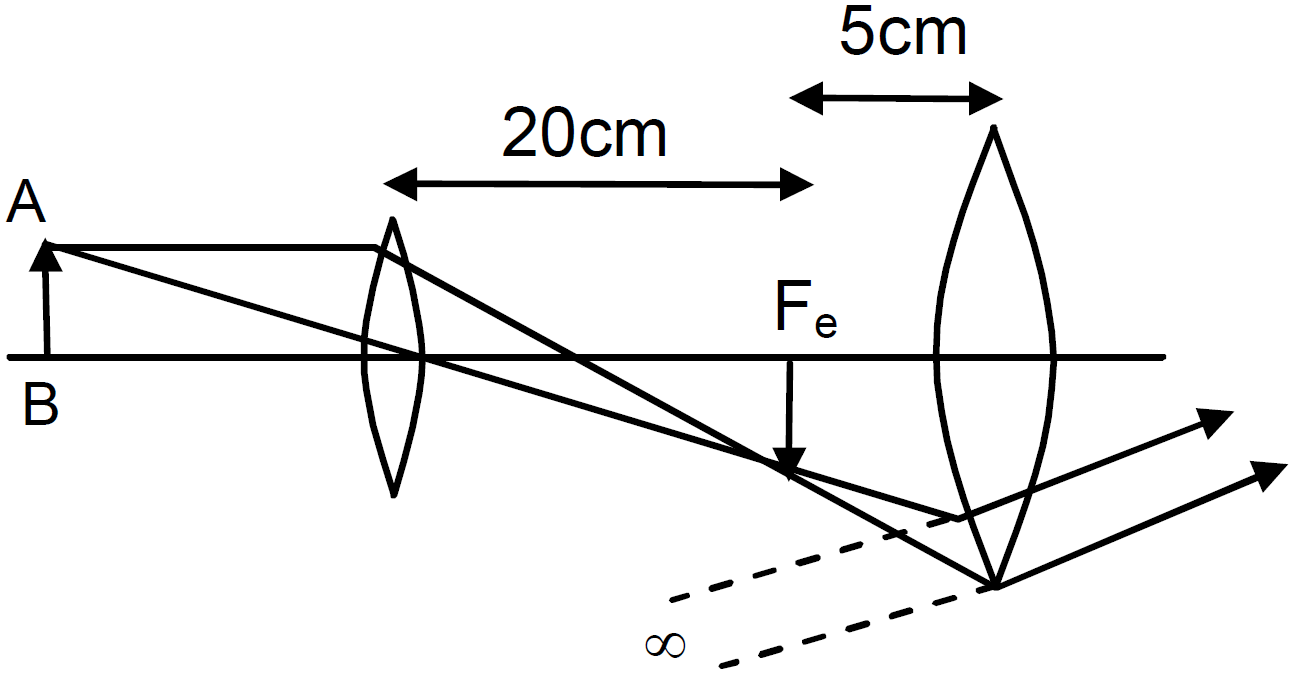
  2. Since the final image is formed at infinity, the image produced by the objective should lie on the focal plane of the eye piece.

So, image distance for objective = v0 = 25 – 5 = 20cm

Now, using lens formula.

$\frac{1}{\text{v}_0}-\frac{1}{\text{u}_0}=\frac{1}{\text{f}_0}$

$\Rightarrow\frac{1}{\text{u}_0}=\frac{1}{\text{v}_0}-\frac{1}{\text{f}_0}=\frac{1}{20}-\frac{1}{4}$

$=\frac{-4}{20}=\frac{-1}{5}\Rightarrow\text{u}_0=-5\text{cm}$

So, angular magnification $\text{m}=-\frac{\text{v}_0}{\text{u}_0}\times\frac{\text{D}}{\text{f}_\text{e}}$[Taking D = 25cm]

$=-\frac{20}{-5}\times\frac{25}{5}=20$
Need a full question paper?

Generate a complete, print-ready paper with questions like this in minutes — across 16+ boards, with answer keys.

Start Generating Free

Similar questions

The electric field at a point associated with a light wave is $\text{E}=\big(100\frac{\text{v}}{\text{m}}\big)\sin[(3.0\times10^{15}\text{s}^{-1})\text{t]sin[(6.0}\times10^{15}\text{s}^{-1})\text{t}].$ If this light falls on a metal surface having a work function of 2.0eV, what will be the maximum kinetic energy of the photoelectrons?
A right-angled triangle abc, made from a metallic wire, moves at a uniform speed v in its plane as shown in figure. A uniform magnetic field B exists in the perpendicular direction. Find the emf induced:
  1. In the loop abc.
  2. In the segment bc.
  3. In the segment ac.
  4. In the segment ab.

A neutron star has a density equal to that of the nuclear matter. Assuming the star to be spherical, find the radius of a neutron star whose mass is 4.0 × 1030kg (twice the mass of the sun).
Use Moseley's law with b = 1 to find the frequency of the $\text{K}_\alpha$ X-ray of La(Z = 57) if the frequency of the $\text{K}_\alpha$ X-ray of Cu(Z = 29) is known to be 1.88 × 10¹⁸Hz.
An aluminium plate fixed in a horizontal position has a hole of diameter 2.000cm. A steel sphere of diameter 2.005cm rests on this hole. All the lengths refer to a temperature of 10°C. The temperature of the entire system is slowly increased. At what temperature willl the ball fall down? Coefficient of linear expansion of aluminium is 23 × 10-6 °C-1 and that of steel is 11 × 10-6 °C-1.
4 × 10²³ tritium atoms are contained in a vessel. The half-life of decay tritium nuclei is 12.3y. Find:
  1. The activity of the sample.
  2. The number of decay in the next 10 hours.
  3. The number of decays in the next 6.15y.
A particle of mass m and charge q is thrown at a speed u against a uniform electric field E. How much distance will it travel before coming to momentary rest?
A U-shaped wire is placed before a concave mirror having radius of curvature 20cm. Find the total length of the image.

Derive an expression for equivalent capacitance of three capacitors when connected
i. in series and
ii. in parallel.