Question
Derive an expression for equivalent capacitance of three capacitors when connected
i. in series and
ii. in parallel.

Answer

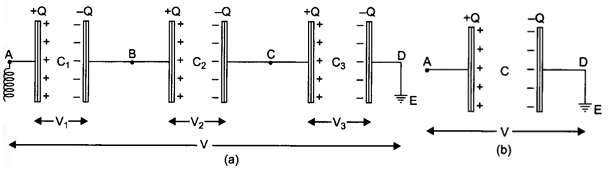
i. In fig. (a) three capacitors of capacitances $C_1, C_2, C_3$ are connected in series between points $A$ and $D$.
Image

In series first plate of each capacitor has charge +Q and second plate of each capacitor has charge -Q i.e., charge on each capacitor is Q.
Let the potential differences across the capacitors $C_1, C_2, C_3$ be $V_1, V_2, V_3$ respectively. As the second plate of first capacitor $C _1$ and first plate of second capacitor $C _2$ are connected together, their potentials are equal. Let this common potential be $V _{ B }$ Similarly the common potential of second plate of $C _2$ and first plate of $C _3$ is $V _{ C }$. The second plate of capacitor $C _3$ is connected to earth, therefore its potential $V_D=0$. As charge flows from higher potential to lower potential, therefore $V_A>V_B$ $> V _{ C }> V _{ D }$.
For the first capacitor, $V _1= V _{ A }- V _{ B }=\frac{Q}{C_1} \ldots$ (i)
For the second capacitor, $V _2= V _{ B }- V _{ C }=\frac{Q}{C_2} \ldots$ (ii)
For the third capacitor, $V _3= V _{ C }- V _{ D }=\frac{q}{c_3} \ldots$ (iii)
Adding (i), (ii) and (iii), we get
$V _1+ V _2+ V _3= V _{ A }- V _{ D }=Q\left[\frac{1}{C_1}+\frac{1}{C_2}+\frac{1}{C_3}\right] \ldots$ (iv)
If V be the potential difference between A and D, then
$V _{ A }- V _{ D }= V$
$\therefore$ From (iv), we get
$V =\left( V _1+ V _2+ V _3\right)=Q\left[\frac{1}{C_1}+\frac{1}{C_2}+\frac{1}{C_3}\right] \ldots( v )$
If in place of all the three capacitors, only one capacitor is placed between A and D such that on giving it charge Q, the potential difference between its plates become V, then it will be called equivalent capacitor. If its capacitance is C, then
$V =\frac{Q}{C} \ldots( vi )$
Comparing (v) and (vi), we get
$\frac{Q}{C}=Q\left[\frac{1}{C_1}+\frac{1}{C_2}+\frac{1}{C_3}\right]$ or $\frac{1}{C}=\frac{1}{C_1}+\frac{1}{C_2}+\frac{1}{C_3} \ldots$ (vii)
Thus in series arrangement, "The reciprocal of equivalent capacitance is equal to the sum of the reciprocals of the individual capacitors."

Need a full question paper?

Generate a complete, print-ready paper with questions like this in minutes — across 16+ boards, with answer keys.

Start Generating Free

Similar questions

Suppose the entire system of the previous question is kept inside an elevator which is coming down with an acceleration a < g. Repeat parts (a) and (b).
An LR circuit has L = 1.0H and $\text{R}=20\Omega.$ It is connected across an emf of 2.0V at t = 0. Find $\frac{\text{di}}{\text{dt}}$ at:
  1. t = 100ms
  2. t = 200ms
  3. t = 1.0s
A particle of mass m and charge q is thrown at a speed u against a uniform electric field E. How much distance will it travel before coming to momentary rest?
Derive the expression for the magnetic field at the site of a point nucleus in a hydrogen atom due to the circular motion of the electron. Assume that the atom is in its ground state and give the answer in terms of fundamental constants.
  1. An object is placed in front of a concave mirror. It is observed that a virtual image is formed. Draw the ray diagram to show the image formation and hence derive the mirror equation $\frac{1}{\text{f}}=\frac{1}{\text{u}}+\frac{1}{\text{v}}.$
  2. An object is placed 30cm in front of a plano-convex lens with its spherical surface of radius of curvature 20cm. If the refractive index of the material of the lens is 1.5, find the position and nature of the image formed.
A block of mass M is kept on a rough horizontal surface. The coefficient of static friction between the block and the surface is $\mu.$ The block is to be pulled by applying a force to it. What minimum force is needed to slide the block? In which direction should this force act?
The current in a conductor and the potential difference across its ends are measured by an ammeter and a voltmeter. The meters draw negligible currents. The ammeter is accurate but the voltmeter has a zero error (that is, it does not read zero when no potential difference is applied). Calculate the zero error if the readings for two different conditions are 1.75A, 14.4V and 2.75A, 22.4V.
A compound microscope has a magnifying power of 100 when the image is formed at infinity. The objective has a focal length of 0.5cm and the tube length is 6.5cm. Find the focal length of the eyepiece.
A thin paper of thickness 0.02mm having a refractive index 1.45 is pasted across one of the slits in a Young's double slit experiment. The paper transmits $\frac{4}{9}$ of the light energy falling on it.
  1. Find the ratio of the maximum intensity to the minimum intensity in the fringe pattern.
  2. How many fringes will cross through the centre if an identical paper piece is pasted on the other slit also? The wavelength of the light used is 600nm.
Find the value of $\frac{\text{t}}{\tau}$ for which the current in an LR circuit builds up to:
  1. 90%,
  2. 99%
  3. 99·9% of the steady-state value.