MCQ
An optically active compound
  • Rotates the plane polarised light
  • B
    Changing the direction of polarised light
  • C
    Do not allow plane polarised light to pass through
  • D
    None of the above

Answer

Correct option: A.
Rotates the plane polarised light
a
(a)When the plane-polarised light passes through certain substance, the plane of polarisation of the light is rotated about the direction of propagation of light through a certain angle.

Need a full question paper?

Generate a complete, print-ready paper with questions like this in minutes — across 16+ boards, with answer keys.
Start Generating Free

Similar questions

If displacement $x$ and velocity $v$ are related as $4v^2 = 25 -x^2$ in a $SHM$. Then time Period of given $SHM$ is (Consider $SI\, units$)
When two surfaces are coated with a lubricant, then they
A nucleus of mass number $189$ splits into two nuclei having mass number $125$ and $64$ . The ratio of radius of two daughter nuclei respectively is:
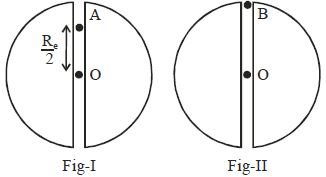
In both figures shown below a hole along the diameter of earth. In first, a particle is released from $A$ and it oscillated with time period $T_1$. In second figure, same particle is released from point $B$ and it oscillates with time period $T_2$ then [$O$ is centre of earth]
A $10\, m$ long wire of $20\,\Omega$ resistance is connected with a battery of $3\, volt$ $e.m.f.$ (negligible internal resistance) and a $10 \,\Omega$ resistance is joined to it is series. Potential gradient along wire in volt per meter is
For a particle executing $S.H.M.,\, x =$ displacement from equilibrium position, $v =$ velocity at any instant and $a =$ acceleration at any instant, then
Which one of the following statements is not true about de-Broglie waves?
Two mercury drops (each of radius $r$) merge to form a bigger drop. The surface energy of the bigger drop, if $T$ is the surface tension is
When radiation is incident on a photoelectron emitter, the stopping potential is found to be $9$ volts. If $e/m$ for the electron is $1.8 \times {10^{11}}\,C\,k{g^{ - 1}}$ the maximum velocity of the ejected electrons is
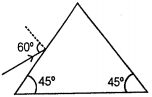
In the diagram the ray passing through prism is parallel to the base. Refractive index of material of prism is