MCQ
An optically active hydrocarbon (X) on catalytic hydrogenation gives an optically inactive compound (Y), C6H14. The hydrocarbon (X) is-
- A3-methyl-1-pentene
- B3-methyl-2-pentene
- C2-ethyl-1-butene
- D3-methylcyclopentene
Explanation:
The optically active hydrocarbon X is 3-methyl-1-pentene CH2=CH−CH(CH3)CH2CH3.
On catalytic hydrogenation, it forms, 3-methyl pentane CH3CH2CH(CH3)CH2CH3, which is optically inactive.
Generate a complete, print-ready paper with questions like this in minutes — across 16+ boards, with answer keys.
$S\left( s \right) + {O_2}\left( g \right) \rightleftharpoons S{O_2}\left( g \right);{K_1} = {10^{52}}$
$2S\left( s \right) + 3{O_2}\left( g \right) \rightleftharpoons 2S{O_3}\left( g \right);{K_2} = {10^{129}}$
The equilibrium constant for the reaction $2S{O_2}\left( g \right) + {O_2}\left( g \right) \rightleftharpoons 2S{O_3}\left( g \right)$ is
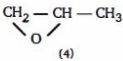
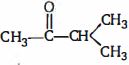
$\underset{(1)}{\mathop{C{{H}_{3}}C{{H}_{2}}CHO}}\,$
$\underset{(2)}{\mathop{\begin{matrix}
O \\
|| \\
C{{H}_{3}}-C-C{{H}_{3}} \\
\end{matrix}}}\,$
$\underset{(3)}{\mathop{C{{H}_{3}}-CH=CH-OH}}\,$