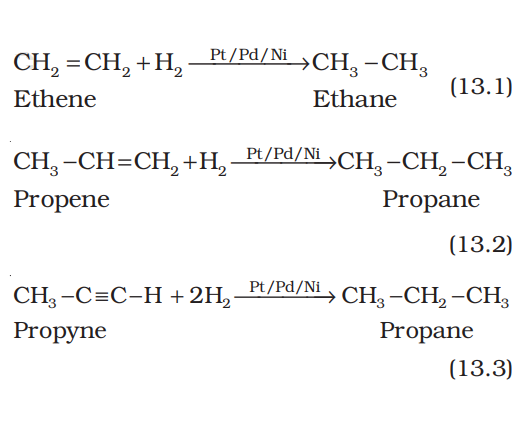
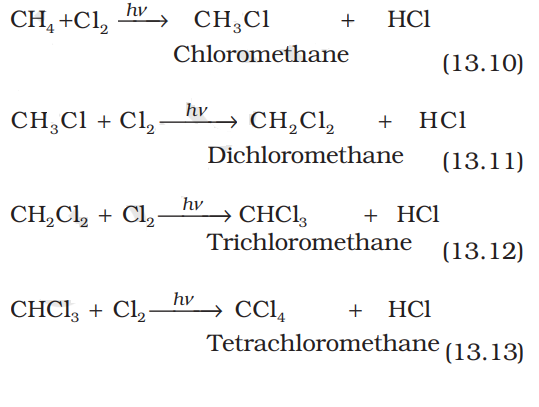
Read the passage given below and answer the following questions from 1 to 5.
Alkenes are unsaturated hydrocarbons containing at least one double bond. What should be the general formula of alkenes? If there is one double bond between two carbon atoms in alkenes, they must possess two hydrogen atoms less than alkanes. Hence, general formula for alkenes is CnH2n. Alkenes are also known as olefins (oil forming) since the first member, ethylene or ethene (C2H4) was found to form an oily liquid on reaction with chlorine.
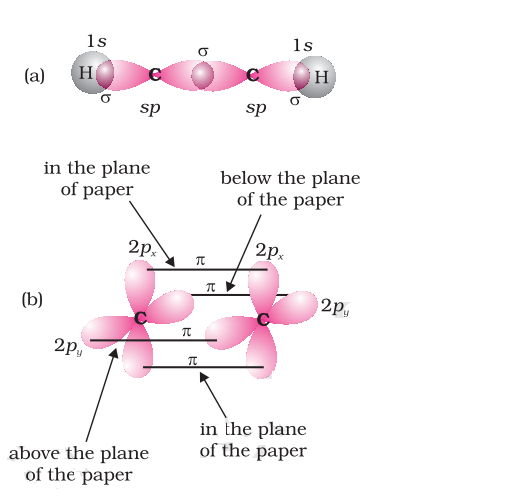
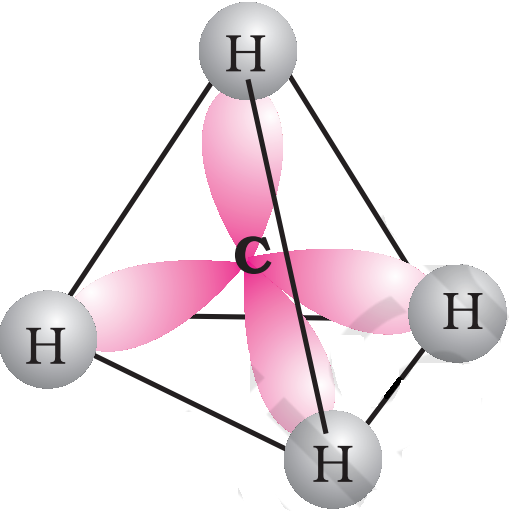
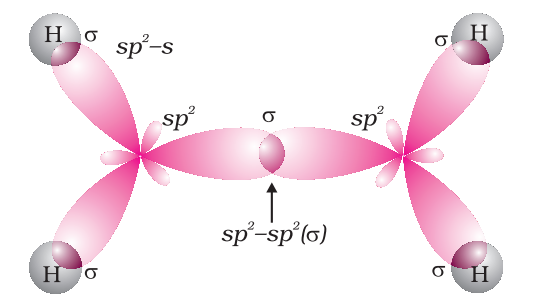
Structure of Double Bond Carbon-carbon double bond in alkenes consists of one strong sigma $(\sigma)$ bond (bond enthalpy about 397 kJ mol–1) due to head-on overlapping of sp2 hybridised orbitals and one weak pi $\pi$ bond (bond enthalpy about 284 kJ mol–1) obtained by lateral or sideways overlapping of the two 2p orbitals of the two carbon atoms. The double bond is shorter in bond length (134 pm) than the C–C single bond (154 pm). You have already read that the pi $(\pi)$ bond is a weaker bond due to poor sideways overlapping between the two 2p orbitals. Thus, the presence of the pi $(\pi)$bond makes alkenes behave as sources of loosely held mobile electrons. Therefore, alkenes are easily attacked by reagents or compounds which are in search of electrons. Such reagents are called electrophilic reagents. The presence of weaker$(\pi)$-bond makes alkenes unstable molecules in comparison to alkanes and thus, alkenes can be changed into single bond compounds by combining with the electrophilic reagents. Strength of the double bond (bond enthalpy, 681 kJ mol–1) is greater than that of a carbon-carbon single bond in ethane (bond enthalpy, 348 kJ mol–1). Orbital diagrams of ethene molecule are shown in Figure.
Geometrical isomerism: Doubly bonded Carbon atoms have to satisfy the remaining two Valences by joining with two atoms or groups. If the two atoms or groups attached to each Carbon atom are different, they can be Represented by YX C = C XY like structure. YX C = C XY can be represented in space in the Following two ways:
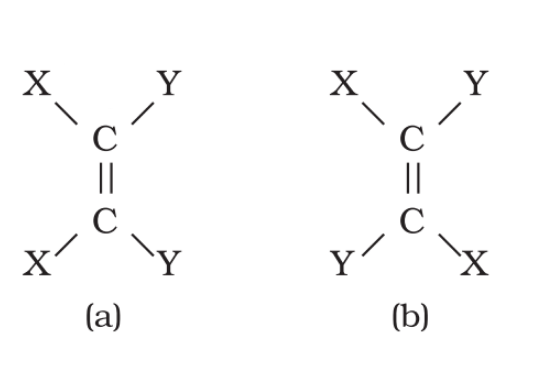
In (a), the two identical atoms i.e., both the X or both the Y lie on the same side of the Double bond but in (b) the two X or two Y lie Across the double bond or on the opposite Sides of the double bond. This results in Different geometry of (a) and (b) i.e. disposition Of atoms or groups in space in the two Arrangements is different. Therefore, they are Stereoisomers. They would have the same Geometry if atoms or groups around C = C bond Can be rotated but rotation around C = C bond Is not free. It is restricted. For understanding This concept, take two pieces of strong Cardboards and join them with the help of two Nails. Hold one cardboard in your one hand And try to rotate the other. Can you really rotate The other cardboard ? The answer is no. The Rotation is restricted. This illustrates that the Restricted rotation of atoms or groups around The doubly bonded carbon atoms gives rise to Different geometries of such compounds. The Stereoisomers of this type are called Geometrical isomers. The isomer of the type (a), in which two identical atoms or groups lie On the same side of the double bond is called Cis isomer and the other isomer of the type (b), in which identical atoms or groups lie on The opposite sides of the double bond is called Trans isomer. Thus cis and trans isomers Have the same structure but have different Configuration (arrangement of atoms or groups In space). Due to different arrangement of Atoms or groups in space, these isomers differ In their properties like melting point, boiling Point, dipole moment, solubility etc. Geometrical or cis-trans isomers of but-2-ene Are represented below:
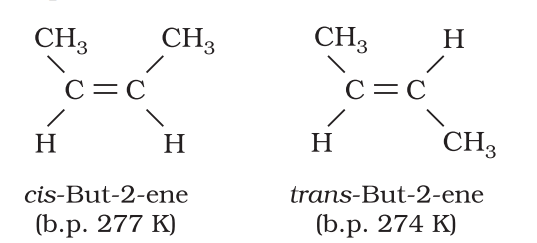
Cis form of alkene is found to be more polar Than the trans form. For example, dipole Moment of cis - but - 2-ene is 0.33 Debye, Whereas, dipole moment of the trans form Is almost zero or it can be said that trans - but - 2 -ene is non-polar. This can be understood by drawing geometries of the two forms as given below from which it is clear that in the trans - but - 2 -ene, the two methyl groups are in opposite directions, Therefore, dipole moments of C - CH3 bonds cancel, thus making the trans form non-polar.
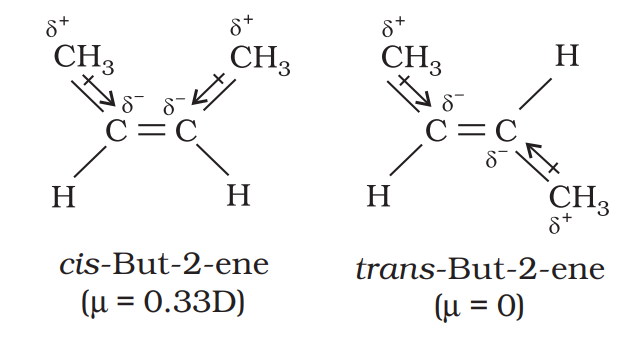
In the case of solids, it is observed that the trans isomer has higher melting point than the cis form. Geometrical or cis-trans isomerism is also shown by alkenes of the types XYC = CXZ and XYC = CZW
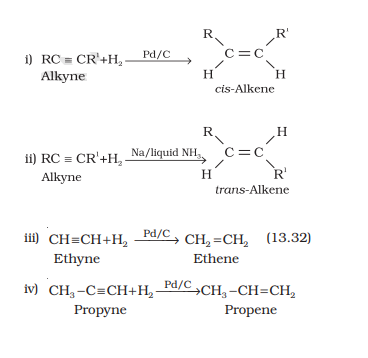
Preparation – From alkynes: Alkynes on partial reduction with calculated amount of dihydrogen in the presence of palladised charcoal partially deactivated with poisons like sulphur
compounds or quinoline give alkenes. Partially deactivated palladised charcoal is known as Lindlar’s catalyst. Alkenes thus obtained are having cis geometry. However, alkynes on reduction with sodium in liquid ammonia form trans alkenes.
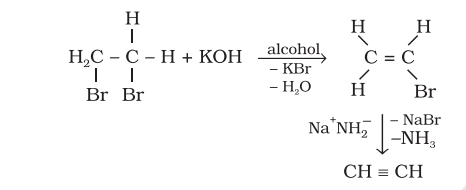
From alkyl halides: Alkyl halides (R-X) on heating with alcoholic potash (potassium hydroxide dissolved in alcohol, say, ethanol) eliminate one molecule of halogen acid to form alkenes. This reaction is known as dehydrohalogenation i.e., removal of halogen acid. This is example of $\beta-$elimination reaction, since hydrogen atom is eliminated from the $\beta$ carbon atom (carbon atom next to the carbon to which halogen is attached).
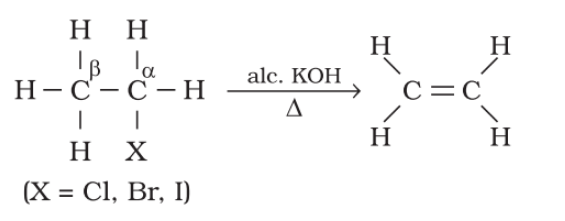
Nature of halogen atom and the alkyl group determine rate of the reaction. It is observed that for halogens, the rate is: iodine > bromine > chlorine, while for alkyl groups it is: tert > secondary > primary.
Physical properties Alkenes as a class resemble alkanes in physical properties, except in types of isomerism and difference in polar nature. The first three members are gases, the next fourteen are liquids and the higher ones are solids. Ethene is a colourless gas with a faint sweet smell. All other alkenes are colourless and odourless, insoluble in water but fairly soluble in non- polar solvents like benzene, petroleum ether. They show a regular increase in boiling point with increase in size i.e., every –CH2 group added increases boiling point by 20–30 K. Like alkanes, straight chain alkenes have higher boiling point than isomeric branched chain compounds.
- The first three members of alkenes are …?
- Gases
- Liquids
- Solids
- None of above
- General formula for alkenes is ….?
- CnH2n+1
- CnH2n
- CnH2n-1
- CnH2n+2
- The colour of ethene gas is …?
- Red
- White
- Pale Green
- None of above
- The bond length of carbon carbon double bond is … pm ?
- 154
- 143
- 134
- 120
- Alkenes are also knows as …?
- Olefines
- Paraffines
- Oleofines
- Paracetofines