Question
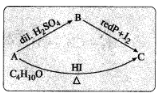
An organic compound 'A' having molecular formula $C _4 H _{10} O$ does not react with sodium metal. On hydrolysis with dilute $H _2 SO _4$ it gives only one organic compound ' $B$ ' The compound $B$ on heating with red phosphorus and iodine gives compound ' $C$ '. The compound $C$ can also be obtained from compound 'A' on heating with excess HI. Identify the compounds $A , B$ and $C$.
Answer

(1) The organic compound 'A' with molecular formula $C _4 H _{10} O$ may be an alcohol or ether.
Image
(2) Since 'A' does not react with sodium ( $Na )$, it is not an alcohol. Hence 'A' may be an ether.
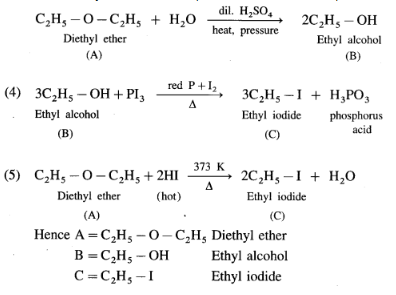
(3) Since an ether 'A' on hydrolysis with dilute $H _2 SO _4$ gives only one compound ' $B$ ', the compound 'A' must be a symmetrical (simple) ether. Hence compound 'A' may be, $C _2 H _5- O - C _2 H _5$

Image

Need a full question paper?

Generate a complete, print-ready paper with questions like this in minutes — across 16+ boards, with answer keys.

Start Generating Free