Question
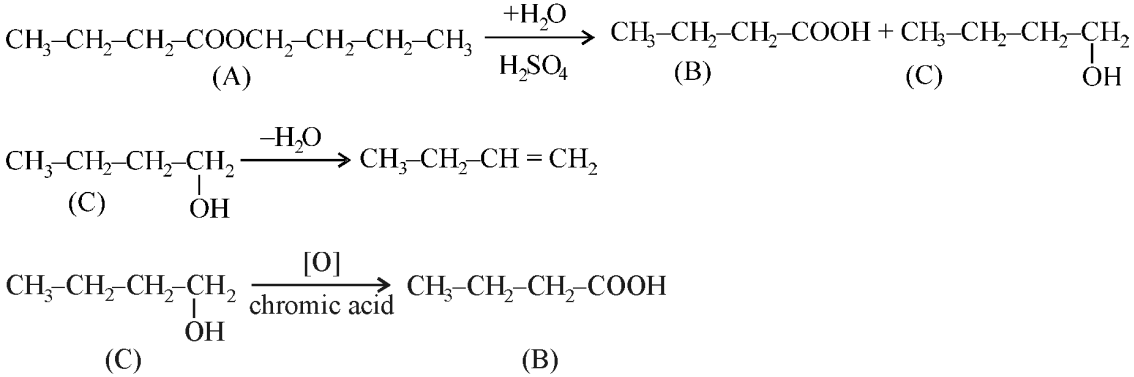
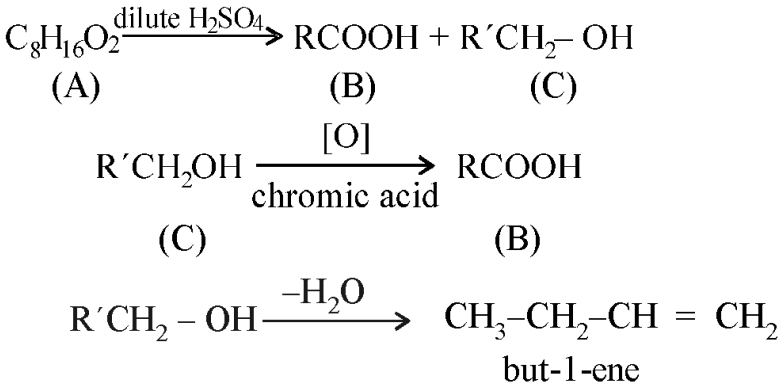
An organic compound (A) [Molecular formula $\left.C _8 H _{10} O _2\right]$ was hydrolysed with dilute sulphuric acid to give a carboxylic acid (B) and an alcohol (C). Oxidation of (C) with chromic acid produced (B). (C) on dehydration gives but-1-ene.
Write equations for the reactions involved.
Need a full question paper?

Generate a complete, print-ready paper with questions like this in minutes — across 16+ boards, with answer keys.

Start Generating Free

Similar questions

Read the following text carefully and answer the questions that follow:
$KMnO _4$ and $K _2 Cr _2 O _7$ are most important chemicals which are used as oxidising agents and disinfectants. $K _2 MnO _4$ is prepared by fusing $MnO _2$ with KOH in presence of $O _2 \cdot K_2 MnO _4$ is electrolysed to get purple coloured $KMnO _4 \cdot Na _2 CrO _4$ is prepared by heating chromite ore with $Na _2 CO _3$ in presence of $O _2 \cdot Na _2 CrO _4$ is converted into $Na _2 Cr _2 O _7$ by reacting with concentrated $H _2 SO _4 \cdot Na _2 Cr _2 O _7$ is reacted with KCl to get $K _2 Cr _2 O _7$, orange coloured solid, soluble in water, changes to yellow coloured $CrO _4^{2-}$ in basic medium, $KMnO _4$ acts as oxidising agent in acidic, neutral as well basic medium. In acidic medium, it converts $Fe ^{2+}$ to $Fe ^{3+}, Sn ^{2+}$ to $Sn ^{4+}, COO ^{-}$to $CO ^2$. In basic medium it converts $I ^{-}$to $IO ^{3-} . K _2 Cr _2 O _7$ acts as oxidising agent only in acidic medium, converts $H _2 S$ to $S , SO _2$ to $SO ^{2-}, I ^{-}$to $I _2$. Lanthanoids and actinoids belong to f-block elements with general electronic configuration $(n-2) f^1$ to $14(n-1) d^{0-2} n s^2$. All actinoids are radioactive. Both show contraction in atomic and ionic radii but actinoid contraction is more than lanthanoid contraction. Lanthanoid show +3 oxidation state, few elements show +2 and +4 oxidation states also. Actinoids show $+3,+4,+5,+6,+7$ oxidation states.
i. Which lanthanoid shows +4 oxidation state and why?
ii. Give two similarities between lanthanoids and actinoids.
iii. Complete the equation and balance:
$
Cr_2 O_7^{2-}+Fe^{2+}+H^{+} \rightarrow ?
$
OR
iii. Convert sodium chromate to sodium dichromate. Give chemical equation.
$2 Na _2 CrO _4+ H _2 SO _4$ (conc.) $\rightarrow$ ?
Read the following text carefully and answer the questions that follow$:$
Aariv Sharma is very fond of a special drink made by his grandmother using different fruits available in their hometown. It has an outstanding taste and also provide great health benefits of natural fruits. He thought of utilizing his grandmother recipe to create a new product in the beverage market that provide health benefits and also contain fizziness of various soft drinks available in the market.
i. How he can add fizz to the special drink made by his grandmother? $(1)$
ii. What is the law stated in the chapter that can help Aariv to make his drink fizzy? $(1)$
iii. What precautions he should take while bottling so that his product does not lose fizz during storage and handling across long distances? $(2)$
What is boiling point? What is elevation of boiling point? Explain Molal elevation constant and derive It's formula.
Sucrose decomposes in acid solution into glucose and fructose according to the first order rate law, with $t_{1 / 2}$ = 3.00 hours. What fraction of sample of surcrose after 8 hours?
(a) Give Reasons -
(i) Monochloro ethanoic acid has a higher P ka value than dichloro ethanoic acid.
(ii) Ketones are less reactive towards nucleophilic addition reaction than aldehydes.
(b) Write short note on aldol condensation
Write the mechanism of hydration of ethene to yield ethanol.
Indicate the steps in the preparation of :
(i) $K _2 Cr _2 O _7$ from chromite ore
(ii) $KMnO _4$ from pyrolusite ore.
Read the following text carefully and answer the questions that follow:
Many chemical and biological processes depend on osmosis, the selective passage of solvent molecules through the porous membrane from a dilute solution to a more concentrated one. The osmotic pressure $\pi$ depends on molar concentration of the solution ($\pi$ = CRT). If two solutions are of equal solute concentration and, hence, have the same osmotic pressure, they are said to be isotonic. If two solutions are of unequal osmotic pressures, the more concentrated solution is said to be hypertonic and the more diluted solution is described as hypotonic. Osmosis is the major mechanism, for transporting water upward in the plants. Transpiration is the leaves supports the transport mechanism of water. The osmotic pressure of seawater is about 30 atm; this is the pressure that must be applied to the seawater (separated from pure water using a semi-permeable membrane) to get drinking water.
i. What will happen if a plant cell kept in a hypertonic solution? 
ii. Blood cells are isotonic with 0.9% sodium chloride solution. What happens if we place blood cells in a solution containing in 1.2% sodium chloride solution?
iii. What happens when the external pressure applied becomes more than the osmotic pressure of solution?
Read the following text carefully and answer the questions that follow:
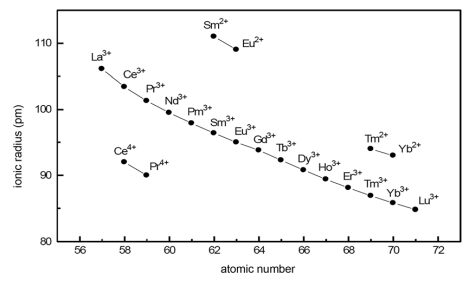
The $f-$ block consists of the two series, lanthanoids $($the fourteen elements following lanthanum$)$ and actinoids $($the fourteen elements following actinium$)$. Because lanthanum closely resembles the lanthanoids. The chemistry of the actinoids is much more complicated. The complication arises partly owing to the occurrence of a wide range of oxidation states in these elements and partly because their radioactivity creates special problems in their study. The overall decrease in atomic and ionic radii from lanthanum to lutetium $($the lanthanoid contraction$)$ is a unique feature in the chemistry of the lanthanoids. In the lanthanoids $,La (II)$ and $Ln (III)$ compounds are predominant species.
Image
i. Which metal in the first transition series $(3d$ series$)$ exhibits $+1$ oxidation state most frequently and why?
ii. The transition metals $($with the exception of $\ce{Zn, Cd}$ and $\ce{Hg})$ are hard and have high melting and boiling points. Give reason.
iii. Both $O_2$ and $F_2$ stabilize high oxidation states of transition metals but the ability of oxygen to do so exceeds that of fluorine. Give reason.
$OR$
iii. The atomic radii of the metals of the third $(5d)$ series of transition elements are virtually the same as those of the corresponding members of the second $(4d)$ series. Give reason.
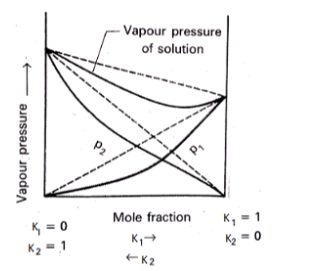
Read the following text carefully and answer the questions that follow: Raoult's law states that for a solution of volatile liquids, the partial vapour pressure of each component of the solution is directly proportional to its mole fraction present in solution.
Dalton's law of partial pressure states that the total pressure $(P_{total})$ over the solution phase in the container will be the sum of the partial pressures of the components of the solution and is given as: $P_{total} = P1 + P2$
Image
i. Is the above $-$ mentioned Raoult's law applicable for non $-$ volatile liquids?
ii. What type of deviation from Raoult's law does the above graph represent?
iii. Give an example of such system.
$OR$
iii. A solution of two liquids boils at a temperature more than the boiling point of either of them. What type of deviation will be shown by the solution formed in terms of Raoult's law?