Rajasthan BoardEnglish MediumSTD 12 ScienceChemistrySolutions4 Marks
Question
What is boiling point? What is elevation of boiling point? Explain Molal elevation constant and derive It's formula.
✓
Answer
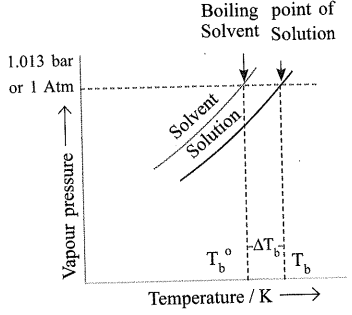
→ Boiling Point: → "The temperature at which, the vapour pressure of solution is equal to the atmospheric pressure, such temperature is known as boiling point of such solution." → For example, water boils at 373.15 K (100° C) because at this temperature the vapour pressure of water is 1.013 bar (1 atmosphere). → Vapour pressure of the solvent decreases in the presence of non-volatile solute. → The vapour pressure of an aqueous solution of sucrose is less than 1.013 bar at 373.15 K. In order to make this solution boil, its vapour pressure must be increased to 1.013 bar by raising the temperature above the boiling temperature of the pure solvent (water). → Thus, the boiling point of a solution is always higher than that of the boiling point of the pure solvent → Let $T_{ b }^0$ be the boiling point of pure solvent and $T_{ b }$ be the boiling point of solution. The increase in the boiling point $\Delta T_{ b }=T_{ b }-T_{ b }^0$ is known as elevation of boiling point. → Experiments have shown that for dilute solutions the elevation of boiling point $\left(\Delta T_{ b }\right)$ is directly proportional to the molal concentration of the solute in a solution. $ \begin{array}{l} \Delta T_{ b } \propto m \\ \therefore \Delta T_{ b }= K _{ b } . m \ldots .(1) \end{array} $ Where, $K _{ b }$ is called Boiling Point Elevation Constant or Molal Elevation Constant (Ebullioscopic Constant). → Molal elevation Constant: →"Increase in boiling point of a solution prepared by dissolving one gram molar mass of Non volatile solute in one kg of solvent is called as Molal elevation constant." → Unit of $K _{ b }= K \cdot kg \cdot Mol ^{-1}$ → If $w_2$ gram of solute of molar mass $M _2$ is dissolved in $w_1$ gram of solvent, then molality, m of the solution is given by the expression : $m=\frac{ W _2 \times 1000}{ M _2 \times W _1}$ Substituting value of molality in eq. (1) $\begin{array}{l}\Delta T_{ b }=\frac{K_{ b } \times 1000 \times w_2}{M_2 \times w_1} \\ M_2=\frac{1000 \times w_2 \times K_{ b }}{\Delta T_{ b } \times w_1}\end{array}$ Where, $w_2=\mathrm{wt}$. of Solute
Where, $\begin{aligned} w_2 & =\text { wt. of Solute } \\ w_1 & =\text { wt. of Solvent } \\ M _2 & =\text { Molar mass of Solute }\end{aligned}$
Need a full question paper?
Generate a complete, print-ready paper with questions like this in minutes — across 16+ boards, with answer keys.