Question
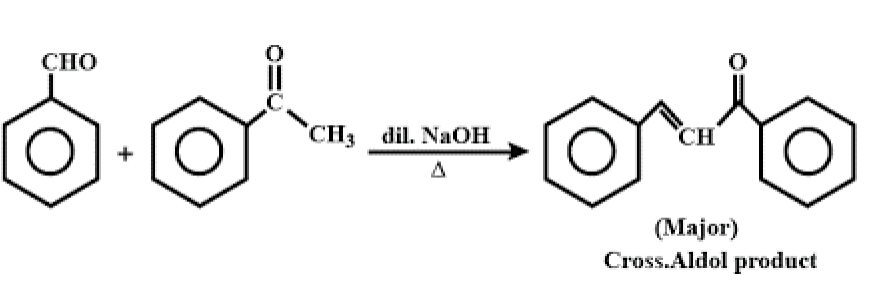
An organic compound 'X', does not undergo aldol condensation. However 'X' with compound 'Y' in the presence of a strong base react to give the compound 1,3-diphenylprop-2-en-1-one.
a. Identify 'X' and 'Y'
b. Write the chemical reaction involved.
c. Give one chemical test to distinguish between X and Y.
Answer

(a) Compound 'X' = Benzaldehyde, Compound Y = Acetophenone
(b)
Image
Chemical test to distinguish between X and Y is the Tollen Test.
(c) Benzaldehyde undergoes Silver mirror test with Tollen reagent and forms silver mirror. However Acetophenone does not react with Tollen Reagent.

Need a full question paper?

Generate a complete, print-ready paper with questions like this in minutes — across 16+ boards, with answer keys.

Start Generating Free

Similar questions

Predict the major product formed when HCl is added to isobutylene. Explain the mechanism involved.
Explain the structure and function of salt bridge of molten galvanic cell.
Iron has a body centred unit cell with a cell edge of 286.6 pm. The density of iron is 7.87 g $ cm^{-3} $ Use these information to calculate Avogadro's number. (Atomic weight of Fe, 56 g $ mol^{-1} $)
An antifreeze solution is prepared from 222.6g of ethylene glycol (C2H4(OH)2) and 200g of water. Calculate the molality of the solution. If the density of this solution be 1.072g mL-1, what will be the molarity of the solution?
In which of the following pairs will more electric current flow and why?
(a) KCl solution $25^{\circ} C$ and KCl solution at $50^{\circ} C$.
(b) $0.2 \quad M \quad CH _3 COOH$ solution and 2 M $CH _3 COOH$ solution.
(c) $NH _4 OH$ solution at $25^{\circ} C$ and at wire at $50^{\circ} C$.
(d) Al wire at $25^{\circ} C$ and Al wire at $50^{\circ} C$.
Write a note on oxidation reaction of alcohols. ### Explain oxidation of alcohols with chemical reactions.
Although fluorine is more electronegative than oxygen, but the ability of oxygen to stabilise higher oxidation states exceeds that of fluorine. Why?
Answer the following question:
An organic compound A having molecular formula C6H6O gives a characteristic colour with aqueous FeCl3 solution. A on treatment with CO2 and NaOH at 400K under pressure gives B which on acidification gives a compound C. The compound C reacts with acetyl chloride to give D which is a popular pain killer. Deduce the structure of A, B, C and D.
Write the IUPAC name of Fe4 [Fe(CN)6]3.
Give reasons for the following:
  1. Ethyl iodide undergoes SN2 reaction faster than ethyl bromide.
  2. $(\pm)$ 2-Butanol is optically inactive.
  3. C-X bond length in halobenzene is smaller than C-X bond length in CH3-X.