Question types

MODEL PAPER 2025 question types

40 questions across 6 question groups — pick any mix to generate a Chemistry paper with step-by-step answer keys.

40
Questions
6
Question groups
5
Question types
Sample Questions

MODEL PAPER 2025 questions

One sample from each question group in this chapter. Select any group above to see the full set with answer keys.

Q 1M.C.Q [1M]1 Mark
Match the properties given in column I with the metals in column II
Column IColumn II
(1) Actinoid having configuration (RN)5f76d17s2 (A) Ce
(2) Lanthanoid which has 4f14 electronic configuration in +3 oxidation state.(B) Lu
(3) Lanthanoid which show +4 Oxidation state(C) Cm
  • (1)-(C), (2)-(B), (3)-(A)
  • B
    (1)-(C), (2)-(A), (3)-(B)
  • C
    (1)-(A), (2)-(B), (3)-(C)
  • D
    (1)-(B), (2)-(A), (3)-(C)

Answer: A.

View full solution
Q 2M.C.Q [1M]1 Mark
Ammonolysis of ethyl chloride followed by reaction of the amine so formed with 1 mole of methyl chloride gives an amine that
  • A
    reacts with Hinsberg reagent to form a product soluble in an alkali.
  • B
    on reaction with Nitrous acid, produced nitrogen gas.
  • reacts with Benzenesulphonyl chloride to form a product that is insoluble in alkali.
  • D
    does not react with Hinsberg reagent.

Answer: C.

View full solution
Q 3M.C.Q [1M]1 Mark
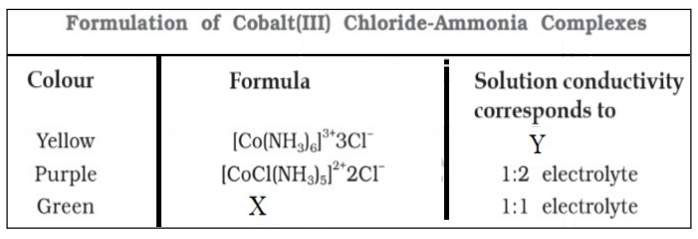
  • A
    $X=\left[\mathrm{Co}\left(\mathrm{NH}_3\right)_6\right]^{2+} 3 \mathrm{Cl}^{-}, \mathrm{Y}=1: 3$
  • $X=\left[\mathrm{Co}\left(\mathrm{NH}_3\right)_4 \mathrm{Cl}_2\right]^{+} \mathrm{Cl},-\mathrm{Y}=1: 3$
  • C
    $X=\left[\mathrm{Co}\left(\mathrm{NH}_3\right)_4 \mathrm{Cl}_2\right]^{+} \mathrm{Cl}^{-}, \mathrm{Y}=1: 1$
  • D
    $X=\left[\mathrm{Co}\left(\mathrm{NH}_3\right)_4 \mathrm{Cl}_2\right]^{3+} 3 \mathrm{Cl}^{-}, \mathrm{Y}=1: 1$

Answer: B.

View full solution
Q 5M.C.Q [1M]1 Mark
Which one of the following has the highest dipole moment?
  • A
    $\mathrm{CH}_3 \mathrm{~F}$
  • $\mathrm{CH}_3 \mathrm{Cl}$
  • C
    $\mathrm{CH}_3 \mathrm{I}$
  • D
    $\mathrm{CH}_3 \mathrm{Br}$

Answer: B.

View full solution
Assertion (A): For strong electrolytes, there is a slow increase in molar conductivity with dilution and can be represented by the equation
      $\Lambda_m^0=\Lambda_m-A c^{1 / 2}$
Reason (R): The value of the constant 'A' for NaCl, CaCl2, and MgSO4 in a given solvent and at a given temperature is different.
  • A
    Both A and R are true and R is the correct explanation of A
  • B
    Both A and R are true but R is not the correct explanation of A.
  • C
    A is true but R is false.
  • A is false but R is true.

Answer: D.

View full solution
Assertion (A): [Mn(CN)6- has a magnetic moment of two unpaired electrons while [MnCl6]3- has a paramagnetic moment of four unpaired electrons.
Reason (R): [Mn(CN)6]3- is inner orbital complexes involving d2sp3 hybridisation, on the other hand, [MnCl6]3-is outer orbital complexes involving sp³d2 hybridisation.
  • Both A and R are true and R is the correct explanation of A
  • B
    Both A and R are true but R is not the correct explanation of A.
  • C
    A is true but R is false.
  • D
    A is false but R is true.

Answer: A.

View full solution
Assertion (A): The half- life for a zero order reaction is independent of the initial 1 concentration of the reactant.
Reason (R): For a zero order reaction, Rate = k
  • A
    Both A and R are true and R is the correct explanation of A
  • B
    Both A and R are true but R is not the correct explanation of A.
  • C
    A is true but R is false.
  • A is false but R is true.

Answer: D.

View full solution
Assertion (A): Glucose does not form the hydrogensulphite addition product with NaHSO3.
Reason (R): Glucose exists in a six-membered cyclic structure called pyranose structure
  • A
    Both A and R are true and R is the correct explanation of A .
  • Both A and R are true but R is not the correct explanation of A.
  • C
    A is true but R is false.
  • D
    A is false but R is true.

Answer: B.

View full solution
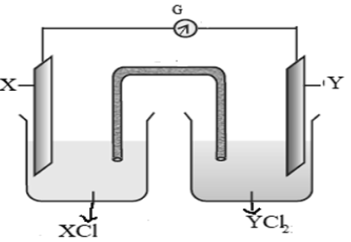
Observe the following cell and answer the questions that follow:
Image
a. Represent the cell shown in the figure.
b. Name the carriers of the current in the salt bridge
c. Write the reaction taking place at the anode.
View full solution
a. Nitrogen gas is soluble in water. At temperature 293 K, the value of KH iS 76.48 kbar. How would the solubility of nitrogen vary (increase, decrease or remain the same) at a temperature above 293 KH if the value of K₁ rises to 88.8 kbar.
b. Chloroform (b.p. 61.2°C) and acetone (b.p. 56°C) are mixed to form an azeotrope. The mole fraction of acetone in this mixture is 0.339. Predict whether the boiling point of the azeotrope formed will be (i) 60°C (ii) 64.5°C or (iii)54 °C. Defend your answer with reason.
View full solution
Q 153 Marks Question3 Marks
The equilibrium constant of cell reaction :
Sn4+(.aq) + Al(s) Al3+ → + Sn2+ (aq) is 4.617 x 10184, at 25 °C
  a. Calculate the standard emf of the cell. (Given: log 4.617 x 10184 = 184.6644)
  b. What will be the E° of the half cell Al3+/Al, if E° of half cell Sn4+/Sn2+ is 4+ 0.15 V.
View full solution
Q 163 Marks Question3 Marks
Various isomeric haloalkanes with the general formula C4H9CI undergo hydrolysis reaction. Among them, compound "A" is the most reactive through SN1 mechanism. Identify "A" citing the reason for your choice. Write the mechanism for the reaction.
View full solution
Q 173 Marks Question3 Marks
Neeta was experimenting in the lab to study the chemical reactivity of alcohols. She carried out a dehydration reaction of propanol at 140°C to 180°C. Different products were obtained at these two temperatures.
a. Identify the major product formed at 140°C and the substitution mechanism followed in this case.
b. Identify the major product formed at 180°C and the substitution mechanism followed in this case.
View full solution
Q 183 Marks Question3 Marks
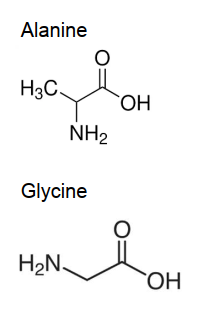
a. Give the structure of all the possible dipeptides formed when the following two amino acids form a peptide bond.
Image
b. Keratin, insulin, and myosin are a few examples of proteins present in the human body. Identify which type of protein is keratin and insulin and differentiate between them based on their physical properties.
View full solution
Q 193 Marks Question3 Marks
An organic compound 'X', does not undergo aldol condensation. However 'X' with compound 'Y' in the presence of a strong base react to give the compound 1,3-diphenylprop-2-en-1-one.
a. Identify 'X' and 'Y'
b. Write the chemical reaction involved.
c. Give one chemical test to distinguish between X and Y.
View full solution
(a). While giving intravenous injections to the patients, the doctors take utmost care of the concentration of the solution used. Why is it necessary to check the concentration of the solution?
(b). A solution of phenol was obtained by dissolving 2X 10⁻² kg of phenol in 1 kg of benzene. Experimentally it was found to be 73% associated. Calculate the depression in the freezing point recorded.
View full solution
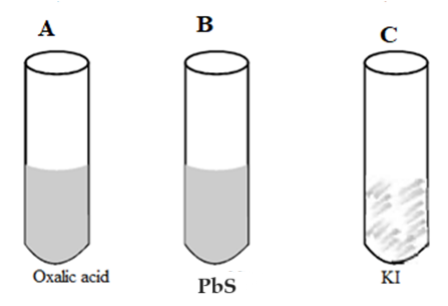
(a). A purple colour compound A, which is a strong oxidising agent and used for bleaching of wool, cotton, silk and other textile fibres was added to each of the three test tubes along with H2SO4. It was followed by strong heating.
Image
In which of the above test tubes; A, B or C:
(i) Violet vapours will be formed
(ii) The bubbles of gas evolved will extinguish a burning matchstick. Write an equation for each of the above observations.
b. A metal ion Mn+ of the first transition series having d5 configuration combines with three didentate ligands. Assuming $\Delta_0$< P:
(i) Draw the crystal field energy level diagram for the 3d orbital of this complex.
(ii) What is the hybridisation of Mnt in this complex and why?
(iii) Name the type of isomerism exhibited by this complex.
View full solution
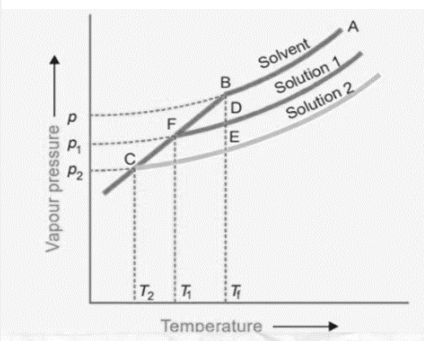
(a). An experiment was carried out in the laboratory, to study depression in freezing point. 1M aqueous solution of Al(NO3)3 and 1 M aqueous solution of glucose were taken. From the given figure identify solution 1 and solution 2. Give a plausible reason for your answer
Image
(b). The osmotic pressure of a solution of cane sugar was found to be 2.46 atm at 300 K. If the solution was diluted five times, calculate the osmotic pressure at the same temperature.
How can the osmotic pressure of the given cane sugar solution be decreased without changing its volume? Give a reason for your answer.
View full solution
(a). Out of formic acid and acetic acid, which one will give the HVZ reaction? Give a suitable reason in support of your answer and write the chemical reaction involved.
(b). Alcohols are acidic but they are weaker acids than water. Arrange various isomers of butanol in the increasing order of their acidic nature. Give a reason for the same.
(c). An organic compound A which is a Grignard reagent is used to obtain 2-methylbutan-2-ol on reaction with a carbonyl compound 'B'. Identify A' and 'B'. Write the equation for the reaction between A and B.
View full solution
(a). Give reasons for the following:
(i)The reaction of ethanol with acetyl chloride is carried out in the presence of pyridine.
(ii) Cresols are less acidic than phenol.
(b). Williamson's process is used for the preparation of ethers from alkyl halide. Identify the alkyl bromide and sodium alkoxide used for the preparation of 2- Ethoxy-3-methylpentane
(c). Convert:
(i) Toluene to 3-nitrobenzoic acid.
(ii) Benzene to m-nitroacetophenone.
View full solution
View full solution
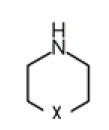
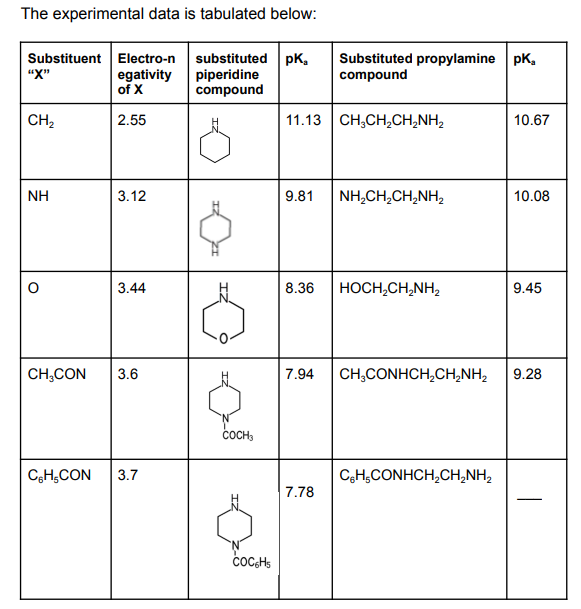
What is the most suitable pKa value of the substituted propylamine formed with substituent "X" with electronegativity 3.0
(i)10.67 (ii)10.08 (iii) 10.15 (iv)11.10
View full solution
What change in the concentration of H₂ will triple the rate of reaction?
(c). Suppose a reaction between A and B, was experimentally found to be first order with respect to both A and B. So the rate equation is:
Rate = k[A][B]
Which of these two mechanisms is consistent with this experimental finding? Why?
Mechanism 1
A → C + D (slow)
B+C → E (fast)
Mechanism 2
A+B →C + D (slow)
C → E (fast)
View full solution
Dependence of the rate of reaction on the concentration of reactants, temperature, and other factors is the most general method for weeding out unsuitable reaction mechanisms. The term mechanism means all the individual collisional or elementary processes involving molecules (atoms, radicals, and ions included) that take place simultaneously or consecutively to produce the observed overall reaction. For example, when hydrogen gas reacts with bromine, the rate of the reaction was found to be proportional to the concentration of H₂ and to the square root of the concentration of Br2. Furthermore, the rate was inhibited by increasing the concentration of HBr as the reaction proceeded. These observations are not consistent with a mechanism involving bimolecular collisions of a single molecule of each kind. The currently accepted mechanism is considerably more complicated, involving the dissociation of bromine molecules into atoms followed by reactions between atoms and molecules:
It is clear from this example that the mechanism cannot be predicted from the overall stoichiometry.
(source: Moore, J. W., & Pearson, R. G. (1981). Kinetics and mechanism. John Wiley & Sons.)
(a). Predict the expression for the rate of reaction and order for the following:
         H2 + Br2 → 2 HBr
What are the units of rate constant for the above reaction?
(b). How will the rate of reaction be affected if the concentration of Br2 is tripled?
View full solution

Generate a MODEL PAPER 2025 paper free

Pick question groups from the list above, set marks and difficulty, and export a branded PDF with step-by-step answer keys. First 3 chapters free — no signup.

Download App