MCQ
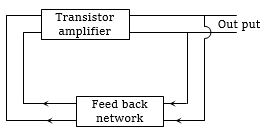
An oscillator is nothing but an amplifier with
  • Positive feed back
  • B
    Large gain
  • C
    No feedback
  • D
    Negative feedback

Answer

Correct option: A.
Positive feed back
a
(a)In oscillator, a portion of the output power is returned back $(feed \,\,back)$  to the input in phase with the starting power. This process is termed as positive feedback.

Need a full question paper?

Generate a complete, print-ready paper with questions like this in minutes — across 16+ boards, with answer keys.

Start Generating Free

Similar questions

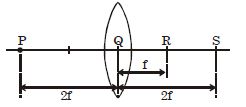
The diagram below shows an object placed at a distance $2f$ in front of a convex lens of focal length $f.$ Which of the following may represents the positions of the image when $(i)$ a parallel sides glass block, or $(ii)$ a converging lens of long focal length is inserted between the object and the convex lens?

Glass block inserted                                         Converging lens inserted                                            
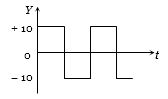
The $r.m.s$. voltage of the wave form shown is......$V$
A particle of mass $m$ having negative charge $q$ move along an ellipse around a fixed positive charge $Q$ so that its maximum and minimum distances from fixed charge are equal to $r_1$ and $r_2$ respectively. The angular momentum $L$ of this particle is
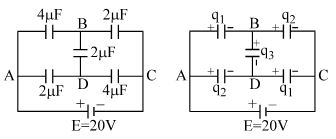
The value of charge $q_1, q_2$ and $q_3$ as shown in the figure are
Broadcasting antennas are generally
A student measures the focal length of a convex lens by putting an object pin at a distance '$u$' from the lens and measuring the distance '$v$' of the image pin. The graph between '$u$' and '$v$' plotted by the student should look like
When a beam of accelerated electrons hits a target, a continuous $X-$ ray spectrum is emitted from the target. Which of the following wavelength is absent in the $X-$ ray spectrum, if the $X-$ ray tube is operating at $40,000$ volts........$\mathop A\limits^o $
For transistor action, which of the following statements is correct$?$
A nucleus of masss $M$ emits $\gamma$-ray photon of frequency $'v'.$ The loss of internal energy by the nucleus is:
A galvanometer of resistance $100\,\Omega $ has $50\, divisions$ on its scale and has sensitivity of $20\,\mu A / division$. It is to be converted to a voltmeter with three ranges, of $0-2\, V$, $0-10\, V$ and $0-20\, V$. The appropriate circuit to do so is