MCQ
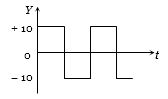
The $r.m.s$. voltage of the wave form shown is......$V$
  • $10$
  • B
    $7$
  • C
    $6.37$
  • D
    None of these

Answer

Correct option: A.
$10$
a
(a) ${V_{rms}} = \sqrt {\frac{1}{T}\int_0^T {{{10}^2}dt} } = 10\;V$

Need a full question paper?

Generate a complete, print-ready paper with questions like this in minutes — across 16+ boards, with answer keys.
Start Generating Free

Similar questions

A particle is moving in a uniform magnetic field, then
In the circuit diagram shown in the adjoining figure, the resultant capacitance between $P$ and $Q$ is........$\mu F$
Light is incident normally on a completely absorbing surface with an energy flux of $25\,W\,cm^{-2}.$ If the surface has an area of $25\,cm^2,$ the maximum momentum transferred to the surface in $40\,min$ time duration will be
A zinc ball of radius $1 \,cm$ charged to a potential $-0.5 \,V$. The ball is illuminated by a monochromatic ultraviolet light with a wavelength $290 \,nm$. The photoelectric threshold for zinc is $332 \,nm$. The potential of ball after a prolonged exposure to the ultraviolet is ............. $V$
In a double slit experiment the angular width of a fringe is found to be $0.2^o $on a screen placed $1\, m$ away. The wavelength of light used is $600\, nm$. What will be the angular width of the fringe if the entire experiment apparatus is immersed in water? Take refractive index of water to be $4/3$.......$^o$
A radio transmitter operates at a frequency of $880 \,kHz$ and a power of $10\,kW$. The number of photons emitted per second are
Velocity of light in a medium is $1.5 \times 10^8 \mathrm{~m} / \mathrm{s}$. Its refractive index will be
A wavefront presents one, two and three HPZ at points A, B and C respectively. If the ratio of consecutive amplitudes of HPZ is 4 : 3, then the ratio of resultant intensities at these point will be
An atomic nucleus $_{90}T{h^{232}}$ emits several $\alpha$ and $\beta$ radiations and finally reduces to $_{82}P{b^{208}}$. It must have emitted
The focal lengths of the objective and the eye-piece of a compound microscope are $2.0\, cm$ and $3.0 \,cm$ respectively. The distance between the objective and the eye-piece is $15.0 \,cm$. The final image formed by the eye-piece is at infinity. The two lenses are thin. The distances in $cm$ of the object and the image produced by the objective measured from the objective lens are respectively