Question
An unknown aldehyde ‘$A’$ on reacting with alkali gives a $ \beta-$ hydroxy aldehyde, which loses water to form an unsaturated aldehyde, $ 2-$ butenal. Another aldehyde ‘$B’$ undergoes disproportionation reaction in the presence of conc. alkali to form products $C$ and $D. C$ is an arylalcohol with the formula, $\ce{C_7H_8O}$.
  1. Identify $A$ and $B$.
  2. Write the sequence of reactions involved.
  3. Name the product, when ‘$B$’ reacts with zinc amalgam and hydrochloric acid.
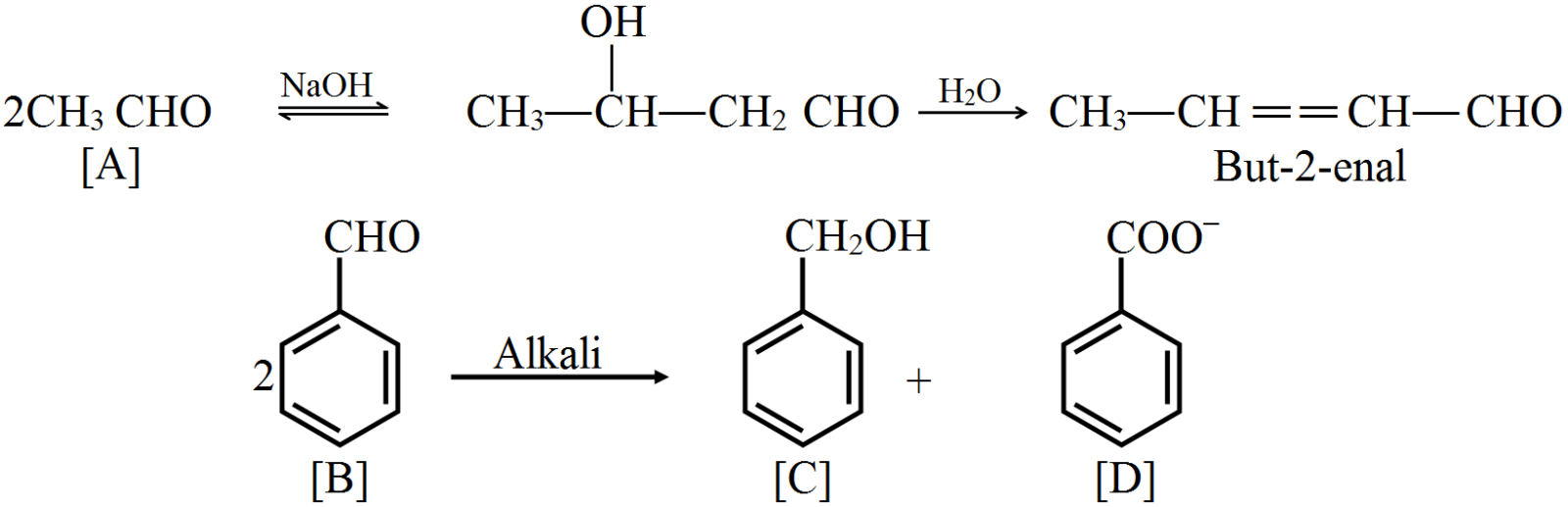
Answer

  1.  is $\ce{CH_3CHO} \ ($ethanal$)$.
  2. is $\ce{C_6H_5CHO} \ ($benzaldehyde$)$.
  3. Toluene.

Need a full question paper?

Generate a complete, print-ready paper with questions like this in minutes — across 16+ boards, with answer keys.

Start Generating Free

Similar questions

Write the products formed when $(CH_3)_3 C-CHO$ reacts with the following reagents:
$i. \ CH_3COCH_3$ in the presence of dilute $NaOH$
$ii.\ HCN$
$iii.\ Conc.\ NaOH$
Shanti, a domestic helper of Mrs. Anuradha, fainted while mopping the floor. Mrs. Anuradha immediately took her to the nearby hospital where she was diagnosed to be severely ‘anaemic’, The doctor prescribed an iron rich diet and multivitamins supplement to her. Mrs. Anuradha supported her financially to get the medicines. After a month, Shanti was diagnosed to be normal.
After reading the above passage, answer the following questions:
  1. What values are displayed by Mrs. Anuradha?
  2. Name the vitamin whose deficiency causes ‘pernicious anaemia’.
  3. Give an example of a water soluble vitamin.
An organic compound ‘$A’ \ce{(C_3H_4)}$ on hydration in presence of $\ce{H_2SO_4/ HgSO_4}$ gives compound ‘$B’ \ce{(C_3H_6O)}$. Compound ‘$B’$ gives white crystalline product $(D)$ with sodium hydrogensulphite. It gives negative Tollens’ test and positive iodoform’s test. On drastic oxidation $‘B\ ’$ gives compound $'C\ ’ \ce{(C_2H_4O_2)}$ along with formic acid. Identify compounds $'A\ ’, 'B\ ’$ and $'C\ ’$ and explain all the reactions.
What is the effect of temperature on the rate constant of a reaction? How can this temperature effect on rate constant be represented quantitatively?
The rate of reaction, $\ce{2NO + Cl_{2 }\rightarrow 2NOCl}$ is doubled when concentration of $Cl_2$ is doubled and it becomes eight times when concentration of both $NO$ and $Cl_2$ are doubled. Deduce the order of the reaction.
What is spectrochemical series? Explain the difference between a weak field ligand and a strong field ligand.
Neeta was experimenting in the lab to study the chemical reactivity of alcohols. She carried out a dehydration reaction of propanol at $140^\circ C$ to $180^\circ C$. Different products were obtained at these two temperatures.
a. Identify the major product formed at $140^\circ C$ and the substitution mechanism followed in this case.
b. Identify the major product formed at $180^\circ C$ and the substitution mechanism followed in this case.
Write the mechanism hydration of ethene to yield ethanol.
  1. Which one of the following is a disaccharide: starch, maltose, fructose, glucose
  2. What is the difference between acidic amino acid and basic amino acid?
  3. Write the name of the linkage joining two nucleotides.
Aqueous copper sulphate solution and aqueous silver nitrate solution are electrolysed by $1$ ampere current for $10$ minutes in separate electrolytic cells. Will the mass of copper and silver deposited on the cathode be same or different? Explain your answer.