MCQ
An X-ray machine has an accelerating potential difference of 25,000 volts. By calculation the shortest wavelength will be obtained as (h = $6.63 \times 10^{-34} \mathrm{~J}-\mathrm{sec}$; e =$ 1.6.\times 10^{-19} $ coulomb)
  • A
    0.25 Å
  • 0.50 Å
  • C
    1.00 Å
  • D
    2.50 Å

Answer

Correct option: B.
0.50 Å
(b) 0.50 Å

Need a full question paper?

Generate a complete, print-ready paper with questions like this in minutes — across 16+ boards, with answer keys.

Start Generating Free

Similar questions

$\frac{x}{x+4}$ is the ratio of energies of photons produced due to transition of an electron of hydrogen atom from its

$(i)$ third permitted energy level to the second level and $(ii)$ the highest permitted energy level to the second permitted level. The value of $x$ will be.

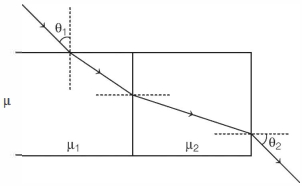
In the figure given below, a ray of light travelling in a medium of refractive index $\mu$ passes through two different connected rectangular blocks of refractive indices $\mu_1$ and $\mu_2\left(\mu_2 > \mu_1\right)$ The angle of incidence $\theta_1$ is increased slightly. Then, the angle $\theta_2$ is
A charged particle is moving in a circular orbit of radius $6\, cm$ with a uniform speed of $3 \times 10^6\, m/s$ under the action of a uniform magnetic field $2 \times 10^{-4}\, Wb/m^2$ which is at right angles to the plane of the orbit. The charge to mass ratio of the particle is
A bar magnet of the magnetic moment $5 Am ^2$ has poles $20 \ cm$ apart. Calculate the pole strength.
Two heater wires of equal length are first connected in series and then in parallel. The ratio of heat produced in the two cases is
The frequency of radio waves corresponding to a wavelength of $10m$ is:
The binding energy of nucleons in a nucleus can be affected by the pairwise Coulomb repulsion. Assume that all nucleons are uniformly distributed inside the nucleus. Let the binding energy of a proton be $E_b^p$ and the binding energy of a neutron be $E_b^n$ in the nucleus.

Which of the following statement($s$) is(are) correct?

$(A)$ $E_b^p-E_b^n$ is proportional to $Z(Z-1)$ where $Z$ is the atomic number of the nucleus.

$(B)$ $E_b^p-E_b^n$ is proportional to $A^{-\frac{1}{3}}$ where $A$ is the mass number of the nucleus.

$(C)$ $E_b^p-E_b^n$ is positive.

$(D)$ $E_b^p$ increases if the nucleus undergoes a beta decay emitting a positron.

A cell of negligible resistance and $e.m.f.$ $2$ $volts$ is connected to series combination of $2$, $3$ and $5\, ohm$. The potential difference in volts between the terminals of $3\, ohm$ resistance will be
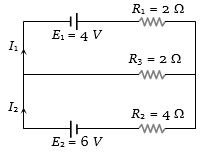
In the circuit shown below $E_1 = 4.0 \,V, R_1= 2 \Omega, E_2 = 6.0 \,V, R_2 = 4 \,\Omega$ and $R_3 = 2 \,\Omega$. The current $I_1$ is ..................... $A$
A galvanometer of resistance, $G,$ is shunted by a resistance $S$ $ohm$. To keep the main current in the circuit unchanged, the resistance to be put in series with the galvanometer is