Questions · Page 1 of 10

M.C.Q (1 Marks)

Take a timed test

50 questions · auto-graded multiple-choice test.

MCQ 11 Mark
Assertion : X-rays can penetrate through the flesh but not through the bones.
Reason : The penetrating power of X-rays depends on voltage.
  • A
    If both assertion and reason are true and the reason is the correct explanation of the assertion.
  • If both assertion and reason are true but reason is not the correct explanation of the assertion.
  • C
    If assertion is true but reason is false.
  • D
    If the assertion and reason both are false.
Answer
Correct option: B.
If both assertion and reason are true but reason is not the correct explanation of the assertion.
 If both assertion and reason are true but reason is not the correct explanation of the assertion.
View full question & answer
MCQ 21 Mark
Assertion : Electric conduction in gases is possible at normal pressure.
Reason : The electric conduction in gases depends only upon the potential difference between the electrodes.
  • A
    If both assertion and reason are true and the reason is the correct explanation of the assertion.
  • B
    If both assertion and reason are true but reason is not the correct explanation of the assertion.
  • C
    If assertion is true but reason is false.
  • If the assertion and reason both are false.
Answer
Correct option: D.
If the assertion and reason both are false.
  If the assertion and reason both are false.
View full question & answer
MCQ 31 Mark
Assertion : The phenomenon of ­X-ray production is basically inverse of photoelectric effect.
Reason : X-rays are electromagnetic waves.
  • A
    If both assertion and reason are true and the reason is the correct explanation of the assertion.
  • If both assertion and reason are true but reason is not the correct explanation of the assertion.
  • C
    If assertion is true but reason is false.
  • D
    If the assertion and reason both are false.
Answer
Correct option: B.
If both assertion and reason are true but reason is not the correct explanation of the assertion.
 If both assertion and reason are true but reason is not the correct explanation of the assertion.
View full question & answer
MCQ 41 Mark
Assertion : X-rays are used for studying the structure of crystals.
Reason : The distance between the atoms of crystals is of the order of wavelength of X-rays.
  • If both assertion and reason are true and the reason is the correct explanation of the assertion.
  • B
    If both assertion and reason are true but reason is not the correct explanation of the assertion.
  • C
    If assertion is true but reason is false.
  • D
    If the assertion and reason both are false.
Answer
Correct option: A.
If both assertion and reason are true and the reason is the correct explanation of the assertion.
 If both assertion and reason are true and the reason is the correct explanation of the assertion.
View full question & answer
MCQ 51 Mark
Assertion : Penetrating power of X-rays increases with the increasing the wavelength.
Reason : The penetrating power of X-rays increases with the frequency of X-rays.
  • A
    If both assertion and reason are true and the reason is the correct explanation of the assertion.
  • B
    If both assertion and reason are true but reason is not the correct explanation of the assertion.
  • C
    If assertion is true but reason is false.
  • If assertion is false but reason is true.
Answer
Correct option: D.
If assertion is false but reason is true.
 If assertion is false but reason is true.
View full question & answer
MCQ 61 Mark
Assertion : Anode of Coolidge tube gets heated up at time of emission of X-rays.
Reason : The anode of Coolidge tube is made of a material of high melting point.
  • A
    If both assertion and reason are true and the reason is the correct explanation of the assertion.
  • If both assertion and reason are true but reason is not the correct explanation of the assertion.
  • C
    If assertion is true but reason is false.
  • D
    If the assertion and reason both are false.
Answer
Correct option: B.
If both assertion and reason are true but reason is not the correct explanation of the assertion.
 If both assertion and reason are true but reason is not the correct explanation of the assertion.
View full question & answer
MCQ 71 Mark
Assertion : Intensity of X-rays can be controlled by adjusting the filament current and voltage.
Reason : The intensity of X-rays does not depend on number of X-ray photons emitted per second from the target.
  • A
    If both assertion and reason are true and the reason is the correct explanation of the assertion.
  • B
    If both assertion and reason are true but reason is not the correct explanation of the assertion.
  • If assertion is true but reason is false.
  • D
    If the assertion and reason both are false.
Answer
Correct option: C.
If assertion is true but reason is false.
 If assertion is true but reason is false.
View full question & answer
MCQ 81 Mark
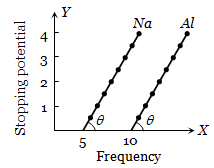
From the figure describing photoelectric effect we may infer correctly that
  • A
    Na and Al both have the same threshold frequency
  • Maximum kinetic energy for both the metals depend linearly on the frequency
  • C
    The stopping potentials are different for Na and Al for the same change in frequency
  • D
    Al is a better photo sensitive material than Na
Answer
Correct option: B.
Maximum kinetic energy for both the metals depend linearly on the frequency
(b) Maximum kinetic energy for both the metals depend linearly on the frequency
View full question & answer
MCQ 91 Mark
The slope of frequency of incident light and stopping potential graph for a given surface will be
  • A
    h
  • h/e
  • C
    eh
  • D
    e
Answer
Correct option: B.
h/e
 h/e
View full question & answer
MCQ 101 Mark
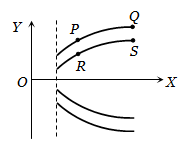
In Thomson spectrograph experiment, four positive ions P,Q,R and S are situated on Y-X curve a shown in the figure
  • The specific charge of R and S are same
  • B
    The masses of P and S are same
  • C
    The specific charges of Q and R are same
  • D
    The velocities of R and S are same
Answer
Correct option: A.
The specific charge of R and S are same
(a) The specific charge of R and S are same
View full question & answer
MCQ 111 Mark
Assertion : X-rays cannot be diffracted by means of grating.
Reason : X-rays does not obey Bragg's law.
  • A
    If both assertion and reason are true and the reason is the correct explanation of the assertion.
  • B
    If both assertion and reason are true but reason is not the correct explanation of the assertion.
  • If assertion is true but reason is false.
  • D
    If the assertion and reason both are false.
Answer
Correct option: C.
If assertion is true but reason is false.
  If assertion is true but reason is false.
View full question & answer
MCQ 121 Mark
Assertion : In photoemissive cell inert gas is used.
Reason : Inert gas in the photoemissive cell gives greater current.
  • If both assertion and reason are true and the reason is the correct explanation of the assertion.
  • B
    If both assertion and reason are true but reason is not the correct explanation of the assertion.
  • C
    If assertion is true but reason is false.
  • D
    If the assertion and reason both are false.
Answer
Correct option: A.
If both assertion and reason are true and the reason is the correct explanation of the assertion.
  If both assertion and reason are true and the reason is the correct explanation of the assertion.
View full question & answer
MCQ 131 Mark
Assertion : The threshold frequency of photoelectric effect supports the particle nature of sunlight.
Reason : If frequency of incident light is less than the threshold frequency, electrons are not emitted from metal surface.
  • A
    If both assertion and reason are true and the reason is the correct explanation of the assertion.
  • If both assertion and reason are true but reason is not the correct explanation of the assertion.
  • C
    If assertion is true but reason is false.
  • D
    If the assertion and reason both are false.
Answer
Correct option: B.
If both assertion and reason are true but reason is not the correct explanation of the assertion.
 If both assertion and reason are true but reason is not the correct explanation of the assertion.
View full question & answer
MCQ 141 Mark
Assertion : In the process of photoelectric emission, all the emitted photoelectrons have the same kinetic energy.
Reason : The photon transfers its whole energy to the electron of the atom in photoelectric effect.
  • A
    If both assertion and reason are true and the reason is the correct explanation of the assertion.
  • B
    If both assertion and reason are true but reason is not the correct explanation of the assertion.
  • C
    If assertion is true but reason is false.
  • If assertion is false but reason is true.
Answer
Correct option: D.
If assertion is false but reason is true.
  If assertion is false but reason is true.
View full question & answer
MCQ 151 Mark
Assertion : In Millikan's experiment for the determination of charge on an electron, oil drops of any size can be used.
Reason : Millikan's experiment determine the charge on electron, by simply measuring the terminal velocity.
  • A
    If both assertion and reason are true and the reason is the correct explanation of the assertion.
  • B
    If both assertion and reason are true but reason is not the correct explanation of the assertion.
  • C
    If assertion is true but reason is false.
  • If assertion is false but reason is true.
Answer
Correct option: D.
If assertion is false but reason is true.
  If assertion is false but reason is true.
View full question & answer
MCQ 161 Mark
Assertion : The specific charge for positive rays is a characteristic constant.
Reason : The specific charge depends on charge and mass of positive ions present in positive rays.
  • A
    If both assertion and reason are true and the reason is the correct explanation of the assertion.
  • If both assertion and reason are true but reason is not the correct explanation of the assertion.
  • C
    If assertion is true but reason is false.
  • D
    If the assertion and reason both are false.
Answer
Correct option: B.
If both assertion and reason are true but reason is not the correct explanation of the assertion.
  If both assertion and reason are true but reason is not the correct explanation of the assertion.
View full question & answer
MCQ 171 Mark
Assertion : An electric field is preferred in comparison to magnetic field for detecting the electron beam in a television picture tube.
Reason : Electric field require low voltage.
  • A
    If both assertion and reason are true and the reason is the correct explanation of the assertion.
  • B
    If both assertion and reason are true but reason is not the correct explanation of the assertion.
  • C
    If assertion is true but reason is false.
  • If the assertion and reason both are false.
Answer
Correct option: D.
If the assertion and reason both are false.
  If the assertion and reason both are false.
View full question & answer
MCQ 181 Mark
Assertion : If different gases are filled turn by turn at the same pressure in the discharge tube the discharge in them takes place at the same potential.
Reason : The discharge depends only on the pressure of discharge tube and not on the ionisation potential of gas.
  • A
    If both assertion and reason are true and the reason is the correct explanation of the assertion.
  • B
    If both assertion and reason are true but reason is not the correct explanation of the assertion.
  • C
    If assertion is true but reason is false.
  • If the assertion and reason both are false.
Answer
Correct option: D.
If the assertion and reason both are false.
 If the assertion and reason both are false.
View full question & answer
MCQ 191 Mark
Assertion : Light is produced in gases in the process of electric discharge through them at high pressure.
Reason : At high pressure electrons of gaseous atoms collide and reach and excited state.
  • A
    If both assertion and reason are true and the reason is the correct explanation of the assertion.
  • B
    If both assertion and reason are true but reason is not the correct explanation of the assertion.
  • C
    If assertion is true but reason is false.
  • If the assertion and reason both are false.
Answer
Correct option: D.
If the assertion and reason both are false.
 If the assertion and reason both are false.
View full question & answer
MCQ 201 Mark
Assertion : An electron is not deflected on passing through certain region of space. This observation confirms that there is no magnetic field in that region.
Reason : The deflection of electron depends on angle between velocity of electron and direction of magnetic field.
  • A
    If both assertion and reason are true and the reason is the correct explanation of the assertion.
  • B
    If both assertion and reason are true but reason is not the correct explanation of the assertion.
  • C
    If assertion is true but reason is false.
  • If assertion is false but reason is true.
Answer
Correct option: D.
If assertion is false but reason is true.
 If assertion is false but reason is true.
View full question & answer
MCQ 211 Mark
Assertion : Photosensitivity of a metal is high if its work function is small.
Reason : Work function = $\mathrm{hf}_0$ where $\mathrm{f}_0$ is the threshold frequency.
  • A
    If both assertion and reason are true and the reason is the correct explanation of the assertion.
  • If both assertion and reason are true but reason is not the correct explanation of the assertion.
  • C
    If assertion is true but reason is false.
  • D
    If the assertion and reason both are false.
Answer
Correct option: B.
If both assertion and reason are true but reason is not the correct explanation of the assertion.
(b) If both assertion and reason are true but reason is not the correct explanation of the assertion.
View full question & answer
MCQ 221 Mark
Assertion : The specific charge of positive rays is not constant.
Reason : The mass of ions varies with speed.
  • A
    If both assertion and reason are true and the reason is the correct explanation of the assertion.
  • If both assertion and reason are true but reason is not the correct explanation of the assertion.
  • C
    If assertion is true but reason is false.
  • D
    If the assertion and reason both are false.
Answer
Correct option: B.
If both assertion and reason are true but reason is not the correct explanation of the assertion.
 If both assertion and reason are true but reason is not the correct explanation of the assertion.
View full question & answer
MCQ 231 Mark
Assertion : Separation of isotope is possible because of the difference in electron numbers of isotope.
Reason : Isotope of an element can be separated by using a mass spectrometer.
  • A
    If both assertion and reason are true and the reason is the correct explanation of the assertion.
  • B
    If both assertion and reason are true but reason is not the correct explanation of the assertion.
  • C
    If assertion is true but reason is false.
  • If assertion is false but reason is true.
Answer
Correct option: D.
If assertion is false but reason is true.
 If assertion is false but reason is true.
View full question & answer
MCQ 241 Mark
Assertion : Kinetic energy of photo electrons emitted by a photosensitive surface depends upon the intensity of incident photon.
Reason : The ejection of electrons from metallic surface is possible with frequency of incident photon below the threshold frequency.
  • A
    If both assertion and reason are true and the reason is the correct explanation of the assertion.
  • B
    If both assertion and reason are true but reason is not the correct explanation of the assertion.
  • C
    If assertion is true but reason is false.
  • If the assertion and reason both are false.
Answer
Correct option: D.
If the assertion and reason both are false.
 If the assertion and reason both are false.
View full question & answer
MCQ 251 Mark
Assertion : Mass of moving photon varies inversely as the wavelength.
Reason : Energy of the particle = Mass × $(\text{Speed of light})^2$
  • A
    If both assertion and reason are true and the reason is the correct explanation of the assertion.
  • If both assertion and reason are true but reason is not the correct explanation of the assertion.
  • C
    If assertion is true but reason is false.
  • D
    If the assertion and reason both are false.
Answer
Correct option: B.
If both assertion and reason are true but reason is not the correct explanation of the assertion.
(b) If both assertion and reason are true but reason is not the correct explanation of the assertion.
View full question & answer
MCQ 261 Mark
Assertion : X-ray travel with the speed of light.
Reason : X-rays are electromagnetic rays.
  • If both assertion and reason are true and the reason is the correct explanation of the assertion.
  • B
    If both assertion and reason are true but reason is not the correct explanation of the assertion.
  • C
    If assertion is true but reason is false.
  • D
    If the assertion and reason both are false.
Answer
Correct option: A.
If both assertion and reason are true and the reason is the correct explanation of the assertion.
 If both assertion and reason are true and the reason is the correct explanation of the assertion.
View full question & answer
MCQ 271 Mark
Assertion : When the speed of an electron increases its specific charge decreases.
Reason : Specific charge is the ratio of the charge to mass.
  • A
    If both assertion and reason are true and the reason is the correct explanation of the assertion.
  •  If both assertion and reason are true but reason is not the correct explanation of the assertion.
  • C
    If assertion is true but reason is false.
  • D
    If the assertion and reason both are false.
Answer
Correct option: B.
 If both assertion and reason are true but reason is not the correct explanation of the assertion.
 If both assertion and reason are true but reason is not the correct explanation of the assertion.
View full question & answer
MCQ 281 Mark
Assertion : Photoelectric effect demonstrates the wave nature of light.
Reason : The number of photoelectrons is proportional to the frequency of light.
  • A
    If both assertion and reason are true and the reason is the correct explanation of the assertion.
  • B
    If both assertion and reason are true but reason is not the correct explanation of the assertion.
  • C
    If assertion is true but reason is false.
  • If the assertion and reason both are false.
Answer
Correct option: D.
If the assertion and reason both are false.
View full question & answer
MCQ 291 Mark
Assertion : The energy (E) and momentum (p) of a photon are related by p = E/c.
Reason : The photon behaves like a particle.
  • If both assertion and reason are true and the reason is the correct explanation of the assertion.
  • B
    If both assertion and reason are true but reason is not the correct explanation of the assertion.
  • C
    If assertion is true but reason is false.
  • D
    If the assertion and reason both are false.
Answer
Correct option: A.
If both assertion and reason are true and the reason is the correct explanation of the assertion.
 If both assertion and reason are true and the reason is the correct explanation of the assertion.
View full question & answer
MCQ 301 Mark
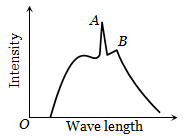
The figure represents the observed intensity of X-rays emitted by an X-ray tube as a function of wavelength. The sharp peaks A and B denote
  • A
    Band spectrum
  • B
    Continuous spectrum
  • Characteristic radiations
  • D
    White radiations
Answer
Correct option: C.
Characteristic radiations
(c) Characteristic radiations
View full question & answer
MCQ 311 Mark
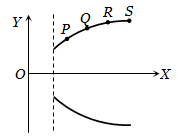
In a parabola spectrograph, the velocities of four positive ions P,Q,R and S are $v_1, v_2, v_3$ and $v_4$ respectively
  • $v_1>v_2>v_3>v_4$
  • B
    $v_1
  • C
    $v_1=v_2=v_3=v_4$
  • D
    $v_1<v_3
Answer
Correct option: A.
$v_1>v_2>v_3>v_4$
(a) $v_1>v_2>v_3>v_4$
View full question & answer
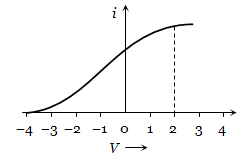
MCQ 321 Mark
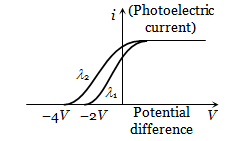
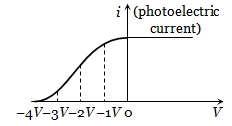
The maximum value of stopping potential in the following diagram is
  • – 4V
  • B
    – 1V
  • C
    – 3V
  • D
    – 2V
Answer
Correct option: A.
– 4V
(a) – 4V
View full question & answer
MCQ 331 Mark
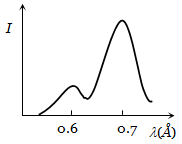
In the diagram a graph between the intensity of X-rays emitted by a molybdenum target and the wavelength is shown, when electrons of 30 keV are incident on the target. In the graph one peak is of $\mathrm{K}_\alpha$ line and the other peak is of $\mathrm{K}_\beta$ line
  • A
    First peak is of $\mathrm{K}_\alpha$ line at 0.6 Å
  • Highest peak is of $\mathrm{K}_{\mathrm{a}}$ line at 0.7 Å
  • C
    If the energy of incident particles is increased, then the peaks will shift towards left
  • D
    If the energy of incident particles is increased, then the peaks will shift towards right
Answer
Correct option: B.
Highest peak is of $\mathrm{K}_{\mathrm{a}}$ line at 0.7 Å
(b) Highest peak is of $\mathrm{K}_{\mathrm{a}}$ line at 0.7 Å
View full question & answer
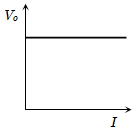
MCQ 341 Mark
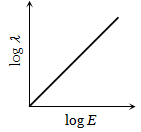
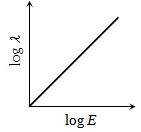
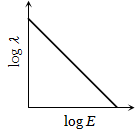
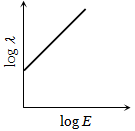
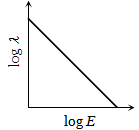
The log-log graph between the energy E of an electron and its de-Broglie wavelength λ will be
  • A
  • B
  • D
Answer
Correct option: C.
(c)
View full question & answer
MCQ 351 Mark
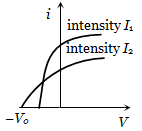
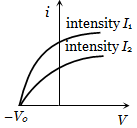
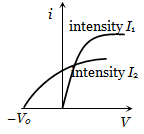
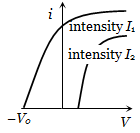
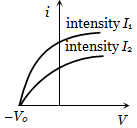
The curves (a), (b) (c) and (d) show the variation between the applied potential difference (V) and the photoelectric current (i), at two different intensities of light ($I_1>I_2$). In which figure is the correct variation shown 
  • A
  • C
  • D
Answer
Correct option: B.
(b)
View full question & answer
MCQ 361 Mark
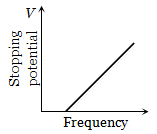
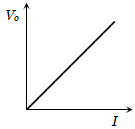
In the graph given below. If the slope is $4.12 \times 10^{-15}$ V-sec, then value of ‘h’ should be
  • A
    $6.6\times 10^{-31}$  J-sec
  • $6.6 \times 10^{-34}$ J-sec
  • C
    $9.1 \times 10^{-31}$ J-sec
  • D
    None of these
Answer
Correct option: B.
$6.6 \times 10^{-34}$ J-sec
(b) $6.6 \times 10^{-34}$ J-sec
View full question & answer
MCQ 371 Mark
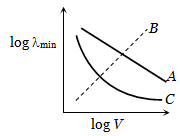
The dependence of the short wavelength limit $\lambda_{\min }$ on the accelerating potential V is represented by the curve of figure
  • A
  • B
    B
  • C
    C
  • D
    None of these
Answer
Correct option: A.
A
(a) A
View full question & answer
MCQ 381 Mark
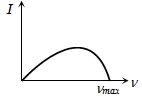
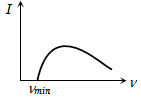
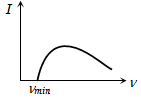
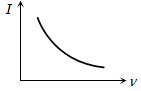
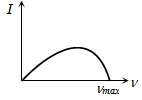
The continuous x-ray spectrum obtained from a Coolidge tube is of the form
  • B
  • C
  • D
Answer
Correct option: A.
(a)
View full question & answer
MCQ 391 Mark
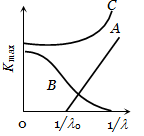
The correct graph between the maximum energy of a photoelectron and the inverse of wavelength of the incident radiation is given by the curve
  • A
  • B
    B
  • C
    C
  • D
    None of the above
Answer
Correct option: A.
A
(a) A
View full question & answer
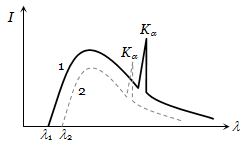
MCQ 401 Mark
The intensity distribution of X-rays from two coolidge tubes operated on different voltages $V_1$ and $V_2$ and using different target materials of atomic numbers $Z_1$ and $Z_2$ is shown in the figure. Which one of the following inequalities is true?
  • $V_1 > V_2, Z_1 < Z_2$
  • B
    $V_1 > V_2, Z_1 > Z_2$
  • C
    $V_1 < V_2, Z_1 > Z_2$
  • D
    $V_1=V_2, Z_1 < Z_2$
Answer
Correct option: A.
$V_1 > V_2, Z_1 < Z_2$
(a) $V_1 > V_2, Z_1 < Z_2$
View full question & answer
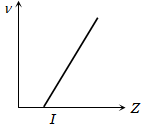
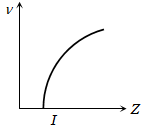
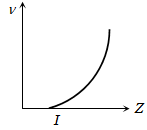
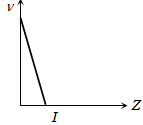
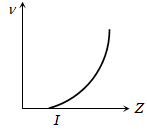
MCQ 411 Mark
The graph that correctly represents the relation of frequency n of a particular characteristic X-ray with the atomic number Z of the material is
  • A
  • B
  • D
Answer
Correct option: C.
(c)
View full question & answer
MCQ 421 Mark
Figure represents the graph of photo current I versus applied voltage (V). The maximum energy of the emitted photoelectrons is
  • A
    2eV
  • 4 eV
  • C
    0 eV
  • D
    4 J
Answer
Correct option: B.
4 eV
(b) 4 eV
View full question & answer
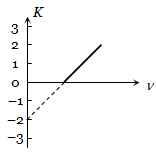
MCQ 431 Mark
Figure represents a graph of kinetic energy (K) of photoelectrons (in eV) and frequency (v) for a metal used as cathode in photoelectric experiment. The work function of metal is
  • A
    1 eV
  • B
    1.5 eV
  • 2 eV
  • D
    3 eV
Answer
Correct option: C.
2 eV
(c) 2 eV
View full question & answer
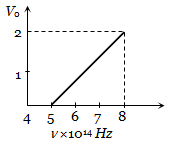
MCQ 441 Mark
The stopping potential ($V_0$) versus frequency (n) plot of a substance is shown in figure the threshold wave length is
  • A
    $5 \times 10^{14} \mathrm{~m}$
  • 6000Å
  • C
    5000 Å
  • D
    Can not be estimated from given data
Answer
Correct option: B.
6000Å
(b) 6000Å
View full question & answer
MCQ 451 Mark
According to Einstein’s photoelectric equation, the plot of the kinetic energy of the emitted photo electrons from a metal versus the frequency, of the incident radiation gives a straight line whose slope
  • Is the same for all metals and independent of the intensity of the radiation
  • B
    Depends on the intensity of the radiation
  • C
    Depends both on the intensity of the radiation and the metal used
  • D
    Depends on the nature of the metals used
Answer
Correct option: A.
Is the same for all metals and independent of the intensity of the radiation
 Is the same for all metals and independent of the intensity of the radiation
View full question & answer
MCQ 461 Mark
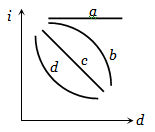
A point source of light is used in an experiment on photoelectric effect. Which of the following curves best represents the variation of photo current (i) with distance (d) of the source from the emitter
  • A
    a
  • B
    b
  • C
    c
  • d
Answer
Correct option: D.
d
(d) d
View full question & answer
MCQ 471 Mark
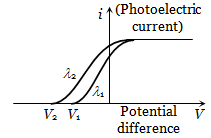
In the following diagram if $V_2 > V_1$ then
  • A
    $\lambda_1=\sqrt{\lambda_2}$
  • B
    $\lambda_1<\lambda_2$
  • C
    $\lambda_1=\lambda_2$
  • $\lambda_1>\lambda_2$
Answer
Correct option: D.
$\lambda_1>\lambda_2$
(d) $\lambda_1>\lambda_2$
View full question & answer
MCQ 481 Mark
The value of stopping potential in the following diagram
  • – 4V
  • B
    – 3 V
  • C
    – 2V
  • D
    – 1 V
Answer
Correct option: A.
– 4V
(a) – 4V
View full question & answer
MCQ 491 Mark
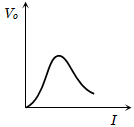
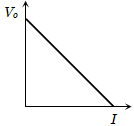
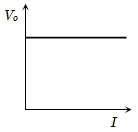
The correct curve between the stopping potential (V) and intensity of incident light (I) is
  • A
  • C
  • D
Answer
Correct option: B.
(b)
View full question & answer
MCQ 501 Mark
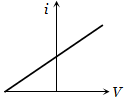
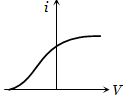
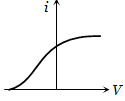
The curve between current (i) and potential difference (V) for a photo cell will be
  • A
  • B
  • C
Answer
Correct option: D.
(d)
View full question & answer
M.C.Q (1 Marks) - Physics STD 12 Science Questions - Vidyadip