Analyse any three broad components of the security strategy of India.
DELHI - OUTSIDE DELHI - FOREIGN SET 1 2018
Download our app for free and get started
Three broad components of Security Strategy of India:
- Strengthening Military Capabilities:
- India’s involvment in conflicts with its neighbours–Indo-Pak (1947-48, 1965, 1971 & 1999) & Indo-China (1962).
- Conducted nuclear test in 1998, was justified by the Indian Government in terms of safeguarding national security.
- Strengthening international norms and institutions:
- India supports-Asian solidarity, decolonisation, disarmament and peaceful settlement of disputes.
- Universal and Non-discriminatory Nuclear Disarmament.
- Support for NAM, NIEO and Kyoto Protocol.
- Participation in UN Peacekeeping Missions.
- Security within the country:
- Separatist movements in Nagaland, Mizoram, Punjab and Kashmir have been dealt with.
- India preserved its national unity by adopting a democratic political system.
- Economic Development:
- Efforts to end economic inequalities.
- Combine economic growth with human development.

Download our appand get started for free
Experience the future of education. Simply download our apps or reach out to us for more information. Let's shape the future of learning together!No signup needed.*
Similar Questions
- 1View SolutionDistinguish between the internal and external notion of traditional security.
- 2View SolutionRead the passage given below carefully and answer the questions that follow:
All proponents of human security agree that its primary goal is the protection of individuals. However, there are differences about precisely what threats individuals should be protected from. Proponents of the ‘narrow’ concept of human security focus on violent threats to individuals.- Which type of security is the main concern of ‘human security’?
- What would you like to include under the ‘broad’ concept of human security? Explain.
- Identify any four threats from which individuals should be protected.
- 3View SolutionWhat is meant by non-traditional notion of security? Differentiate between the narrow and broad concept of human security.
- 4View Solution
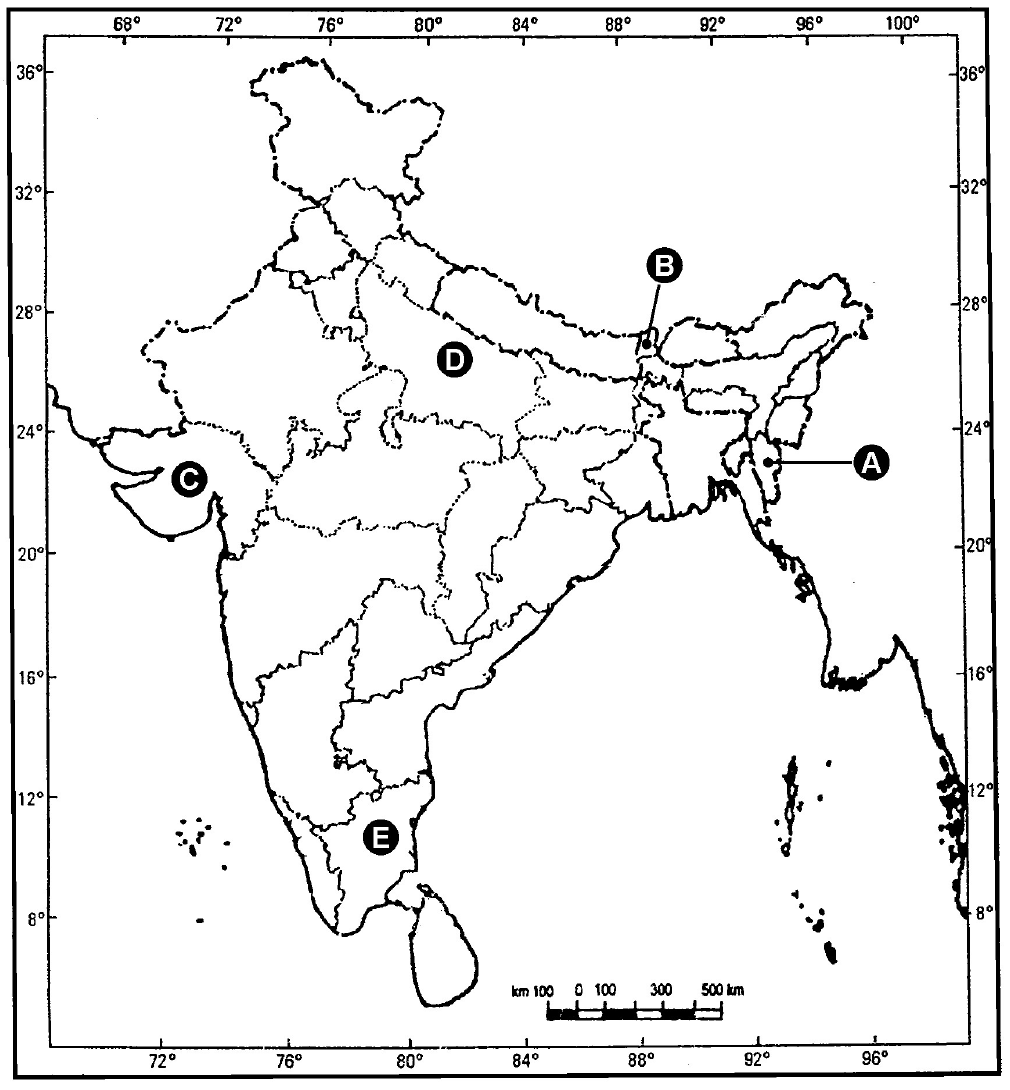
In the political outline map of India given above, five states have been marked as $\text{A, B, C, D}$ and $E.$ Identify these states on the basis of information given below and write their correct names in your answer book along with the respective serial number of the information used and the concerned alphabet in the map as per the following format.Sr. No. of the information usedConcerned alphabet in the MapName of the State$i.$ $ii.$ $iii.$ $iv.$ $v.$ - The state where a violent incident took place at Godhara in $2002.$
- The state which was earlier known as Madras.
- The state which has the maximum number of seats in India in its Legislative Assembly.
- The state to which Laldenga belonged.
- The state which integrated with India in $1975$ as $22^{nd}$ State of India.
- 5View SolutionDescribe the security challenges faced by the newly independent countries of Asia and Africa after the Second World War.
- 6View SolutionDescribe any two important components of India's security strategy.
- 7View SolutionWhat are the objectives of military alliances? Give an example of a functioning military alliance with its specific objectives.
- 8View SolutionWhat is meant by alliance building as a component of traditional security policy? What are its advantages?
- 9View SolutionDescribe terrorism as a new source of threat to security.
- 10View SolutionExplain the concept of "Human Security".