Describe the security challenges faced by the newly independent countries of Asia and Africa after the Second World War.
OUTSIDE DELHI - SET 1 2017
Download our app for free and get started
The security challenges facing the newly-independent countries of Asia and Africa after the Second World War:
- The newly independent countries faced the prospect of military conflict with neighbouring countries.
- They had to worry about internal military conflict. These countries faced threats not only from outside their borders, mostly from neighbours, but also from within.
- Many newly independent countries came to fear their neighbours even more than they feared the US or the Soviet Union or the former colonial powers. They quarrelled over borders and territories or control of people and populations or all of these simultaneously.
- Internally, the new states were worried about threats from separatist movements which wanted to form independent countries. Sometimes, the external and internal threats merged.
- A neighbour might help or instigate an internal separatist movement leading to tensions between the two neighbouring countries.
- Internal wars now make up more than 95 per cent of all armed conflicts fought anywhere in the world.
- Between 1946 and 1991, there was a twelve-fold rise in the number of civil wars— the greatest jump in 200 years. So, for the new states, external wars with neighbours and internal wars posed a serious challenge to their security.

Download our appand get started for free
Experience the future of education. Simply download our apps or reach out to us for more information. Let's shape the future of learning together!No signup needed.*
Similar Questions
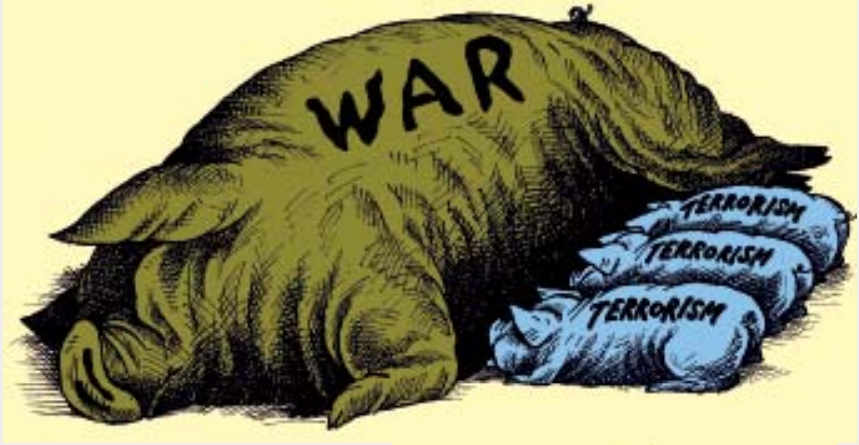
- 1View SolutionRead the cartoon below and write a short note in favour or against the connection between war and terrorism depicted in this cartoon.
- 2View SolutionHow do per capita income and population growth affect the economic disparity in the world? Suggest any two ways to reduce economic disparitybetween the poor and the rich at the global level.
- 3View SolutionLooking at the Indian scenario, what type of security has been given priority in India, traditional or non-traditional?What examples could you site to substantiate the argument?
- 4View SolutionDescribe migration and health epidemics as the new sources of threat to the nontraditional notion of security.
- 5View SolutionAnalyse any three broad components of the security strategy of India.
- 6View SolutionWhat is meant by Security? Mention any four components of Indian security strategy.
- 7View SolutionDescribe any three new sources of threat under the non-traditional concept of security, giving examples for each.
- 8View SolutionRead the passage given below carefully and answer the questions that follow:
All proponents of human security agree that its primary goal is the protection of individuals. However, there are differences about precisely what threats individuals should be protected from. Proponents of the ‘narrow’ concept of human security focus on violent threats to individuals.- Which type of security is the main concern of ‘human security’?
- What would you like to include under the ‘broad’ concept of human security? Explain.
- Identify any four threats from which individuals should be protected.
- 9View SolutionExplain any four economic consequences of globalisation.
- 10View SolutionDescribe terrorism as a new source of threat to security.