Question
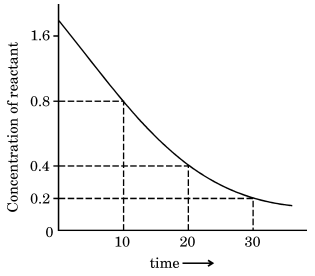
Analyse the given graph, drawn between concentration of reactant vs. time.
Image
(a) Predict the order of reaction.
(b) Theoretically, can the concentration of the reactant reduce to zero after infinite time? Explain.

Answer

(a) First order.
(b) No, due to exponential relation, curve never touches x-axis.

Need a full question paper?

Generate a complete, print-ready paper with questions like this in minutes — across 16+ boards, with answer keys.

Start Generating Free

Similar questions

Write a note on tertiary structure of protein compound.
Explain why :
alkyl halides, though polar, are immiscible with water?
An alkene with molecular formula $C _6 H _2$ on ozonolysis gives two different products. One of these gave a positive iodoform test but does not reduced Tollens' reagent. The other product give a positive Tollens' test but does not give iodoform test. What is the name and formula of alkene and its products?
Cyanide ion acts as an ambident nucleophile. From which end it acts as a stronger nucleophile in aqueous medium? Give reason for your answer.
What is meant by positive deviations from Raoult's law? Give an example. What is the sign of $\triangle _{\text{mix}}\text{H}$ for positive deviation?
A reaction is first order in A and second order in B.
  1. Write the differential rate equation.
  2. How is the rate affected on increasing the concentration of B three times?
  3. How is the rate affected when the concentrations of both A and B are doubled?
Account for the following:
  1. Phenol does not react with $\ce{NaHCO_3}$ whereas carboxylic acids react.
  2. Phenol is more easily nitrated than benzene.
Note: In the following questions a statement of assertion followed by a statement of reason is given. Choose the correct answer out of the following choices.
Assertion: $Λ_m$ for weak electrolytes shows a sharp increase when the electrolytic solution is diluted.
Reason: For weak electrolytes degree of dissociation increases with dilution of solution.
Write down uses of halogen containing organic compounds.
Using $\text{IUPAC}$ norms write the formulae for the following $:$
  1. Potassium trioxalatoaluminate$(III)$
  2. Dichloridobis$($ethane$-1,2-$diamine$)$cobalt$(III)$