Question types

Chemical Kinetics question types

61 questions across 6 question groups — pick any mix to generate a Chemistry paper with step-by-step answer keys.

61
Questions
6
Question groups
5
Question types
Sample Questions

Chemical Kinetics questions

One sample from each question group in this chapter. Select any group above to see the full set with answer keys.

If the rate equation for a reaction is $\frac{dx}{dt}=k[H]^{1/2}[B]^{1/2}$, the order of reaction is:
  • A
    2
  • B
    $\frac{1}{2}$
  • C
    $\frac{3}{2}$
  • 1

Answer: D.

View full solution
The unit of rate constant of a second order reaction is :
  • A
    mol $L^{-1}sec^{-1}$
  • B
    $mol^{-1}L^{-1}sec^{-1}$
  • $mol^{-1}L~sec^{-1}$
  • D
    $\operatorname{mol} L \sec ^{-1}$

Answer: C.

View full solution
Which of the following is not a first order reaction?
  • A
    $CH _3 COOCH _3+ H _2 O \xrightarrow{ H ^{+}} CH _3 COOH + CH _3 OH$
  • $CH _3 COOC _2 H _5+ NaOH \rightarrow CH _3 COONa + C _2 H _5 OH$
  • C
    $2 H _2 O _2 \rightarrow 2 H _2 O + O _2$
  • D
    $2 N_2 O _5 \rightarrow 4 NO _2+ O _2$

Answer: B.

View full solution
The rate of zero order reaction $A+B \longrightarrow C$ is :
  • Rate $= K [ A ]^0[B]^0$
  • B
    Rate $= K [ A ]^1[B]^0$
  • C
    Rate $= K [ A ]^0[B]^1$
  • D
    None of these

Answer: A.

View full solution
The rate constant for a first order reaction is $60~s^{-1}$. How much time will it take to reduce the initial concentration of the reactant to its 1/16th value?
View full solution
For the reaction $A\rightarrow B,$ the rate of reaction becomes 27 times when the concentration of A is increased 3 times. What is the order of the reaction?
View full solution
What is the effect of temperature on the rate constant of reaction? How can this temperatures effect on rate constant be represented quantitatively?
View full solution
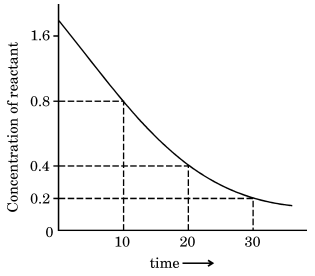
Analyse the given graph, drawn between concentration of reactant vs. time.
Image
(a) Predict the order of reaction.
(b) Theoretically, can the concentration of the reactant reduce to zero after infinite time? Explain.
View full solution
For the reaction, $2 N_2 O _{5(g)} \rightarrow 4 NO _{2(g)}+ O _{2(g)}$, the rate of formation of $NO _{2(g)}$ is $2.8 \times 10^{-3} ms^{-1}$. Calculate the rate of disappearance of $N _2 O _{5(g) \text {. }}$
View full solution
Q 173 Marks Question3 Marks
The decomposition of A into product has value of k as $4.5\times10^{3}s^{-1}$ at $10^{\circ}C$ and energy of activation $60~kJ~mol^{-1}$. At what temperature would k be $1.5\times10^{10}s^{-1}$?
View full solution
Q 183 Marks Question3 Marks
For a reaction $2 H _2 O _2 \frac{ I ^{-}}{\text {alkaline medium }} 2 H _2 O + O _2$
the proposed mechanism is as given below:
(1) $H_{2}O_{2}+I^{-}\rightarrow H_{2}O+IO^{-}$ (slow)
(2) $H_{2}O_{2}+IO^{-}\rightarrow H_{2}O+I^{-}+O_{2}$ (fast)
(i) Write rate law for the reaction.
(ii) Write the overall order of reaction.
(iii) Out of steps (1) and (2), which one is rate determining step?
View full solution
Q 193 Marks Question3 Marks
A first order reaction is 50% completed in 40 minutes at 300 K and in 20 minute at 320 K. Calculate the activation energy of the reaction. (Given: log 2=0.3010, log 4=0.6021, $R=8.314$ $J~K^{-1}$ mol).
View full solution
Q 203 Marks Question3 Marks
The decomposition of $N _2 O _5$ in $CCl _4$ solution follows the first order rate law. The concentration of $N _2 O _5$ measured at different time intervals are given ahead:
Time $(t) \sec$08016041060011301720
$\left[ N _2 O _2\right] mol /$ litre5.55.04.84.03.42.41.6

Calculate its rate constant at 410 sec and 1130 sec. What does these result show?
View full solution
For the decomposition of azoisopropane to hexane and nitrogen at 543 K , the following data is obtained :
$t( sec )$$P$ (mm of Hg )
035.0
36054.0
72063.0

Calculate the rate constant.
View full solution
The rate constant for the first order decomposition of $H_{2}O_{2}$ is given by the following equation: $log~k=14.2-\frac{1.0\times10^{4}K}{T}$. Calculate $E_a$ for this reaction and rate constant k if its half-life period be 200 minute.
( given $R =8.314 J K ^{-1} mol^{-1}$)
View full solution

Generate a Chemical Kinetics paper free

Pick question groups from the list above, set marks and difficulty, and export a branded PDF with step-by-step answer keys. First 3 chapters free — no signup.

Download App