MCQ
Angular velocity vector is directed along:
  • A
    The tangent to the circular path.
  • B
    The inward radius.
  • C
    The outward radius.
  • The axis of rotation In translational equilibrium.

Answer

Correct option: D.
The axis of rotation In translational equilibrium.

Need a full question paper?

Generate a complete, print-ready paper with questions like this in minutes — across 16+ boards, with answer keys.

Start Generating Free

Similar questions

From a waterfall, water is falling down at the rate of $100 kg/s$  on the blades of turbine. If the height of the fall is $ 100 m$ , then the power delivered to the turbine is approximately equal to ........... $kW$
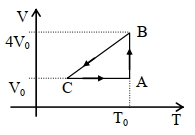
One mole of an ideal gas in initial state $\mathrm{A}$ undergoes a cyclic process $A B C A$, as shown in the figure. Its pressure at $A$ is $\mathrm{P}_0$. Choose the correct option$(s)$ from the following

$(A)$ Internal energies at $\mathrm{A}$ and $\mathrm{B}$ are the same

$(B)$ Work done by the gas in process $\mathrm{AB}$ is $\mathrm{P}_0 \mathrm{~V}_0 \ln 4$

$(C)$ Pressure at $C$ is $\frac{P_0}{4}$

$(D)$ Temperature at $\mathrm{C}$ is $\frac{\mathrm{T}_0}{4}$
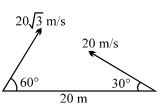
In the figure shown, the two projectiles are fired simultaneously. The minimum distance between them during their flight is  ........ $m$
Body of mass $M$ is much heavier than the other body of mass $m$. The heavier body with speed $v$ collides with the lighter body which was at rest initially elastically. The speed of lighter body after collision is
A unit scale is to be prepared whose length does not change with temperature and remains $20\,cm$, using a bimetallic strip made of brass and iron each of different length. The length of both components would change in such a way that difference between their lengths remains constant. If length of brass is $40\,cm$ and length of iron will be$...cm$

$\left(\alpha_{\text {iron }}=1.2 \times 10^{-5} K ^{-1}\right.$ and $\left.\alpha_{\text {brass }}=1.8 \times 10^{-5} K ^{-1}\right)$.
The acceleration of a body due to the attraction of the earth (radius $R$) at a distance $2 \,R$ from the surface of the earth is ($g =$ acceleration due to gravity at the surface of the earth)
A particle of mass $1 kg$ is subjected to a force which depends on the position as $\vec{F}=-k(x \hat{i}+y \hat{j}) kgms ^{-2}$ with $k=1 kgs ^{-2}$. At time $t=0$, the particle's position $\vec{r}=\left(\frac{1}{\sqrt{2}} \hat{i}+\sqrt{2} \hat{j}\right) m$ and its velocity $\vec{v}=\left(-\sqrt{2} \hat{i}+\sqrt{2} \hat{j}+\frac{2}{\pi} \hat{k}\right) m s^{-1}$. Let $v_x$ and $v_y$ denote the $x$ and the $y$ components of the particle's velocity, respectively. Ignore gravity. When $z=0.5 m$, the value of $\left(x v_y-y v_x\right)$ is. . . . . $m^2 s^{-1}$
The potential energy of a particle of mass $0.1\,kg,$ moving along $x-$ axis, is given by $U = 5x(x-4)\,J$ where $x$ is in metres. It can be concluded that
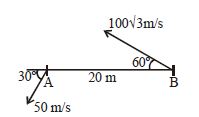
Velocity of two particles $A$ and $B$ separated by distance $20\ m$ apart is as shown in figure then ........ $rad/s$ will be the angular velocity of $B$ with respect to $A$
A ball rolls without slipping.  The radius of gyration of the ball about an axis passing through its centre of mass $K$. If radius of the ball be $R$, then the fraction of total energy associated with its rotational energy will be