MCQ
Anhydrous sodium acetate on heating with sodalime gives
  • A
    Acetic acid
  • Methane
  • C
    Calcium acetate
  • D
    Ethane

Answer

Correct option: B.
Methane
b
(b) $\mathop {C{H_3}COONa}\limits_{{\rm{Sodium acetate}}}  + NaOH  \xrightarrow{CaO}  \mathop {C{H_4}}\limits_{{\rm{Methane}}}  + N{a_2}C{O_3}$

Need a full question paper?

Generate a complete, print-ready paper with questions like this in minutes — across 16+ boards, with answer keys.
Start Generating Free

Similar questions

In the nucleus of $_{20}C{a^{40}}$ there are
Consider the below reaction, and choose the correct statement:
Ammonia forms the complex $[Cu(NH)_3)_4]^{2+}$ with copper ions in alkaline solution but not in acidic solution. the reason for this is
The incorrect statements among the following is
$3\,g$ urea is dissolved in $45\,g$ of water. The relative lowering of vapour pressure is
When comparing the hydrogenation of benzene with that of a hypothetical $1, 3,
5-$ cyclohexatriene, benzene .................... than the cyclohexatriene.
If energy absorbed for conversion of $M_{(g)}$ into $M_{(g)}^+$ for $Li, Be, B, C$ and $N$ is $a, b, c, d$ and $e$ (in $k\,cal/ mol$) respectively then correct order will be
Which is correctly matched
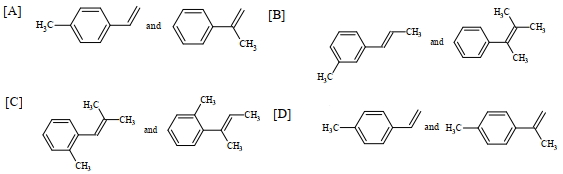
Compounds $P$ and $R$ upon ozonolysis produce $Q$ and $S$, respectively. The molecular formula of $Q$ and $S$ is $C_8 \mathrm{H}_8 \mathrm{O}$. $Q$ undergoes Cannizzaro reaction but not haloform reaction, whereas $\mathrm{S}$ undergoes haloform reaction but not Cannizzaro reaction.

($i$) $P \xrightarrow[\text { ii) } \mathrm{Zn} / \mathrm{H}_2 \mathrm{O}]{\text { i) } \mathrm{O}_3 / \mathrm{CH}_2 \mathrm{Cl}_2} \underset{\left(\mathrm{C}_8 \mathrm{H}_8 \mathrm{O}\right)}{Q}$

($ii$) $R \xrightarrow[\text { ii) } \mathrm{Zn} / \mathrm{H}_2 \mathrm{O}]{\text { i) } \mathrm{O}_3 / \mathrm{CH}_2 \mathrm{Cl}_2} \underset{\left(\mathrm{C}_8 \mathrm{H}_8 \mathrm{O}\right)}{S}$

The option(s) with suitable combination of $P$ and $R$, respectively, is(are)
Newmann projection representation of. . . . ..  Then $X$ and $Y$ are respectively :

$\begin{array}{*{20}{c}} {{H_3}C - C{H_2} - CH - Et} \\ {\,\,\,\,\,\,\,\,\,\,\,\,\,\,\,\,\,\,\,\,\,\,\,\,\,\,\,\,\,\,\,\,\,\,\,|\,\,\,\,\,\,\,\,\,\,\,\,\,\,\,\,\,\,\,} \\ {\,\,\,\,\,\,\,\,\,\,\,\,\,\,\,\,\,\,\,\,\,\,\,\,\,\,\,\,\,\,\,\,\,\,\,\,C{H_3}\,\,\,\,\,\,\,\,\,\,\,\,\,\,\,} \end{array}$ about $C_2-C_3$ is (figure)