Question
Answer the following question: How will you convert phenol to benzoic acid?

Answer

Get the step-by-step solution for this question inside the Vidyadip app.

Get the answer in the app

Need a full question paper?

Generate a complete, print-ready paper with questions like this in minutes — across 16+ boards, with answer keys.

Start Generating Free

Similar questions

Match the items of Columns I and II and mark the correct option.
  Column I   Column II
$(A)$ $H_2SO_4$ $(1)$ Highest electron gain enthalpy
$(B)$ $CCl_3NO_2$ $(2)$ Chalcogen
$(C)$ $Cl_2$ $(3)$ Tear gas
$(D)$ Sulphur $(4)$ Storage batteries
  1. $A (4) B (3) C (1) D (2)$
  2. $A (3) B (4) C (1) D (2)$
  3. $A (4) B (1) C (2) D (3)$
  4. $A (2) B (1) C (3) D (4)$
After watching a programme on TV about the presence of carcinogens (cancer causing agents) Potassium bromate and Potassium iodate in bread and other bakery products, Rupali a Class XII student decided to make others aware about the adverse effects of these carcinogens in foods. She consulted the school principal and requested him to instruct the canteen contractor to stop selling sandwiches, pizzas, burgers and other bakery products to the students. The principal took an immediate action and instructed the canteen contractor to replace the bakery products with some protein and vitamin rich food like fruits, salads, sprouts, etc. The decision was welcomed by the parents and the students.
After reading the above passage, answer the following questions:
  1. What are the values (at least two) displayed by Rupali?
  2. Which polysaccharide component of carbohydrates is commonly present in bread?
  3. Write the two types of secondary structures of proteins.
  4. Give two examples of water soluble vitamins.
  1. $30 g$ of urea $(M = 60 g mol^{-1})$ is dissolved in 846 g of water. Calculate the vapour pressure of water for this solution if vapour pressure of pure water at $298 K$ is $23.8$ mm Hg.
  2. Write two differences between ideal solutions and non-ideal solutions.
  1.  
  1. Write the disproportionation reaction of $H_3PO_3$.
  2. Draw the structure of $XeF_4$.
  1. Account for the following:
  1. Although Fluorine has less negative electron gain enthalpy yet $F_2$ is strong oxidizing agent.
  2. Acidic character decreases from $N_2O_3$​​​​​​​ to $Bi_2O_3​​​​​​​$​​​​​​​ in group $15$.
  1. Write a chemical reaction to test sulphur dioxide gas. Write chemical equation involved.
Explain primary, secondary and tertiary structure of proteins with diagram.
Discuss the different chemical properties of amines.
Describe the reactions of -COOH group present in carboxylic acids.
Answer the following question:
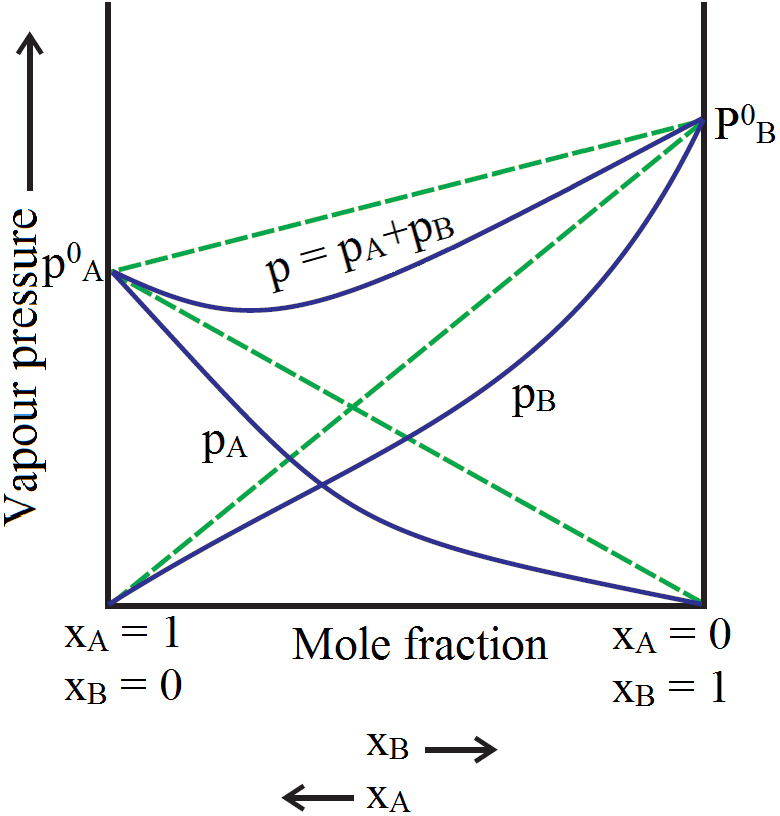
The graphical representation of vapour pressures of two component system as a function of composition is given alongside. By graphic inspection, answer the following questions:
  1. Are the A-B interactions weaker, stronger or of the same magnitude as A-A and B-B?
  2. Name the type of deviation shown by this system from Raoult’s law.
  3. Predict the sign of $\Delta_\text{mix}\text{H}$ for this system.
  4. Predict the sign of $\Delta_\text{mix}\text{H}$ for this system.
  5. Give an example of such a system.
  6. What type of azeotrope will this system form, if possible?
Attempt any five of the following:
$(a)$ What are Purines and Pyrimidines? Name the purines and Pyrimidines present in $ \text{DNA}$ and $ \text{RNA}$ nucleic Acids.
$(b)$ Write the full forms of $ \text{DNA}$ and $ \text{RNA}$
$(c)$ Name the vitamin whose deficiency causes convulsions.
$(d)$ Which vitamin $B$ group can be stored in our body?
$(e) (i).$ What is the difference between a nucleoside and nucleotide?
$(ii).$ Write one difference between $a-$helix and $\beta-$pleated sheet structures of protein.
$(f)$ What are nucleic acids? Why two strands in $ \text{DNA}$ are not identical but are complementary?
$(g)$ Some enzymes are named after the reaction, where they are used. What name is given to the class of enzymes which catalyse the oxidation of one substrate with simultaneous reduction of another substrate?
How can you remove the hard calcium carbonate layer of the egg without damaging its semiprermiable membrane? Can this egg be inserted into a bottle with a narrow neck without distorting its shape? Explain the process involved.