Question
Explain primary, secondary and tertiary structure of proteins with diagram.

Answer

self

Need a full question paper?

Generate a complete, print-ready paper with questions like this in minutes — across 16+ boards, with answer keys.

Start Generating Free

Similar questions

Explain the method of preparing haloalkanes by free radical substitution of alkanes.
Explain the effect of substitutents on the basic strength of aromatic amines.
Match the complex ions given in Column I with the hybridisation and number of unpaired electrons given in Column II and assign the correct code:
 
Column I (Complex ion)
 
Column II (Hybridisation, number of unpaired electrons)
$a.$
$[Cr(H_2O)_6]^{3+}$
$1.$
$dsp^2, 1$
$b.$
$[Co(CN)_4]^{2-}$
$2.$
$sp^3d^2, 5$
$c.$
$[Ni(NH_3)_6]^{2+}$
$3.$
$d^2sp^3, 3$
$d.$
$[MnF_6]^{4-}$
$4.$
$sp^3, 4$
 
 
$5.$
$sp^3d^2, 2$
Code:
  1. $A (3), B (1), C (5), D (2).$
  2. $A (4), B (3), C (2), D (1).$
  3. $A (3), B (2), C (4), D (1).$
  4. $A (4), B (1), C (2), D (3).$
Explain the methods of preparation of aromatic aldehydes (benzoic aldehyde) from aromatic hydrocarbons.
  1. Why do transition elements show variable oxidation states?
  1. Name the element showing maximum number of oxidation states among the first series of transition metals form Sc (Z=21) to Zn (Z=30).
  2. Name the element which shows only +3 oxidation state.
  1. What is lanthanoid contraction? Name an important alloy which contains some of the lanthanoid metals.
  1. What happens when
  1. Chlorine gas is passed through a hot concentrated solution of $NaOH$?
  2. Sulphur dioxide gas is passed through an aqueous solution of a Fe (III) salt?
  1. Answer the following:
  1. What is the basicity of $H_3PO_3$ and why?
  2. Why does fluorine not play the role of a central atomin interhalogen compounds?
  3. Why do noble gases have very low boiling points?

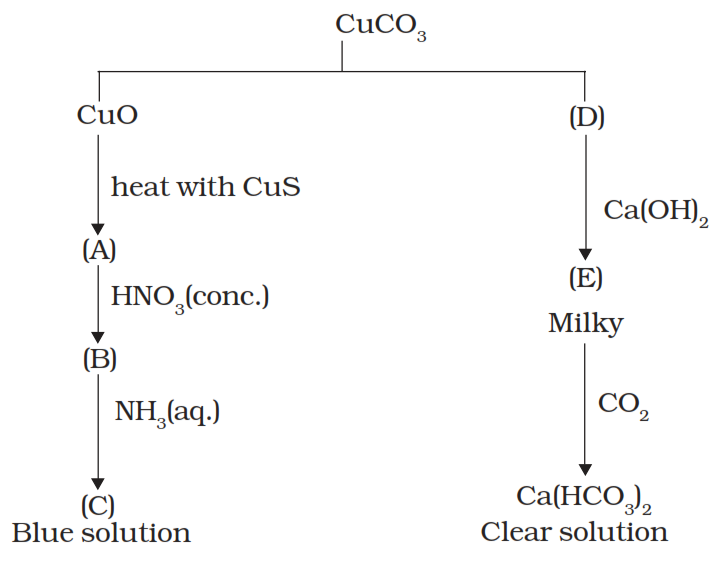
Identify $A$ to $E$ and also explain the reactions involved.
Indicate the types of isomerism exhibited by the following complexes and draw the structures for these isomers$:$
$i. k \left[ Cr \left( H _2 O \right)_2\left( C _2 O _4\right)_2\right]$
$ii. \left[ Co ( en )_3\right] Cl _3$
$iii. \left[ Co \left( NH _3\right)_5\left( NO _2\right)\left( NO _3\right)_2\right]$
$iv. \left[ Pt \left( NH _3\left( H _2 O \right) Cl _2\right.\right.$
Assign reasons for the following:
i. The enthalpies of atomisation of transition elements are high.
ii. The transition metals and many of their compounds act as good catalyst.
iii. From element to element the actinoid contraction is greater than the lanthanoid contraction.
iv. The $E ^0$ value for the $Mn ^{3+} / Mn ^{2+}$ couple is much more positive than that for $Cr ^{3+} / Cr ^{2+}$.
v. Scandium $(Z=21)$ does not exhibit variable oxidation states and yet it is regarded as a transition element.
What happens to most probable kinetic energy and the energy of activation with increase in temperature?