Question
Answer the following questions.
A non-reducing disaccharide ‘A’ on hydrolysis with dilute acid gives an equimolar mixture of D-(+)-glucose and D-(-)-fructose.
$\text{A}+\text{H}_2\text{O}\xrightarrow{\text{HCl}\ \ \ \ }\ \ \ \ \ \ \text{C}_6\text{H}_{12}\text{O}_6+\ \ \ \ \ \ \text{C}_6\text{H}_{12}\text{O}_6\\ [\alpha]_{\text{D}}=+66.5\hat{\text{O}}\phi\Omega\ \ \ \ \ +52.5\hat{\text{O}}\phi\Omega\ \ \ \ \ -92.4\hat{\text{O}}\phi\Omega$
Identify A. What is the mixture of D-(+)-glucose and D-(-)-fructose known as? Name the linkage that holds the two units in the disaccharide.
Answer

  1. $A = C_{12}H_{22}O_{11}$ (sucrose).
  2. Invert sugar.
  3. Glycosidic linkage.

Need a full question paper?

Generate a complete, print-ready paper with questions like this in minutes — across 16+ boards, with answer keys.

Start Generating Free

Similar questions

$3.9\ g$ of benzoic acid dissolved in $49\ g$ of benzene shows a depression in freezing point of $1.62\ K.$ Calculate the van't Hoff factor and predict the nature of solute (associated or dissociated).
$($Given: Molar mass of benzoic acid $=122 \mathrm{~g} \mathrm{~mol}^{-1}, \mathrm{~K}_{\mathrm{f}}$ for benzene $=4.9 \mathrm{~K} \mathrm{~kg} \mathrm{~mol}^{-1} )$
State Raoult’s law for a solution containing volatile components. How does Raoult’s law become a special case of Henry’s law?
For the complex $[NiCI_4]^{2-},$ write
  1. The IUPAC name.
  2. The hybridization type.
  3. The shape of the complex.
$($Atomic no. of $Ni = 28)$
How would you achieve the following conversions:
  1. Nitrobenzene to aniline.
  2. An alkyl halide to a quaternary ammonium salt.
  3. Aniline to benzonitrile.
Write the chemical equation with reaction conditions in each case.
If NaCl is doped with $10^{–3}\ mol\ \%$ of $SrCl_2,$ what is the concentration of cation vacancies?
Explain why the stability of oxoacids of chlorine increases in the order given below:
$HClO < HClO_2 < HClO_3 < HClO_4$
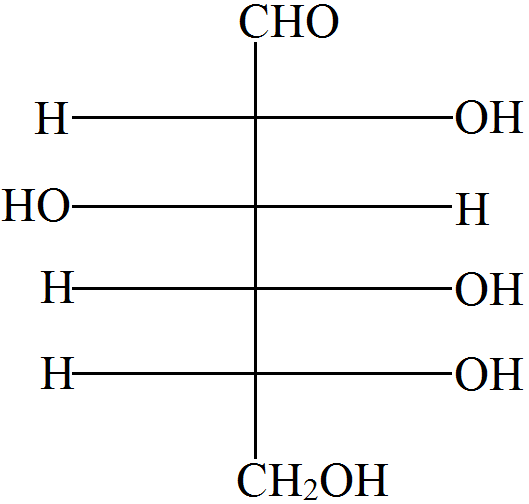
The Fischer projection of D-Glucose is given alongside.
Give the Fischer projection of L-Glucose.
Explain chemical properties of $KMnO _4$
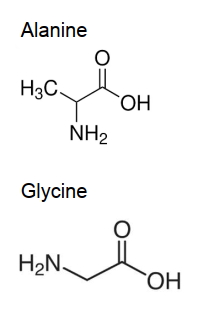
a. Give the structure of all the possible dipeptides formed when the following two amino acids form a peptide bond.
Image
b. Keratin, insulin, and myosin are a few examples of proteins present in the human body. Identify which type of protein is keratin and insulin and differentiate between them based on their physical properties.
Write the structures of monomers used for getting the following polymers:
  1. Nylon$-6, 6$
  2. Glyptal
  3. Buna$-S$