Question
State Raoult’s law for a solution containing volatile components. How does Raoult’s law become a special case of Henry’s law?

Answer

For a solution of volatile liquids, Raoult’s law states that the partial vapour pressure of each component of the solution is directly proportional to its mole fraction present in solution, i.e., $\text{P}_\text{A}\propto\text{x}_\text{A},\ \text{or }\text{P}_{\text{A}}=\text{P}_\text{A}^0\text{x}_\text{A}$ According to Henry’s law, the partial pressure of a gas in vapour phase (p) is directly proportional to mole fraction (x) of the gas in the solution. $p = K_HxOn$ comparing it with Raoult’s law it can be seen that partial pressure of the volatile component or gas is directly proportional to its mole fraction in solution, only the proportionality constant $K_H$ differs from $\text{P}_\text{A}^0,$
$\text{p}_\text{A}\propto\text{x}$
Thus, it becomes a special case of Henry's law in which $\text{K}_\text{H}=\text{P}^0_\text{A}.$

Need a full question paper?

Generate a complete, print-ready paper with questions like this in minutes — across 16+ boards, with answer keys.
Start Generating Free

Similar questions

Depict the galvanic cell in which the reaction:
$ Z n(s)+2 A g^{+}(a q) \rightarrow Z n^{2+}(a q)+2 A g(s) $
takes place. Further show:
i. Which of the electrodes is negatively charged?
ii. The carries of current in the cell.
iii. Individual reaction at each electrode.
  1. Write the principle of Zone refining.
  2. What is the role of collectors in froth floatation process? Give an example of a collector.
  3. Write the name of a reducing agent to obtain Fe from $Fe_2O_3$ at low temperature.
Ionisation enthalpies of Ce, Pr and Nd are higher than Th, Pa and U.
Write a note on halogenation of phenol.
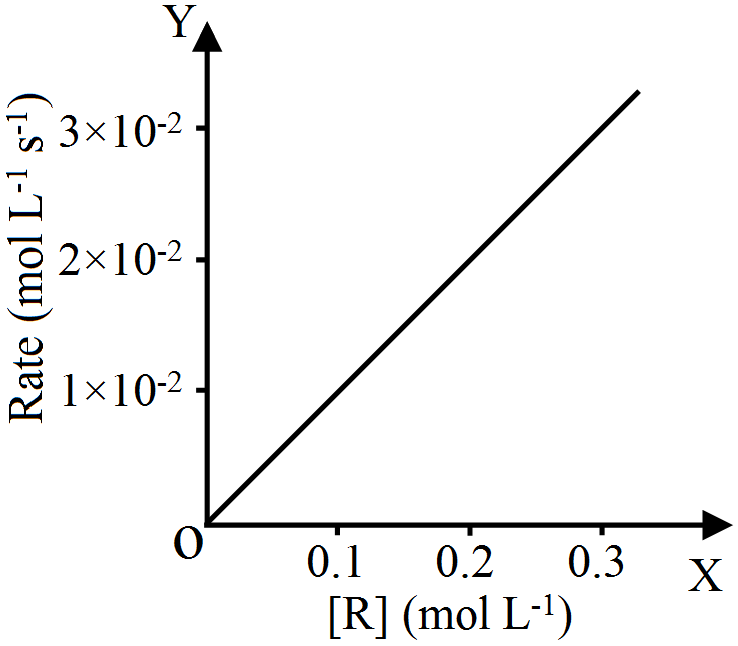
The rate for the reaction $R→P$ is rate = k[R]. It has been shown graphically below. What is rate constant for the reaction?
For a first order reaction, show that time required for $99\%$ completion is twice the time required for the completion of $90\%$ of reaction.
What is the coordination number of:
  1. Zinc in zinc blende $(ZnS)?$
  2. Oxide ion in sodium oxide $(Na_2O)?$
  3. Calcium in calcium fluoride $(CaF_2)?$
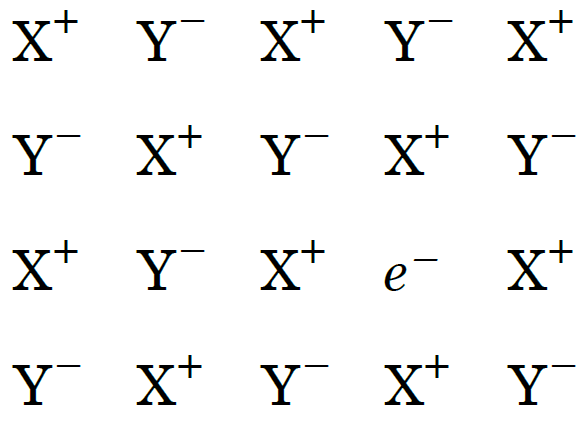
Examine the given defective crystal:
Answer the following questions:
  1. Is the above defect stoichiometric or non-stoichiometric?
  2. write the term used for the electron occupied site.
  3. Give an example of the compound which shows this type of defect.
A compound is formed by two elements X and Y. Atoms of the element Y(as anions) make ccp and those of the element X(as cations) occupy all the octahedral voids. What is the formula of the compound?
Calculate the mass percentage of benzene $(C_6H_6) $ and carbon tetrachloride $(CCl_4)$ if $22$ g of benzene is dissolved in $122$ g of carbon tetrachloride.