Question
✓
Answer
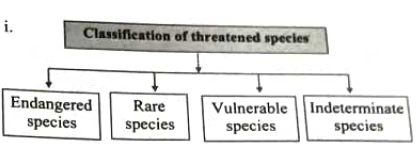
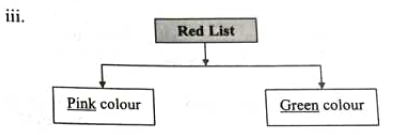
ii. Biodiversity can be conserved by tollowing ways:
a. Conservation of all plants and animals.
b. Protection of rare species of organisms.
c. Projects for conservation of special species.
d. Establishment of national parks and sanctuaries.
e. Declaration of some regions as bioreserves.
f. Maintenance of records of traditional knowledge.
g. Obey the rules that fall under Biodiversity Act.
Need a full question paper?
Generate a complete, print-ready paper with questions like this in minutes — across 16+ boards, with answer keys.
Explore more
Similar questions
In the previous example, how much time the satellite will take to complete one revolution around the earth?
Consider the following substances $:NaCl, Ca(OH)_2, NaHCO_3, NH_3, Na_2CO, H_2O, Cl_2, CO_2, CaSO_4.2H_2O, 2CaSO_4.H_2O, CaOCl_2$
→- Which two substances combine to form bleaching powder?
- Which four substances are utilised in the production of washing soda?
- Which compound represents plaster of Paris?
- Which compound is a part of baking powder?
- Which compound is used as an antacid?
Observe the following figure and write the answer of the question.
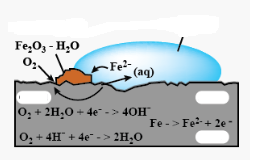
- Which process is shown in the figure?
- Explain the chemical reaction shown in the figure.
- Write the reactions on anode and cathode.
Give four uses of decomposition reaction.
Draw a neat labelled diagram: Magnetic separation method.
Why is variation during reproduction beneficial to the species but not necessarily for the individual?
Construction of a compound microscope:
(1) A compound microscope consists of a metal tube fitted with two convex lenses at the two ends. These lenses are called the objective lens (the lens directed towards the object) and the eyepiece (the lens directed towards the eye). Both the lenses are small in size, but the cross section of the objective lens is less than that of the eyepiece. The objective lens has a short focal length. The focal length of the eyepiece is more than that of the objective lens.(2) The metal tube is mounted on a stand. The principal axes of the objective lens and the eyepiece are along the same line. The distance between the object and the objective lens can be changed with a screw. It is possible to change the distance between the objective lens and the eyepiece.
Working:
(1) The object to be observed is illuminated and placed in front of the objective lens, slightly beyond the focal length of the objective lens. Its real, inverted and enlarged image is formed by the, objective lens on the other side.
(2) This intermediate image lies within the focal length of the eyepiece. It serves as an object for the eyepiece. The eyepiece works as a simple microscope. The final image is virtual, highly enlarged and inverted with respect to the original object. It can be formed at the minimum distance of distinct vision from the eyepiece. The final image is observed by keeping the eye close to the eyepiece.
Use: This microscope is used to observe blood cells, microorganisms, etc.
1.In a compound microscope, which lens has greater focal length?
2.Where do you place the object to be observed with a compound microscope?
3.State which distance is adjusted to observe the object with a compound microscope.
4.State the nature of the final image in compound microscope relative to the object.
5.State the use of a compound microscope.
(1) A compound microscope consists of a metal tube fitted with two convex lenses at the two ends. These lenses are called the objective lens (the lens directed towards the object) and the eyepiece (the lens directed towards the eye). Both the lenses are small in size, but the cross section of the objective lens is less than that of the eyepiece. The objective lens has a short focal length. The focal length of the eyepiece is more than that of the objective lens.(2) The metal tube is mounted on a stand. The principal axes of the objective lens and the eyepiece are along the same line. The distance between the object and the objective lens can be changed with a screw. It is possible to change the distance between the objective lens and the eyepiece.
Working:
(1) The object to be observed is illuminated and placed in front of the objective lens, slightly beyond the focal length of the objective lens. Its real, inverted and enlarged image is formed by the, objective lens on the other side.
(2) This intermediate image lies within the focal length of the eyepiece. It serves as an object for the eyepiece. The eyepiece works as a simple microscope. The final image is virtual, highly enlarged and inverted with respect to the original object. It can be formed at the minimum distance of distinct vision from the eyepiece. The final image is observed by keeping the eye close to the eyepiece.
Use: This microscope is used to observe blood cells, microorganisms, etc.
1.In a compound microscope, which lens has greater focal length?
2.Where do you place the object to be observed with a compound microscope?
3.State which distance is adjusted to observe the object with a compound microscope.
4.State the nature of the final image in compound microscope relative to the object.
5.State the use of a compound microscope.
What are the main organs of the human nervous system? Draw a labelled diagram to show the main organs of the human nervous system.
What is a plant hormone? Name four plant hormones. State one function of each.
Draw a scientifically correct labelled diagram of a human eye and answer the questions based on it:
i. Name the type of lens in the human eye.
ii. Name the screen at which the maximum amount of incident light is refracted?
iii. State the nature of the image formed of the object on the screen inside the eye.
i. Name the type of lens in the human eye.
ii. Name the screen at which the maximum amount of incident light is refracted?
iii. State the nature of the image formed of the object on the screen inside the eye.