Question
Answer the following questions:
  1. Define electric flux. Write its $SI $ unit.
  2. Using Gauss’s law, prove that the electric field at a point due to a uniformly charged infinite plane sheet is independent of the distance from it.
  3. How is the field directed if:
  • The sheet is positively charged.
  • Negatively charged?

Answer

  1. Electric flux: It is defined as the total number of electric field lines passing through an area normal to its surface.
$\Phi=\oint\vec{\text{E}}.\vec{\text{dS}}$
The $SI$ unit is $Nm^2/ C$ or volt $-$ metre.
  1. Image
Let electric charge be uniformly distributed over the surface of a thin, non-conducting infinite sheet.
Let the surface charge density $($i.e., charge per unit surface area$)$ be $\sigma$ .
​​​​​​​We need to calculate the electric field strength at any point distant r from the sheet of charge.
To calculate the electric field strength near the sheet, we now consider a cylindrical Gaussian surface bounded by two plane faces $A$ and $B$ lying on the opposite sides and parallel to the charged sheet and the cylindrical surface perpendicular to the sheet$ ($fig$)$. By symmetry the electric field strength at every point on the flat surface is the same and its direction is normal outwards at the points on the two plane surfaces and parallel to the curved surface.
Total electric flux,
or $\oint\limits_\text{S}\vec{\text{E}}.\vec{\text{dS}}=\oint\limits_{\text{S}_1}\vec{\text{E}}.\vec{\text{dS}_1}+\oint\limits_{\text{S}_2}\vec{\text{E}}.\vec{\text{dS}_2}+\oint\limits_{\text{S}_3}\vec{\text{E}}.\vec{\text{dS}_3}$
$\oint\limits_\text{S}\vec{\text{E}}.\vec{\text{dS}}=\oint\limits_{\text{S}_1}\text{E dS}_1\cos0^\circ+\oint\limits_{\text{S}_2}\text{E dS}_2\cos0^\circ+\oint\limits_{\text{S}_3}\text{E dS}_3\cos90^\circ$
$=\text{E}\oint\text{dS}_1+\text{E}\oint\text{dS}_2=\text{Ea}+\text{Ea}=2\text{Ea}$
$\therefore$ Total electric flux $= 2Ea$
As $\sigma$ is charge per unit area of sheet and a is the intersecting area, the charge enclosed by Gaussian surface $=\sigma\text{a}$
Total electric flux $=\frac{1}{\epsilon_0}\times  \ ($total charge enclosed by the surface$)$
i.e., $2\text{Ea}=\frac{1}{\epsilon_0}(\sigma\text{a})$
$\therefore\ \text{E}=\frac{\text{p}}{2\epsilon_0}.$
Thus electric field strength due to an infinite flat sheet of charge is independent of the distance of the point.
  1.  
  • If $\sigma$ is positive, $\vec{\text{E}}$ points normally outwards/ away from the sheet.
  • If $\sigma$ is negative, $\vec{\text{E}}$ points normally inwards/ towards the sheet.

Need a full question paper?

Generate a complete, print-ready paper with questions like this in minutes — across 16+ boards, with answer keys.

Start Generating Free

Similar questions

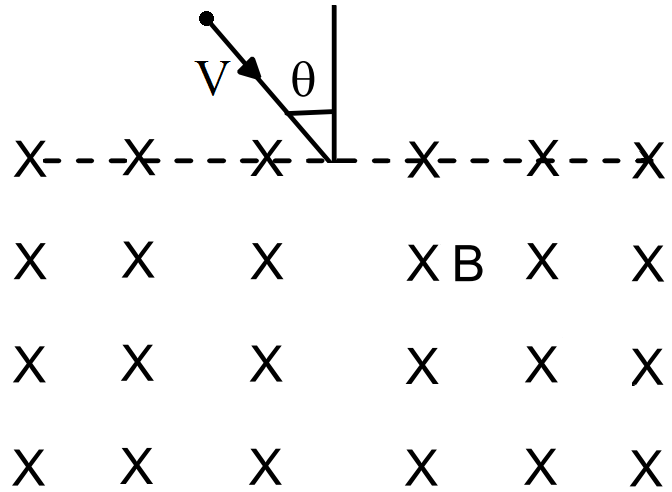
A particle of mass m and positive charge q, moving with a uniform velocity v, enters a magnetic field B, as shown,
  1. Find the radius of the circular arc it describes in the magnetic field.
  2. Find the angle subtended by the arc at the centre.
  3. How long does the particle stay inside the magnetic field?
  4. Solve the three parts of the above problem if the charge q on the particle is negative.
The intensity of the sunlight reaching Earth is $1380Wm^{-2}.$ Assume this light to be a plane, monochromatic wave. Find the amplitudes of electric and magnetic fields in this wave.
The work function of a photoelectric material is 4.0eV.
  1. What is the threshold wavelength?
  2. Find the wavelength of light for which the stopping potential is 2.5V.
A vessel of volume $125\ cm^3$ contains tritium $\big(\text{ }^3\text{H,t}_{\frac{1}{2}}=12.3\text{y}\big)$ at $500\ kPa$ and $300K.$ Calculate the activity of the gas.
What is nuclear fusion? How is energy produced in the sun by this process? Explain with necessary equations.
Suppose that the electric field amplitude of an electromagnetic wave is $E_0=120 N / C$ and that its frequency is v = 50.0MHz
(a) Determine,$B _0, \omega, k$ and λ. (b) Find expressions for E and B. s
Two audio speakers are kept some distance apart and are driven by the same amplifier system. A person is sitting at a place 6.0m from one of the speakers and 6.4m from the other. If the sound signal is continuously varied from 500Hz to 5000Hz, what are the frequencies for which there is a destructive interference at the place of the listener? Speed of sound in air = 320m/s.
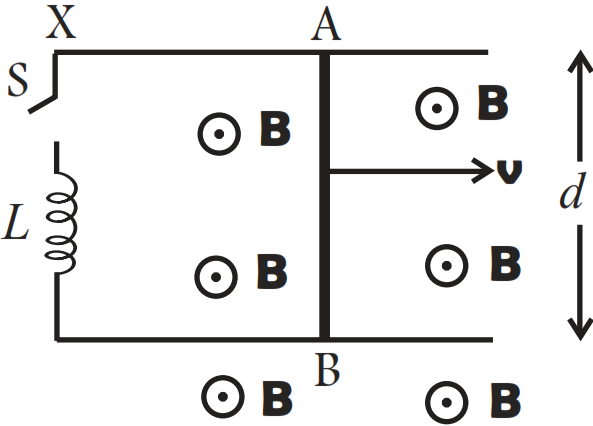
Find the current in the sliding rod AB (resistance = R) for the arrangement shown in Fig. B is constant and is out of the paper. Parallel wires have no resistance. v is constant. Switch S is closed at time t = 0.
A group of students while coming from the school noticed a box marked "Danger H.T. 2200 V" at a substation in the main street. They did not understand the utility of such a high voltage, while they argued, the supply was only 220 V.They asked their teacher this question the next day. The teacher thought it to be an important question and therefore explained to the whole class.
Answer the following questions:
  1. What device is used to bring the high voltage down to low voltage of a.c. Current and what is the principle of its working?
  2. Is it possible to use this device for bringing down the high d.c. Voltage to the low voltage? Explain.
  3. Write the values displayed by the students and the teacher.
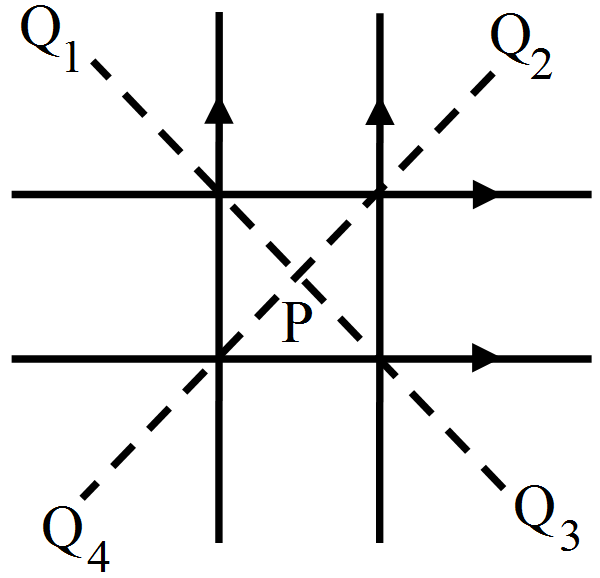
Four long, straight wires, each carrying a current of $5.0A,$ are placed in a plane as shown in figure. The points of intersection form a square of side $5.0\ cm.$
  1. Find the magnetic field at the centre $P$ of the square.
  2. $Q_1, Q_2, Q_3,$ and $Q_4$ are points situated on the diagonals of the liquare and at a distance from $P$ that is equal to the length of the diagonal of the square. Find the magnetic fields at these points.