Question
Answer the following questions:
Explain Polygenic inheritance and Multiple allelism with the help of suitable examples.

Answer

Co–dominance:

  • The alleles which are able to express themselves independently, even when present together are called co–dominant alleles and this biological phenomenon is called co–dominance. For example, ABO blood grouping in humans.
  • ABO blood groups are controlled by gene I. Gene I has three alleles IA, IB and IO/i.
  • IA and IB produce RBC surface antigens sugar polymer A and B, respectively, whereas i does not produce any antigen.
  • IA and IB are dominant over i hence IA and IB are dominant alleles and i is recessive allele as in IAi and IBi. • When IA and IB are present together, both express equally and produce the surface antigens A and B, hence show co–dominance.
  • Since humans are diploid, each person possesses any two of the three ‘I’ gene alleles, resulting into six different genotypic combinations and four phenotypic expressions.

Table showing the genetic basis of blood groups in human population.

Allele from Parent 1
Allele from Parent 2
Genotype of offspring 
Blood groups of offspring
IA
IA
IAIA
A
IA
IB
IAIB
AB
IA
i
IAi
A
IB
IB
IBIB
B
IB
i
IBi
B
i
i
ii
O

Polygenic Inheritance:

  • It is a type of inheritance, in which traits are controlled by three or more genes. Such traits are called polygenic traits.
  • The phenotype reflects contribution of each allele and is also influenced by the environment.
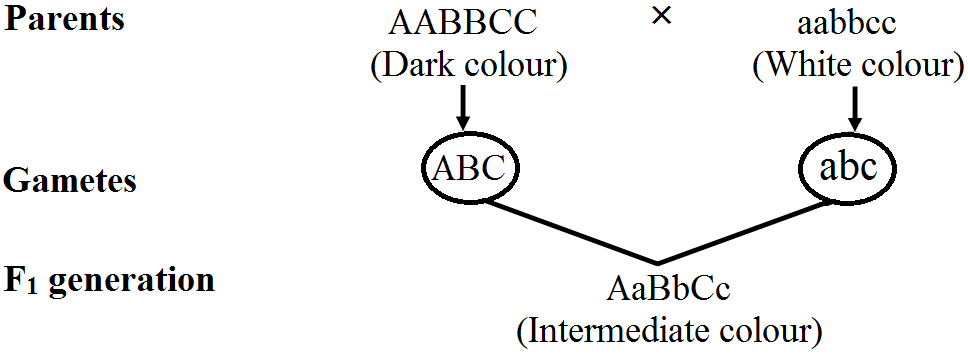
  • For example, human skin colour. Suppose three genes A, B and C control skin colour with A, B, C being the dominant alleles and a, b, c being the recessive alleles. Then,

  • The F2 generation will have varied skin tones, with each type of allele in the genotype determining the darkness or lightness of the skin.

Need a full question paper?

Generate a complete, print-ready paper with questions like this in minutes — across 16+ boards, with answer keys.
Start Generating Free