Question
What is biolistic or gene-gun technique ?

Answer

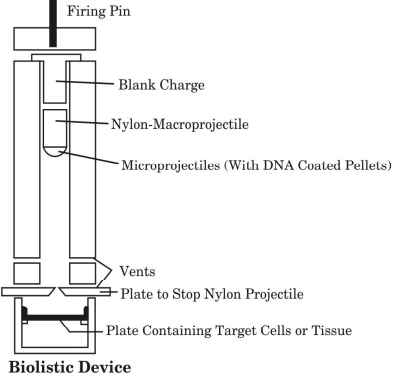
In genetic engineering, a gene gun or biolistic particle delivery system is a device used to deliver foreign DNA. By coating particles of a heavy metal with a gene of interest and firing these micro-projectiles into cells using mechanical force, an integration of desired genetic information can be introduced into desired cells. The technique involved with such micro-projectile delivery of DNA is also known as biolistics.
This device is able to transform almost any type of cell and is not limited to the transformation of the nucleus; it can also transform organelles, including plastids and mitochondria.
The earliest custom manufactured gene guns used a 22 caliber nail gun cartridge to propel a polyethylene cylinder (bullet) down a 22 caliber douglas barrel. A droplet of the tungsten powder coated with genetic material was placed onto the bullet and shot down into a petri dish below. The bullet welded to the disk below the Petri plate, and the genetic material blasted into the sample with a doughnut effect involving devastation in the middle of the sample with a ring of good transformation around the periphery. The gun was connected to a vaccum pump. Other heavy metals such as gold and silver are also used to deliver genetic material with gold being favoured due to lower cytotoxicity in comparison to tungsten projectile carriers.
Gene guns are mostly used with plant cells. However, there is much potential use in humans and other animals as well.
Image

Need a full question paper?

Generate a complete, print-ready paper with questions like this in minutes — across 16+ boards, with answer keys.

Start Generating Free

Similar questions

Using a flow chart explain the process of decomposition. List the factors which affect this process.
What are biofertilisers? Name the categories of organisms used as biofertilisers with an example for each. How do they function in organic farming?
Explain the difference between the following :
(i) Nucleoside and nucleotide
(ii) DNA and RNA
(iii) Codon and anticodon
(iv) Transcription and translation
(v) Inductive regulation and inhibitory regulation
(vi) RNA splicing and RNA editing
(a) Draw the diagram of human sperm and label the cellular component. Also mention the functions of three components.
(b) Where does the head of sperm remain embedded in spermatogenesis.
What is a biogeochemical cycle. What is the role of the reservoir in a biogeochemical cycle. Give an example of a sedimentary cycle with reservoir located in earth’s crust.
Mention any two autosomal genetic disorders with their symptoms.
Explain why a recessive allele is unable to express itself in a heterozygous state.
What is the significance of epididymis in male fertility?
Describe the disease 'Typhoid' under the following headings :
(i) Name of the pathogen
(ii) Name of the test to confirm the disease
(iii) Mode of infection
(iv) Four main symptoms of the disease
(v) Diagram of the structure of an antibody molecule.
"It is often said that the pyramid of energy is always upright. On the other hand, the pyramid of biomass can be both upright and inverted." Explain with the help of examples and sketches.