Question
Answer the following questions:
How did Morgan show the deviation in inheritance pattern in Drosophila with respect to this law?
Answer

Linkage and Recombination:

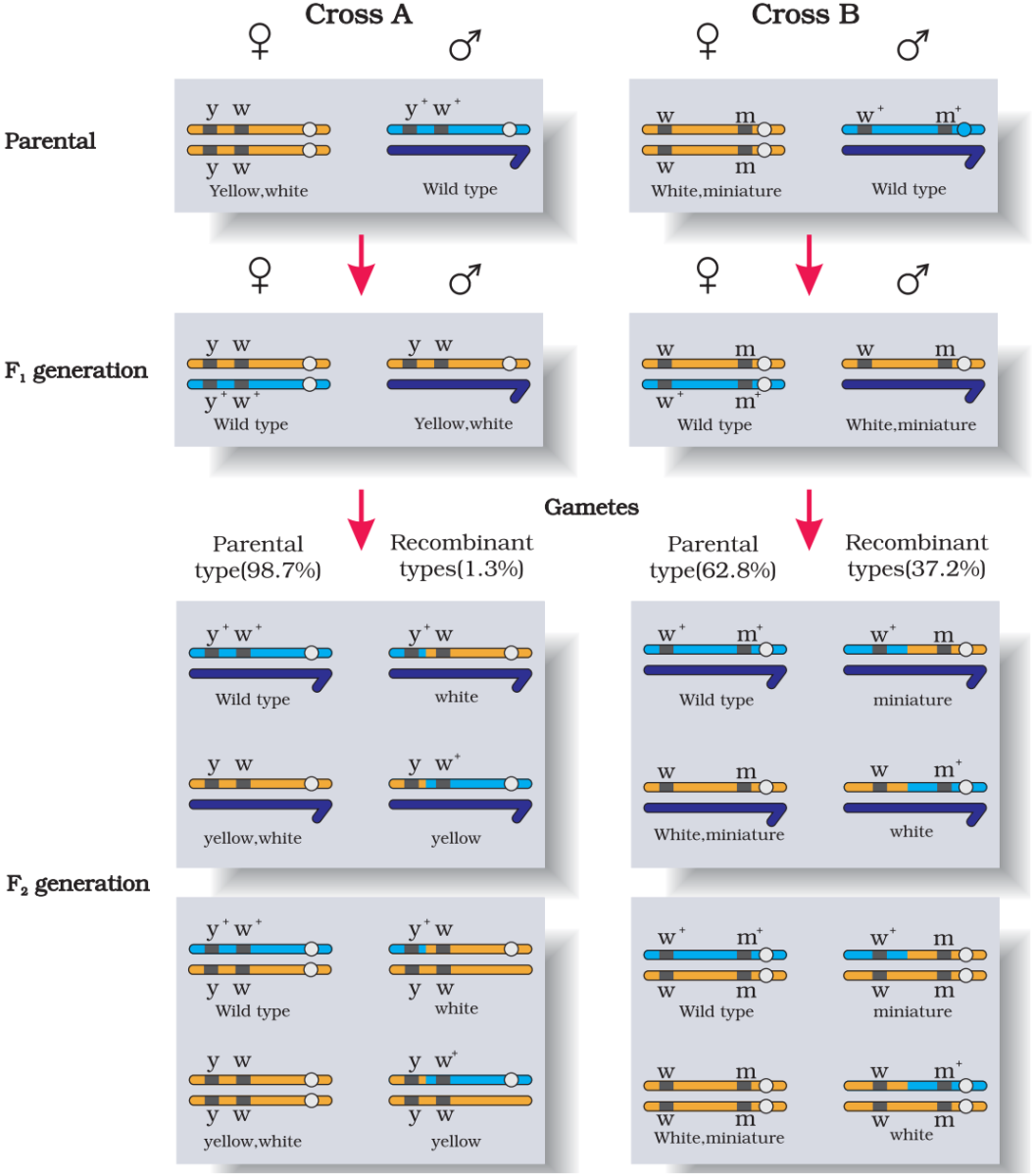
  • T. H. Morgan carried out several dihybrid crosses in Drosophila to study the genes that are sex–linked. He observed that when the two genes in a dihybrid cross are located on the same chromosome, the proportion of parental gene combinations in the progeny was much higher than the non-parental or recombination of genes.
  • Morgan and his group found that when genes are grouped on the same chromosome, some genes are tightly linked or associated and show little recombination.

  • Linkage: Results of two dihybrid crosses conducted by Morgan. Cross A shows crossing between genes y and w; Cross B shows crossing between genes w and m. Here dominant wild type alleles are represented with (+) sign in superscript.
  • When the genes are loosely linked they show higher percentage of recombination.
  • Morgan hybridised yellow bodied and white eyed females with brown bodied and red eyed males (wild type) (cross–A) and inter–crossed their F1 progeny.
  • Alfred Sturtevant determined that genes of Drosophila are arranged in a linear order. He measured the distance between genes and prepared chromosome maps with the position of genes on the chromosomes based on percentage of recombinants. These are also called genetic maps.

Need a full question paper?

Generate a complete, print-ready paper with questions like this in minutes — across 16+ boards, with answer keys.

Start Generating Free

Similar questions

Read the following and answer any four questions from (i) to (v) given below:

Transgenic animals can serve as factories that in some cases, may produce large amount of proteins more efficiently. Transgenic mice have been engineered to express human antibodies by introducing large segment of human DNA encoding human immunoglobulin genes. In transgenic large animals such as cow or sheep proteins of pharmaceutical value can be produced in large quantities in milk which is later purified. Transgenesis can be used to alter many phenotypic properties including growth rate, fat composition, milk production, hair texture, etc.

  1. The production of transgenic animals includes
  1. Identification and separation of desired gene.
  2. Combining the desired gene with appropriate vector.
  3. Introduction of vector in cells, tissues or embryos.
  4. All of these.
  1. In transgenic animals, i.e., cow and sheep proteins of pharmaceutical value are produced in large quantities in the
  1. Blood.
  2. Accumulated fat.
  3. Mammary glands.
  4. None of these.
  1. Mouse is mostly preferred animal for studies on gene transfer because.
  1.  Short oestrous cycle.
  2. Long gestation period.
  3. Short generation time.
  4. Production of one or two offspring per pregnancy.
  1. Both (A) and (C)
  2. Both (A) and (B)
  3. Only D
  4. Both (C) and (D).
  1. Transgenic genes alter many phenotypic properties including:
  1. Growth rate.
  2. Fat composition.
  3. Milk production.
  4. All of these.
  1. Assertion: Transgenic mice have been engineered to express human antibodies.

Reason: Large segment of human DNA encoding human immunoglobulin have been transferred to mice.
  1. Both assertion and reason are true and reason is the correct explanation of assertion.
  2. Both assertion and reason are true but reason is not the correct explanation of assertion.
  3. Assertion is true but reason is false.
  4. Both assertion and reason are false.

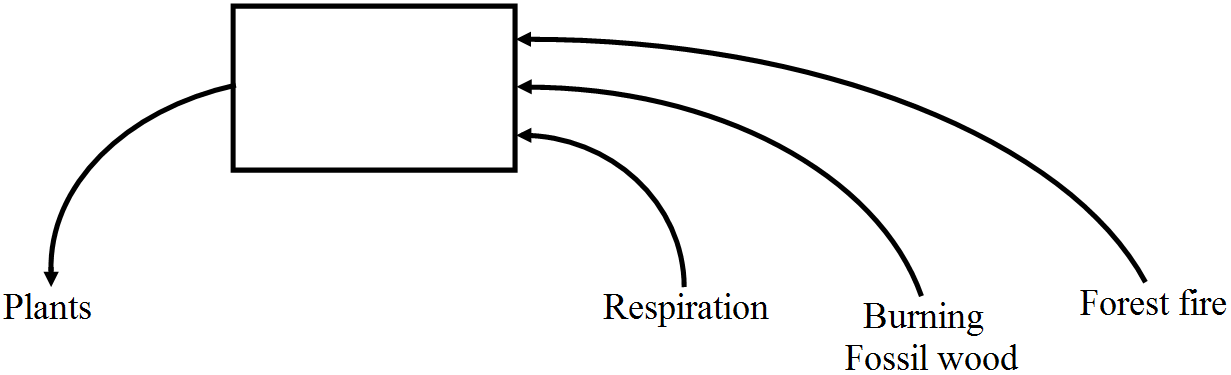
The above diagram shows a simplified biogeochemical cycle.

  1. Name the compound whose cycle is depicted.
  2. In what way do vehicles add this compound to atmosphere?
  3. What adverse effect does its excess have on the environment?
  4. Cite an event which depicts this effect in the modern times.
  5. Suggest two ways of reducing this effect.
Describe the components of an ecosystem
What is the major advantage of producing plants by micropropagation?
Explain the mechanism of sex determination in human being.
Differentiate between the genetic codes given below:
  1. Unambiguous and Universal.
  2. Degenerate and Initiator.
What is meant by microorganisms in industrial products? How do microorganisms help us in making beverages? Explain.
Discuss the various types of positive interactions between species.
  1. Mention the contributions of the following scientists:
  1. Maurice Wilkins and Rosalind Franklin.
  2. Erwin Chargaff.
  1. Draw a double-stranded dinucleotide chain with all the four nitrogen bases. Label the polarity and the components of the dinucleotide.
Answer the following questions:
Explain the role of ovarian hormones in inducing changes in the uterus during menstrual cycle.