Question
Answer the following questions on the basis of given data set:

index date duration item month network network_type
0 0 15/10/14 06:58 34.429 data 2014-11 data data
1 1 15/10/14 06:58 13.000 call 2014-11 Vodafone mobile
2 2 15/10/14 14:46 23.000 call 2014-11 Airtel mobile
3 3 15/10/14 14:48 4.000 call 2014-11 data mobile
4 4 15/10/14 17:27 4.000 call 2014-11 Airtel mobile
5 5 15/10/14 18:55 4.000 call 2014-11 Airtel mobile
6 6 16/10/14 06:58 34.429 call 2014-11 data data
7 7 16/10/14 15:01 602.000 call 2014-11 Vodafone mobile
8 8 16/10/14 15:12 1050.000 call 2014-11 Airtel mobile
9 9 16/10/14 15:30 19.000 call 2014-11 voicemail voicemail
10 10 16/10/14 16:21 1183.000 call 2014-11 Vodafone mobile
11 11 16/10/14 22:18 1.000 sms 2014-11 Airtel mobile
12 12 16/10/14 22:21 1.000 sms 2014-11 Vodafone mobile
13 13 17/10/14 06:58 34.429 data 2014-11 data data

(i) To count the rows in the dataset

(ii) What was the longest phone call / data entry?

(iii) How many seconds of phone calls are recorded in total?

(iv) How many entries are there for each month?

(v) To print the group key

(vi) To count the group keys

(vii) Get the first entry for each month

(viii) Get the sum of the durations per month

(ix) Get the number of dates / entries in each month

(x) What is the sum of durations, for calls only, to each network

(xi) How many calls, sms, and data entries are in each month?

(xii) How many calls, texts, and data are sent per month, split by network_type?

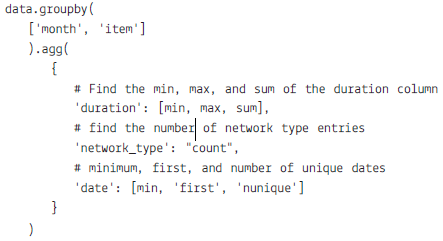
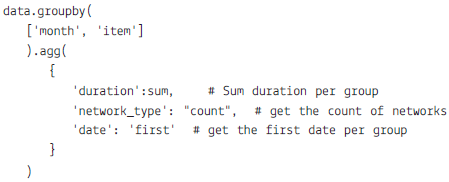
(xiii) Group the data frame by month and item and extract a number of stats from each group

(xiv) Group the data frame by month and item and extract a number of stats from each group
Answer

(i) data['item'].count()

(ii) data['duration'].max()

(iii) data['duration'][data['item'] == 'call'].sum()

(iv) data['month'].value_counts()

(v) data.groupby(['month']).groups.keys()

(vi) len(data.groupby(['month']).groups['2014-11'])

(vii) data.groupby('month').first()

(viii) data.groupby('month')['duration'].sum()

(ix) data.groupby('month')['date'].count()

(x) data[data['item'] == 'call'].groupby('network')['duration'].sum()

(xi) data.groupby(['month', 'item'])['date'].count()

(xii) data.groupby(['month', 'network_type'])['date'].count()

(xiii)

(xiv)

Need a full question paper?

Generate a complete, print-ready paper with questions like this in minutes — across 16+ boards, with answer keys.

Start Generating Free

Similar questions

Write the few negative points related to the usage of technology in our society.
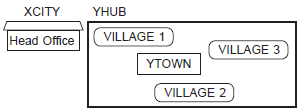
Intelligent Hub India is a knowledge community aimed to uplift the standard of skills and knowledge in the society. It is planning to setup its training centers in multiple towns and villages pan India with its head offices in the nearest cities. They have created a model of their network with a city, a town and 3 villages as follows.

As a network consultant, you have to suggest the best network related solutions for their issues/problems raised in (a) to (d), keeping in mind the distances between various locations and other given parameters.

Shortest distance between various locations:

VILLAGE 1 to YTOWN 2 KM
VILLAGE 2 to YTOWN 1.5 KM
VILLAGE 3 to YTOWN 3 KM
VILLAGE 1 to VILLAGE 2 3.5 KM
VILLAGE 1 to VILLAGE 3 4.5 KM
VILLAGE 2 to VILLAGE 3 3.5 KM
CITY Head Office to YHUB 30 KM

Number of computers installed at various locations are as follows:

YTOWN 100
VILLAGE 1 10
VILLAGE 2 15
VILLAGE 3 15
CITY OFFICE 5

Note:

• In Villages, there are community centers, in which one room has been given as training center to this organization to install computers.

• The organization has got financial support from the government and top IT companies.

(a) Suggest the most appropriate location of the SERVER in the YHUB (out of the 4 locations), to get the best and effective connectivity. Justify your answer.

(b) Suggest the best wired medium and draw the cable layout (location to location) to efficiently connect various locations within the YHUB.

(c) Which hardware device will you suggest to connect all the computers within each location of YHUB?

(d) Which service/protocol will be most helpful to conduct live interactions of Experts from Head Office and people at YHUB locations?

Answer the questions given below based on the given dataset:

(i) To print the name of the libraries required.

(ii) To create the data frame for the above data.

(iii) To Display a summary of the basic information about this DataFrame and its data.

(iv) To display first 3 rows of the DataFramedf.

(v) Select just the 'animal' and 'age' columns from the DataFramedf

(vi) Select the data in rows [3, 4, 8] and in columns ['animal', 'age'].

(vii) Select only the rows where the number of visits is greater than 3.

(viii) Select the rows where the age is missing, i.e. is NaN.

(ix) Select the rows where the animal is a cat and the age is less than 3.

(x) Select the rows the age is between 2 and 4 (inclusive).

(xi) Change the age in row 'f' to 1.5.

(xii) Append a new row 'k' to df with your choice of values for each column. Then delete that row to return the original DataFrame.

(xiii) In the 'animal' column, change the 'snake' entries to 'python'.

Consider the following DEPT and WORKER tables. Write SQL queries for (i) to (iv) and find outputs for SQL queries (v) to (viii): [Delhi 2015]

Table: DEPT

DCODE DEPARTMENT CITY
D01 MEDIA DELHI
D02 MARKETING DELHI
D03 INFRASTRUCTURE MUMBAI
D05 FINANCE KOLKATA
D04 HUMAN RESOURCE MUMBAI

Table: WORKER

WNO NAME DOJ DOB GENDER DCODE
1001 George K 2013-09-02 1991-09-01 MALE D01
1002 Ryma Sen 2012-12-11 1990-12-15 FEMALE D03
1003 Mohitesh 2013-02-03 1987-09-04 MALE D05
1007 Anil Jha 2014-01-17 1984-10-19 MALE D04
1004 Manila Sahai 2012-12-09 1986-11-14 FEMALE D01
1005 R SAHAY 2013-11-18 1987-03-31 MALE D02
1006 Jaya Priya 2014-06-09 1985-06-23 FEMALE D05

Note: DOJ refers to date of joining and DOB refers to date of Birth of workers.

(i) To display Wno, Name, Gender from the table WORKER in descending order of Wno.

(ii) To display the Name of all the FEMALE workers from the table WORKER.

(iii) To display the Wno and Name of those workers from the table WORKER who are born between ‘1987-01-01’ and ‘1991-12-01’.

(iv) To count and display MALE workers who have joined after ‘1986-01-01’.

(v) SELECT COUNT(*), DCODE FROM WORKER GROUP BY DCODE HAVING COUNT(*)>1;

(vi) SELECT DISTINCT DEPARTMENT FROM DEPT;

(vii) SELECT NAME, DEPARTMENT, CITY FROM WORKER W,DEPT D WHERE W.DCODE=D.DCODE AND WNO<1003;

(viii) SELECT MAX(DOJ), MIN(DOB) FROM WORKER;

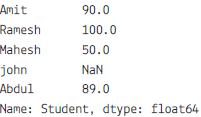
Mr. Sharma is working on pandas series and he is facing some problem while working on Series. Help him with few concepts by answering the given question:
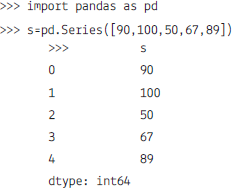
He has created the series:

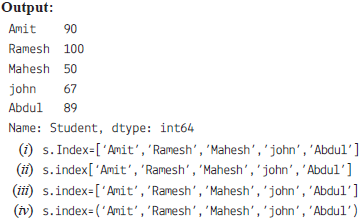
(a) He wanted the given output, which command will be appropriate to do the sam(e)

(b) Which command will give him the output as 5.
(i) s.index
(ii) s.size
(iii) s.values
(iv) None of the mentioned
(c) Assuming the changed structure, answer the question.

Which command will display the given output?
(i) s.head (2) (ii) s.top(2)
(iii) s.head() (iv) s.first(2)
(d) Choose the write output for the given command:
>>>print(stud1.count())
(i) 4 (ii) 3
(iii) 5 (iv) Error
(e) What is the name of the above Series?
(i) Student (ii) s
(iii) int64 (iv) float64
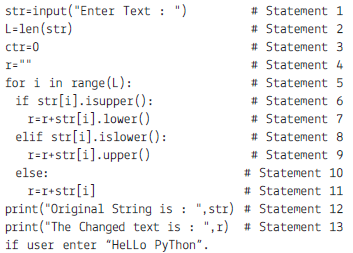
The Teacher wrote the following code. Sanya was absent on the day when the topic was taught. Help her to complete the assignment. Choose the output on the basis of the above code.
(a) Which statement is used to display “HeLLo PyThon”?
(i) Statement 1 (ii) Statement 12
(iii)Statement 13 (iv) No Statement will display.
(b) Which statement will check for capital letters?
(i) Statement 6 (ii) Statement 7
(iii) Statement 8 (iv) Statement 9
(c) Which statement will convert it into capital letters?
(i) Statement 6 (ii) Statement 7
(iii) Statement 8 (iv) Statement 9
(d) Which is iterative Statement?
(i) Statement 5 (ii) Statement 6
(iii) Statement 8 (iv)There is No iterative Statement.
(e) What will be the output of Python code (Statement 1 to Statement 13)
(i) HeLLo PyThon (ii) No Output
(iii) hEllO pYtHON (iv) Hello Python
Choose the correct option.
(a) What is String data-type in Python?
(i) It is written in double quotes only.
(ii) Its value can be changed.
(iii) It is enclosed in square brackets.
(iv) It is immutable data-type.
(b) Ms. Ragini is confused on the way to compare the strings. Help her in choosing the correct statement.
(i) equal() (ii) equals()
(iii) == (iv) compare()
(c) Tejas is confused in the output of the following code. Help him to choose the correct option.
age = 12
txt = "My name is Tejas, I am ", age
print(txt)
(i) ('My name is Tejas, I am ', 12)
(ii) My name is Tejas, and I am 12
(iii) (My name is Tejas, I am , 12)
(iv) [My name is Tejas, I am , 12]
(d) Help mini to choose the correct output of the following Python code.
rollno = 3
name = "Mini "
Average = 88.76
Txt = "My name is {1}, having roll no {0} and scored {2} percent."
print(Txt.format(rollno, name, Average))
(i) My name is ‘Mini ’, having roll no 3 and scored 88.76 percent.
(ii) My name is Mini, having roll no 3 and scored 88.76 percent.
(iii) ‘My name is Mini, having roll no 3 and scored 88.76 percent.’
(iv) (My name is Mini, having roll no 3 and scored 88.76 percent.)
(e) Help Gurnika to choose the correct option for the following Python code.
b = "Hello, World!"
print(b[-5:2])
(i) Hello, World! (ii) orl
(iii) Error (iv) No Output

Consider the table LOANS given below:

Table: LOANS

AccNo Name Loan Amt EMI IntRate Start Date Interest
1001 R.K. Gupta 300000 36 12.00 19-07-2009 1200
1002 S. P. Shanna 500000 48 10.00 22-03-2008 1800
1003 K.P. Jain 300000 36 NULL 08-03-2007 1600
1004 M.P. Yadav 800000 60 10.00 06-12-2008 2250
1005 S.P. Sinlia 200000 36 12.50 03-01-2010 4500
1006 P. Shanna 700000 60 12.50 05-06-2008 3500
1007 K.S. Dhall 500000 48 NULL 05-03-2008 3800

(a) State the command that will give the output as:

Name
S. P. Shanna
K.S. Dhall
M.P. Yadav
P. Shanna
K.S. Dhall

(i) Select name from LOANS where Name >‘D ’;

(ii) Select name from LOANS where AccNo >1001;

(iii) Select name from LOANS where Loan_Amt >= 500000;

(iv) Select name from LOANS where Loan_Amt >500000 order Loan_AmtDESC;

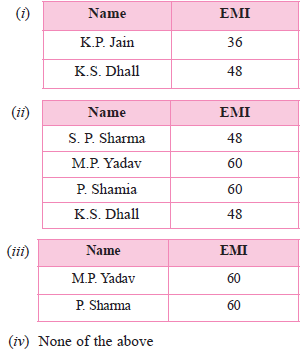
(b) What will be the output of the following command:

Select name, EMI from LOANS where Loan_Amt >500000 and Int_Rate is NULL;

(c) John has given the following command to display the count of all loan holders whose name ends with “Sharma ”:

Select count() from LOANS where Name like ‘Sharma%’;

But he is not getting the desired result. Help him by finding out the correct command fromthe followings:

(i) Select count(*) from LOANS where name Like ‘Sharma%’;

(ii) Select count(*) from LOANS where name Like ‘%Sharma ’;

(iii) Select count( ) from LOANS where name like ‘%sharma ’;

(iv) Select count(Name) from LOANS where name ‘Sharma%’;

(d) State the command to display the maximum Loan_Amt and Cust_Name :-

(i) Select Max(Cust_Name, Loan_Amt) from LOANS;

(ii) Select Cust_Name, max(LoanAmt) from LOANS;

(iii) Select Cust_Name, max(Loan_Amount) from LOANS;

(iv) Select Cust_name, max(Loan_Amt) from LOANS;

(e) Help Ramesh to display the count of all loan holders whose interest is NULL.

(i) Select Count(*) from LOANS where Int_Rate is NULL.

(ii) Select Count() from LOANS where Interest is NULL.

(iii) Select Count(*) from LOANS where Int_rate = NULL;

(iv) Select Count( ) from LOANS where Interest = NULL;

Write SQL queries for (i) to (iv) and find outputs for SQL queries (v) to (vii), which are based on the tables. [CBSE Sample Paper 2018]

Table: Trainer

TID Tname City HireDate Salary
101 Sunaina Mumbai 1998-10-15 90000
102 Anamika Delhi 1994-12-24 80000
103 Deepti Chandigarh 2001-12-21 82000
104 Meenakshi Delhi 2002-12-25 78000
105 Richa Mumbai 1996-01-12 95000
106 Maniprabha Chennai 2001-12-12 69000

Table: Course

CID CNAME FEES STARTDATE TID
C201 AGDCA 12000 2018-07-02 101
C202 ADCA 15000 2018-07-15 103
C203 DCA 10000 2018-10-01 102
C203 DDTP 9000 2018-09-15 104
C205 DHN 20000 2018-08-01 101
C206 O LEVEL 18000 2018-07-25 105

(a) Display the Trainer Name, City and Salary in descending order of their hire date.

(b) To display the TNAME and CITY of Trainer of joined the institute in the month of December 2001.

(c) To display TNAME, HIREDATE,CNAME, STARTDATE from tables TRAINER and COURSE whose FEES is less than or equal to 10000

(d) To display number of trainer from each city (e) select tid, tname,from trainer where city not in(‘delhi’,’mumbai’);

(f) select distinct tid from course;

(g) select tid , count (*), min(fees) from course group by tid having count(*)>1;

(h) Select count(*),sum(fees) from course where startdate <’2018-09-15’;

Consider the following tables GAMES and PLAYER. Write SQL commands for the statements (a) to (d) and give outputs for SQL queries (e1) to (e4)

Relation: GAMES

GCode Game Name Number Prize Money Schedule Date
101 Carom Board 2 5000 3-Jan-2004
102 Badminton 2 12000 12-Dec-2003
103 Table Tennis 4 8000 14-Feb-2004
105 Chess 2 9000 01-Jan-2004
108 Lawn
Tennis
4 25000 19-Mar-2004

Relation: PLAYER

PCode Name Gcode
1 Nabi Ahmad 101
2 Ravi Sahai 108
3 Jatin 101
4 Nazneen 103

(a) To display the name of all Games with their Gcodes

(b) To display details of those games which are having PrizeMoney more than 7000.

(c) To display the content of the GAMES table in ascending order of ScheduleDate.

(d) To display sum of PrizeMoney for each of the Number of participation groupings (as shown in column Number)

(e1) Select COUNT(DISTINCT Number) FROM GAMES;

(e2) Select MAX(ScheduleDate),MIN(ScheduleDate) FROM GAMES;

(e3) Select SUM(PrizeMoney) FROM GAMES;

(e4) Select DISTINCT Gcode FROM PLAYER;