Question
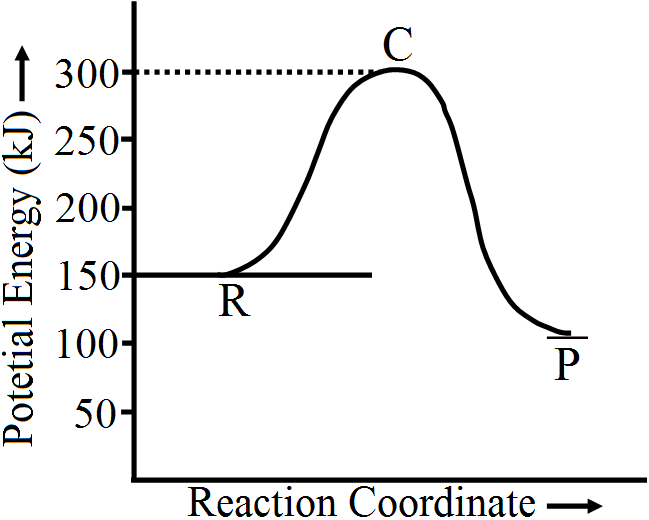
Answer the following questions on the basis of the given plot of potential energy vs reaction coordinate:

  1. What is the threshold energy for the reaction?
  2. What is the activation energy for forward reaction?
  3. What is the activation energy for backward reaction?
  4. What is enthalpy change for the forward reaction?
Answer

  1. Threshold energy for the reaction = 300KJ mol-1.
  2. Activation energy for the forward reaction = 300 - 150 = 150KJ mol-1.
  3. Activation energy for the backward reaction = 300 - 100 = 200KJ mol-1.
  4. Enthalpy change for the forward reaction $\Delta_\text{t}\text{H}$ = 100 - 150 = - 50KJ mol-1.

Need a full question paper?

Generate a complete, print-ready paper with questions like this in minutes — across 16+ boards, with answer keys.

Start Generating Free

Similar questions

When a chromite ore (A) is fused with sodium carbonate in free excess of air and the product is dissolved in water, a yellow solution of compound (B) is obtained. After treatment of this yellow solution with sulphuric acid,compound (C) can be crystallised from the solution. When compound (C) is treated with KCl, orange crystals of compound (D) crystallise out. Identify A to D and also explain the reactions.
  1. What type of isomerism is shown by the complex [Co(NH3)6] [Cr(CN)6]?
  2. Why a solution of [Ni(H2O)6]2+ is green while a solution of [Ni(CN)4]2– is colourless?(At. no. of Ni = 28)
  3. Write the IUPAC name of the following complex: [Co(NH3)5(CO3)]Cl.
A copper-silver cell is set up. The copper ion concentration in it is 0.10 M. The concentration of silver ion is not known. The cell potential measured 0.422 V. Determine the concentration of silver ion in the cell.
$\text{Given: E}^{o}_{\text{Ag}^{+}/\text{Ag}}=+0.80\text{V},\text{E}^{o}_{\text{Cu}^{2+}/\text{Cu}}=+0.34\text{V}.$
Write the structures of the major products expected from the following reactions:
a. Mononitration of 3-methylphenol
b. Dinitration of 3-methylphenol
c. Mononitration of phenyl methanoate
Write IUPAC names of the following coordination compounds:
  1. [Co(NH3)6]Cl3
  2. [Co(NH3)5Cl]Cl2
  3. K3[Fe(CN)6]
  1. The cell in which the following reaction occurs:

2 Fe3+ (aq) + 2 I- (aq) $\longrightarrow$ 2 Fe2+ (aq) + I2 (s)

has $\text{E}^0_{\text{cell}}$ = 0·236 V at 298 K. Calculate the standard Gibbs energy of the cell reaction. (Given : 1 F = 96,500 C mol-1)

  1. How many electrons flow through a metallic wire if a current of 0·5 A is passed for 2 hours? (Given : 1 F = 96,500 C mol-1)
A solution containing 8 g of a substance in 100 g of diethyl ether boils at 36,86° C, whereas pure ether boils at 35.60° C. Determine the molecular mass of the solute. (For ether Kb = 2.02 K kg mol–1).
Write electrode reactions taking place in:
  1. Ni–Cd cell.
  2. Lead Acid Accumulator.
Define conductivity and molar conductivity for the solution of an electrolyte.
Discuss their variation with concentration.
How can phenol be converted to aspirin?