Question
Answer the following questions, which help you understand the difference between Thomson’s model and Rutherford’s model better.
Is the average angle of deflection of α-particles by a thin gold foil predicted by Thomson’s model much less, about the same, or much greater than that predicted by Rutherford’s model?
Answer

about the same
The average angle of deflection of α-particles by a thin gold foil predicted by Thomson's model is about the same size as predicted by Rutherford's model. This is because the average angle was taken in both models.

Need a full question paper?

Generate a complete, print-ready paper with questions like this in minutes — across 16+ boards, with answer keys.

Start Generating Free

Similar questions

The threshold wavelength of a metal is $\lambda_0.$ Light of wavelength slightly less $\tan \lambda_0.$ is incident on an insulated plate made of this metal. It is found that photoelectrons are emitted for some time and after that the emission stops. Explain.
If a spherical mirror is dipped in water, does its focal length change?
Write following radiations in descending order of wavelengths:X-rays, Radio waves, Ultraviolet waves, Gamma rays.
The value of photoelectric current depend on which factor at constant frequency?
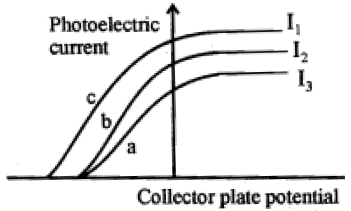
The figure shows a plot of three curves a, b, c showing the variation of photocurrent vs collector plate potential for three different intensities I1, I2 and I3 having frequencies $\sqrt{1} ,\sqrt{2}$ and $\sqrt{3}$, respectively incident on a photosensitive surface.

Point out the two curves for which the incident radiations have same frequency but different intensities.


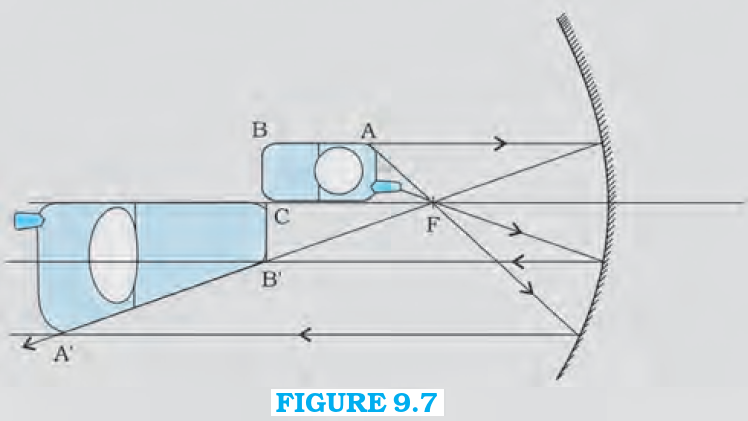
A mobile phone lies along the principal axis of a concave mirror, as shown in Fig. 9.7. Show by suitable diagram, the formation of its image. Explain why the magnification is not uniform. Will the distortion of image depend on the location of the phone with respect to the mirror?
Image
What is the direction of a current carrying solenoid when suspended freely in earth's horizontal plane?
Why self-induction is called inertia of electricity?
What is the geometrical shape of equipotential surfaces due to a single isolated charge?
What is the average friction force when a person has a usual 1km walk?