Define the distance of closest approach. An α-particle of kinetic energy 'K' is bombarded on a thin gold foil. The distance of the closest approach is 'r'. What will be the distance of closest approach for an α-particle of double the kinetic energy?
Question types
Atoms question types
403 questions across 7 question groups — pick any mix to generate a Physics paper with step-by-step answer keys.
403
Questions
7
Question groups
5
Question types
01
2 Marks Questions
50 Q→023 Marks Question
47 Q→031 Marks Question
14 Q→044 Marks Questions
12 Q→05M.C.Q (1 Marks)
227 Q→06Assertion (A) & Reason (B) MCQ
18 Q→075 Marks Questions
35 Q→Sample Questions
Atoms questions
One sample from each question group in this chapter. Select any group above to see the full set with answer keys.
View full solution →
The ground state energy of hydrogen atom is –13.6 eV. What are the kinetic and potential energies of the electron in this state?
The radius of the innermost electron orbit of a hydrogen atom is 5.3×10⁻¹¹ m. What are the radii of the n = 2 and n = 3 orbits?
If Bohr’s quantisation postulate (angular momentum $=\text{nh}/\pi$) is a basic law of nature, it should be equally valid for the case of planetary motion also. Why then do we never speak of quantisation of orbits of planets around the sun?
View full solution →Suppose you are given a chance to repeat the alpha-particle scattering experiment using a thin sheet of solid hydrogen in place of the gold foil. (Hydrogen is a solid at temperatures below 14 K.) What results do you expect?
Obtain the first Bohr’s radius and the ground state energy of a muonic hydrogen atom [i.e., an atom in which a negatively charged muon $(\mu)$ of mass about 207me orbits around a proton].
View full solution →A difference of 2.3 eV separates two energy levels in an atom. What is the frequency of radiation emitted when the atom make a transition from the upper level to the lower level?
In accordance with the Bohr’s model, find the quantum number that characterises the earth’s revolution around the sun in an orbit of radius 1.5 × 10¹¹ m with orbital speed 3 × 10⁴ m/s. (Mass of earth = 6.0 × 1024 kg.)
What is the shortest wavelength present in the Paschen series of spectral lines?
The total energy of an electron in the first excited state of the hydrogen atom is about –3.4 eV.
- What is the kinetic energy of the electron in this state?
- What is the potential energy of the electron in this state?
- Which of the answers above would change if the choice of the zero of potential energy is changed?
Choose the correct alternative from the clues given at the end of the each statement:
In the ground state of .......... electrons are in stable equilibrium, while in .......... electrons always experience a net force. (Thomson’s model/ Rutherford’s model.)
In the ground state of .......... electrons are in stable equilibrium, while in .......... electrons always experience a net force. (Thomson’s model/ Rutherford’s model.)
Answer the following questions, which help you understand the difference between Thomson’s model and Rutherford’s model better.
Keeping other factors fixed, it is found experimentally that for small thickness t, the number of α-particles scattered at moderate angles is proportional to t. What clue does this linear dependence on t provide?
Choose the correct alternative from the clues given at the end of the each statement:
An atom has a nearly continuous mass distribution in a .......... but has a highly non-uniform mass distribution in .......... (Thomson’s model/ Rutherford’s model.)
An atom has a nearly continuous mass distribution in a .......... but has a highly non-uniform mass distribution in .......... (Thomson’s model/ Rutherford’s model.)
Answer the following questions, which help you understand the difference between Thomson’s model and Rutherford’s model better.
Is the average angle of deflection of α-particles by a thin gold foil predicted by Thomson’s model much less, about the same, or much greater than that predicted by Rutherford’s model?
Is the average angle of deflection of α-particles by a thin gold foil predicted by Thomson’s model much less, about the same, or much greater than that predicted by Rutherford’s model?
Answer the following questions, which help you understand the difference between Thomson’s model and Rutherford’s model better.
In which model is it completely wrong to ignore multiple scattering for the calculation of average angle of scattering of α-particles by a thin foil?
In which model is it completely wrong to ignore multiple scattering for the calculation of average angle of scattering of α-particles by a thin foil?
When the electron orbiting in hydrogen atom in its ground state moves to the third excited state, show how the de Broglie wavelength associated with it would be affected.
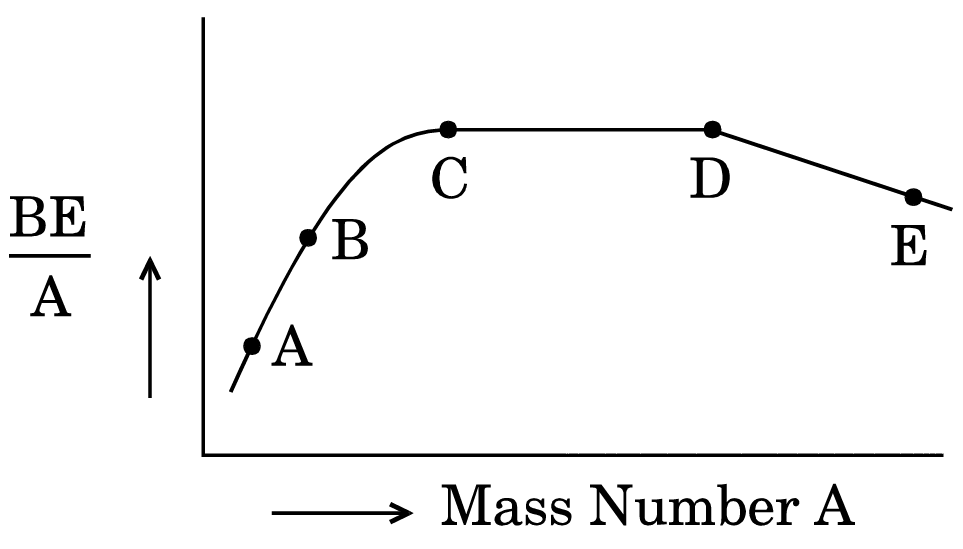
- The figure shows the plot of binding energy (BE) per nucleon as a function of mass number A. The letters A, B, C, D and E represent the positions of typical nuclei on the curve. Point out, giving reasons, the two processes (in terms of A, B, C, D and E), one of which can occur due to nuclear fission and the other due to nuclear fusion.
- Identify the nature of the radioactive radiations emitted in each step of the decay process given below.
$^{A}_{Z}\text{X}\rightarrow ^{A-4}_{Z-2}\text{Y}\rightarrow ^{A-4}_{Z-1}\text{W}$.
In the study of Geiger-Marsdon experiment on scattering of α particles by a thin foil of gold, draw the trajectory ofα−particles in the Coulomb field of target nucleus. Explain briefly how one gets the information on the size of the nucleus from this study. From the relation R = R0 A1/3, where R0 is constant and A is the mass number of the nucleus, show that nuclear matter density is independent of A.
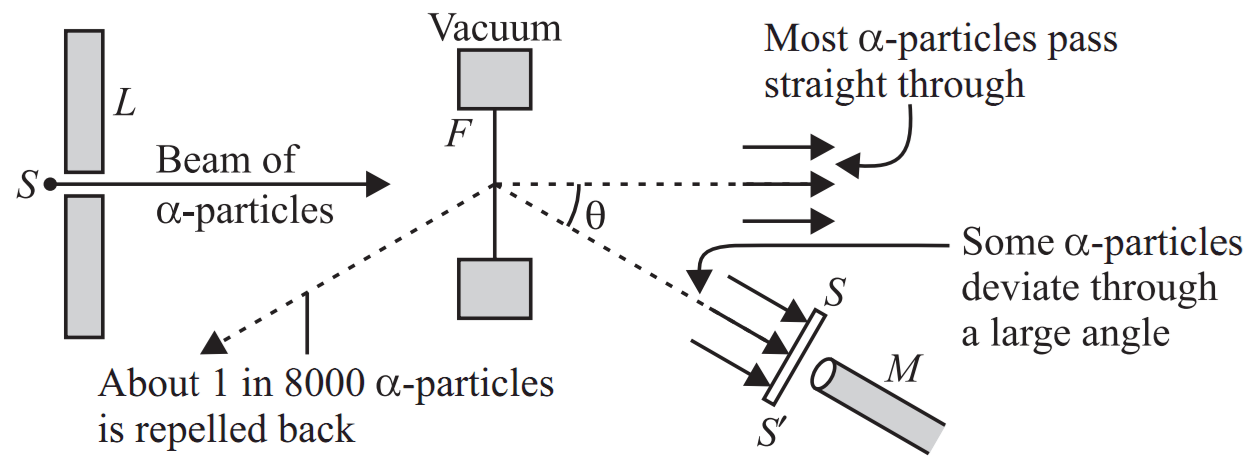

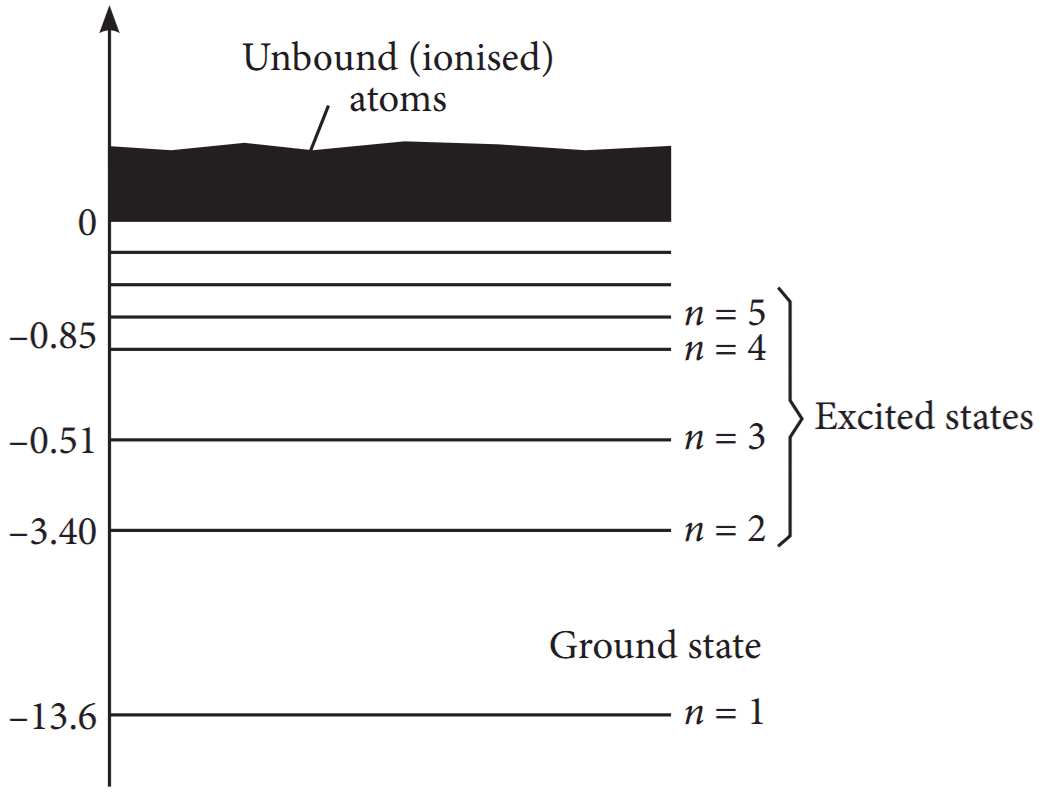
Which of the following statements is not correct according to Rutherford model?
- AMost of the space inside an atom is empty.
- BThe electrons revolve around the nucleus under the influence of coulomb force acting on them.
- CMost part of the mass of the atom and its positive charge are concentrated at its centre.
- DThe stability of atom was established by the model.
Consider aiming a beam of free electrons towards free protons. When they scatter, an electron and a proton cannot combine to produce a H-atom:
- ABecause of energy conservation.
- BWithout simultaneously releasing energy in the from of radiation.
- CBecause of momentum conservation.
- DBecause of angular momentum conservation.
An ionised H-molecule consists of an electron and two protons. The protons are separated by a small distance of the order of angstrom. In the ground state:
- AThe electron would not move in circular orbits.
- BThe energy would be (2)4 times that of a H-atom.
- CThe electrons, orbit would go arround the protons.
- DThe molecule will soon decay in a proton and a H-atom.
The concept of stationary orbits was proposed by:
- AJ. J. Thomson
- BRutherford
- CNeil Bohr
- DLNewton
In the Geiger-Marsden experiment, the force that scatters particles is:
- ANuclear force
- BCoulomb force
- CBoth A and B
- DGravitational force
For question two statements are given-one labelled Assertion (A) and the other labelled Reason (R). Select the correct answer to these questions from the codes (a), (b), (c) and (d) as given below.
- Both A and R are true, and R is the correct explanation of A.
- Both A and R are true, but R is NOT the correct explanation of A.
- A is true, but R is false.
- A is false and R is also false.
Assertion (A): Fraunhofer lines are observed in the spectrum of the sun.
Reason (R): The different elements have different spectra.
For question two statements are given-one labelled Assertion (A) and the other labelled Reason (R). Select the correct answer to these questions from the codes (a), (b), (c) and (d) as given below.
View full solution →- Both A and R are true, and R is the correct explanation of A.
- Both A and R are true, but R is NOT the correct explanation of A.
- A is true, but R is false.
- A is false and R is also false.
Assertion (A): The positively charged nucleus of an atom has a radius of almost 10-15m.
Reason (R): In
$\alpha$-particle scattering experiment, the distance of closest approach for $\alpha$-particles is 10-15m.For question two statements are given-one labelled Assertion (A) and the other labelled Reason (R). Select the correct answer to these questions from the codes (a), (b), (c) and (d) as given below.
Reason (R): The band spectrum consists of coloured bands of light on a dark background.
- Both A and R are true, and R is the correct explanation of A.
- Both A and R are true, but R is NOT the correct explanation of A.
- A is true, but R is false.
- A is false and R is also false.
Reason (R): The band spectrum consists of coloured bands of light on a dark background.
For question two statements are given-one labelled Assertion (A) and the other labelled Reason (R). Select the correct answer to these questions from the codes (a), (b), (c) and (d) as given below.
- Both A and R are true, and R is the correct explanation of A.
- Both A and R are true, but R is NOT the correct explanation of A.
- A is true, but R is false.
- A is false and R is also false.
Assertion (A): A tube light emits white light
Reason (R): Emission of light in a tube takes place at a very high temperature.For question two statements are given-one labelled Assertion (A) and the other labelled Reason (R). Select the correct answer to these questions from the codes (a), (b), (c) and (d) as given below.
Reason (R): Energy is a scalar quantity. It can have positive or negative value.
- Both A and R are true, and R is the correct explanation of A.
- Both A and R are true, but R is NOT the correct explanation of A.
- A is true, but R is false.
- A is false and R is also false.
Reason (R): Energy is a scalar quantity. It can have positive or negative value.
The gravitational attraction between electron and proton in a hydrogen atom is weaker than the coulomb attraction by a factor of about 10–40. An alternative way of looking at this fact is to estimate the radius of the first Bohr orbit of a hydrogen atom if the electron and proton were bound by gravitational attraction. You will find the answer interesting.
A 12.5 eV electron beam is used to bombard gaseous hydrogen at room temperature. What series of wavelengths will be emitted?
Obtain an expression for the frequency of radiation emitted when a hydrogen atom de-excites from level n to level (n – ncy of revolution of the electron in the orbit.
A hydrogen atom initially in the ground level absorbs a photon, which excites it to the n = 4 level. Determine the wavelength and frequency of photon.
- Using the Bohr’s model calculate the speed of the electron in a hydrogen atom in the n = 1, 2, and 3 levels.
- Calculate the orbital period in each of these levels.
Generate a Atoms paper free
Pick question groups from the list above, set marks and difficulty, and export a branded PDF with step-by-step answer keys. First 3 chapters free — no signup.