Question
Answer the following questions:
Would the maximum possible magnetisation of a paramagnetic sample be of the same order of magnitude as the magnetisation of a ferromagnet?
Answer

The maximum possible maqnetisanon of a paramagnetic sample can be of the sarne order of magnitude as the magnetisation of a ferromagnet. This requires high magnetising fields for saturation.

Need a full question paper?

Generate a complete, print-ready paper with questions like this in minutes — across 16+ boards, with answer keys.

Start Generating Free

Similar questions

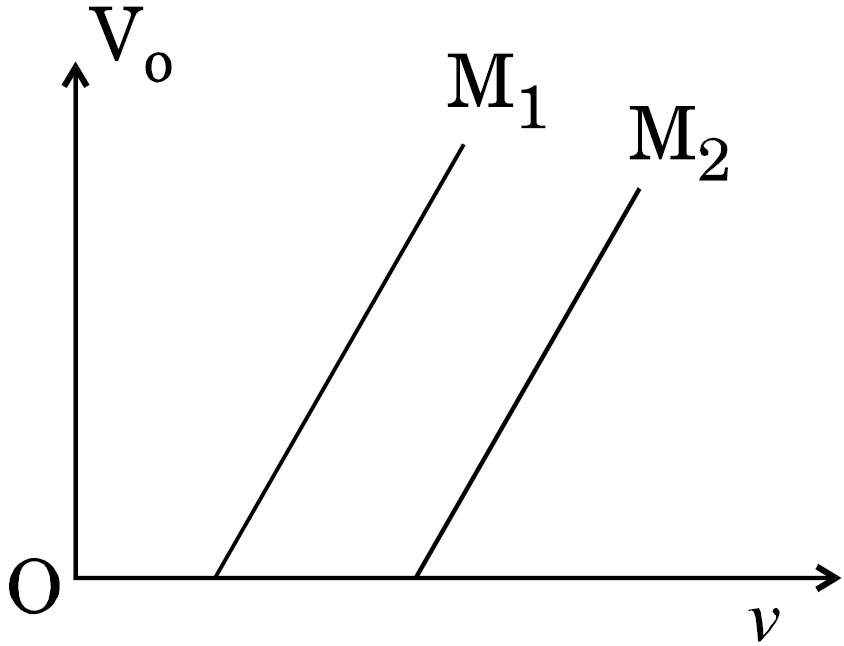
The variation of the stopping potential $(V_0)$ with the frequency (v) of the light incident on two different photosensitive surfaces $M_1$ and $M_2$ is shown in the figure. Identify the surface which has greater value of the work function.
When a p-type impurity is doped in a semiconductor, a large number of holes are created. This does not make the semiconductor charged. But when holes diffluse from the p-side to the n-side in a p-n junction, the n-side gets positively charged. Explain.
Define the term 'drift velocity' of charge carriers in a conductor and write its relationship with the current flowing through it.
How does the value of capacitance depend on the condition of the dielectric material when the space between the plates of a parallel plate capacitor is partially filled with a dielectric material?
Magnetic scalar potential is defined as$\text{U}(\overrightarrow{\text{r}_2})-\text{U}(\overrightarrow{\text{r}_1})=-\int\limits^{\vec{\text{r}}_2}_{\vec{\text{r}_1}} \vec{\text{B}}.\text{d}\vec{\text{l}}.$
Apply this equation to a closed curve enclosing a long atraicht wire. The RHS of the above equation is then $-{\mu}_\text{o} \text{ i}$ by Ampere's law. We see that $\text{U}(\vec{\text{r}_2})\neq\text{U}(\vec{\text{r}_1})$ even when $\vec{\text{r}_2}=\vec{\text{r}_1}.$Can we have a magnetic acalar potential in this case?
How does the fringe width of interference fringes change, when the whole apparatus of Young’s experiment is kept in a liquid of refractive index 1.3?
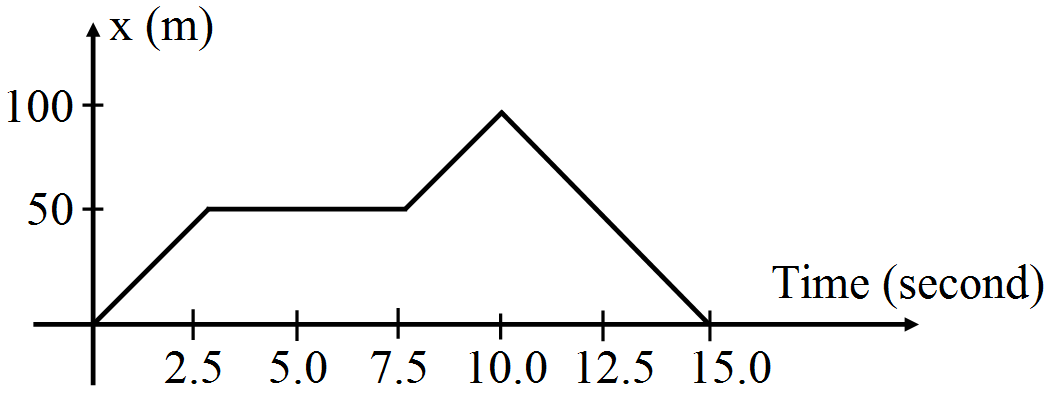
Figure shows the graph of the x-coordinate of a particle going along the X-axis as a function of time. Find:
  1. The average velocity during 0 to 10s.
  2. Instantaneous velocity at 2, 5, 8 and 12s.
Write dimensional formula and unit of magnetic permeability of vacuum.
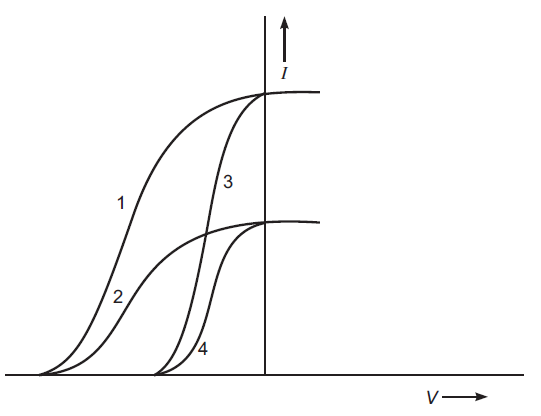
The given graph shows the variation of photo-electric current (I) versus applied voltage (V) for two different photosensitive materials and for two different intensities of the incident radiation. Identify the pairs of curves that correspond to different materials but same intensity radiation.
What pre-information would you require to convert a galvanometer into ammeter or voltmeter?