Questions

1 Marks Question

Take a timed test

43 questions · self-marked practice — reveal the answer and mark yourself.

Question 11 Mark
Answer the following questions regarding earth’s magnetism:
In which direction would a compass free to move in the vertical plane point to, if located right on the geomagnetic north or south pole?
Answer
A compass is free to move in a horizontal plane, while, the earth's field is exactly vertical at the magnetic poles. So the compass can point in any direction there.
View full question & answer
Question 21 Mark
Answer the following questions regarding earth’s magnetism:
Geologists claim that besides the main magnetic N-S poles, there are several local poles on the earth’s surface oriented in different directions. How is such a thing possible at all?
Answer
The earth's field is only approximately a dipole field. Local north-south poles may arise due to, for instance, magnetised mineral deposits found on the surface of the earth.
View full question & answer
Question 31 Mark
Answer the following questions:
Magnetic field lines are always nearly normal to the surface of a ferromagnet at every point. (This fact is analogous to the static electric field lines being normal to the surface of a conductor at every point.) Why?
Answer
The permeability of a ferromagnetic material is not less than one. It is always greater than one. Hence, magnetic field lines are always nearly normal to the surface of such materials at every point.
View full question & answer
Question 41 Mark
The magnetic moment vectors $\mu_\text{s}$ and $\mu_\text{l}$ associated with the intrinsic spin angular momentum S and orbital angular momentum l, respectively, of an electron are predicted by quantum theory (and verified experimentally to a high accuracy) to be given by:
$\mu_\text{s}=-(\text{e}/\text{m})\text{S}.$
$\mu_\text{l}=-(\text{e}/2\text{m})\text{l}.$
Which of these relations is in accordance with the result expected classically? Outline the derivation of the classical result.
Answer
The magnetic moment associated with the intrinsic spin angular momentum and the orbital angular momentum.
View full question & answer
Question 51 Mark
Answer the following questions:
If a toroid uses bismuth for its core, will the field in the core be (slightly) greater or (slightly) less than when the core is empty?
Answer
Bisrnuth is a diamagnetic substance. Hence, a toroid with a bismuth core has a magnetic field slightly greater than a toroid whose core is empty.
View full question & answer
Question 61 Mark
Answer the following questions:
The earth’s magnetic field varies from point to point in space. Does it also change with time? If so, on what time scale does it change appreciably?
Answer
Earth's magnetic field does changes with time and, the time scale for appreciable change is roughly a few hundred years. Though the change is in much smaller scale of few years, the variations are not completely negligible.
View full question & answer
Question 71 Mark
Answer the following questions regarding earth’s magnetism:
If you made a map of magnetic field lines at Melbourne in Australia, would the lines seem to go into the ground or come out of the ground?
Answer
Melborne in Australia is situated at the southern hemisphere of the globe where, north pole of the earth's magnetic field lies.
Hence, magnetic field lines, due to the earth's magnetism would seem to come out of the ground.
View full question & answer
Question 81 Mark
Answer the following questions regarding earth’s magnetism:
The angle of dip at a location in southern India is about 18° Would you expect a greater or smaller dip angle in Britain?
Answer
Since Britain is closer to the magnetic north pole, we can expect a greater angle of dip in Britain. It's magnitude is about 70° in Britain.
View full question & answer
Question 91 Mark
Answer the following questions:
The earth may have even reversed the direction of its field several times during its history of 4 to 5 billion years. How can geologists know about the earth’s field in such distant past?
Answer
Earth's magnetic field gets weakly 'recorded' in certain rocks during solidification. Analysis of this rock magnetism offers clues to geomagnetic history.
View full question & answer
Question 101 Mark
Answer the following questions:
Why is diamagnetism, in contrast, almost independent of temperature?
Answer
The induced dipole moment in a diamagnetic substance is always opposite to the magnetising field. Hence, the internal motion of the atoms (which is related to the temperature) does not affect the diamagnetism of a material.
View full question & answer
Question 111 Mark
Answer the following questions:
The earth’s core is known to contain iron. Yet geologists do not regard this as a source of the earth’s magnetism. Why?
Answer
Earth's core contains molten iron (which is the phase of the iron at the high temperatures of the core) which, is not ferromagnetic due to temperature beyond Curie temp.
Note: Ferromagnetic subtances are those which gets strongly magnetised when placed in external magnetic field.
View full question & answer
Question 121 Mark
Answer the following questions:
Would the maximum possible magnetisation of a paramagnetic sample be of the same order of magnitude as the magnetisation of a ferromagnet?
Answer
The maximum possible maqnetisanon of a paramagnetic sample can be of the sarne order of magnitude as the magnetisation of a ferromagnet. This requires high magnetising fields for saturation.
View full question & answer
Question 131 Mark
Answer the following questions:
Why does a paramagnetic sample display greater magnetisation (for the same magnetising field) when cooled?
Answer
Owing to therandorn thermal motion of rnolecules, the allqnments of dipoles get disrupted at high temperatures. on cooling, this disruption is reduced. Hence, a pararnaqnetlc sample displays greater magnetisation when cooled.
View full question & answer
Question 141 Mark
Answer the following questions:
The charged currents in the outer conducting regions of the earth’s core are thought to be responsible for earth’s magnetism. What might be the ‘battery’ (i.e., the source of energy) to sustain these currents?
Answer
Radioactivity may be one of the possible sources for the charged current in the outer conducting regions of the earth's core which is thought to be responsible for earth's magnetism.
View full question & answer
Question 151 Mark
Answer the following questions:
The earth’s field departs from its dipole shape substantially at large distances (greater than about 30,000 km). What agencies may be responsible for this distortion?
Answer
At large distance, the field gets modified due to the field of ions in motion (in the earth's ionosphere). The field of these ions, in turn, is sensitive to extraterrestrial disturbances such as the solar wind. Hence, there is distortion in the earth's field.
View full question & answer
Question 161 Mark
Answer the following questions:
Is the permeability of a ferromagnetic material independent of the magnetic field? If not, is it more for lower or higher fields?
Answer
The permeability of ferromagnetic materials is not independent of the applied magnetic field. It is greater for a lower field and vice versa.
View full question & answer
Question 171 Mark
In what way is the behaviour of a diamagnetic material different from that of a paramagnetic, when kept in an external magnetic field.
Answer
A diamagnetic specimen would move towards the weaker region of the field while a paramagnetic specimen would move towards the stronger region./A diamagnetic specimen is repelled by a magnet while a paramagnetic specimen moves towards the magnet./The paramagnetic get aligned along B and the diagrammatic perpendicular.
View full question & answer
Question 191 Mark
Steel is preferred for making permanent magnets whereas soft iron is preferred for making electromagnets. Give one reason.
Answer
Steel has Higher retentivity/Higher coercivity/Higher permeability/Large area of (B-H curve).
Alternate Answer
Soft iron has lower retentivity/Lower coercivity/Lower permeability/Smaller area of (B-H curve).
View full question & answer
Question 211 Mark
At a place, the horizontal component of earth's magnetic field is B and angle of dip is 60°. What is the value of horizontal component of the earth's magnetic field at equator?
Answer
$B_H=B_E\text{ }\cos\delta$

$B=B_E\text{ }\cos\text{ }60^\circ\Rightarrow B_E=2B$

At equator $\delta=0^\circ$

$\therefore\text{ }B_H=2B\cos\text{ }0=2B$
View full question & answer
Question 221 Mark
What are permanent magnets? Give one example.
Answer
Substances, which at room temperature, retain their ferromagnetic property for a long period of time are called permanent magnets. Alnico, cobalt, steel and ticonal.
View full question & answer
Question 231 Mark
The horizontal component of the earth's magnetic field at a place is B and angle of dip is 60°.What is the value of vertical component of earth's magnetic field at equator?
Answer
Zero.
View full question & answer
Question 241 Mark
The permeability of a magnetic material is 0.9983. Name the type of magnetic materials it represents.
Answer
Diamagnetic.
Alternate Answer
Ferromagnetic.
View full question & answer
Question 251 Mark
Why should the material used for making permanent magnets have high coercivity?
Answer
Magnetisation is not easily erased by stray magnetic field/minor mechanical damage/temperature variation.
View full question & answer
Question 261 Mark
The vertical component of Earth’s magnetic field at a place is $ \sqrt{3}$ times the horizontal component. What is the value of angle of dip at this place?
Answer
$\tan\theta=\frac{B_{v}}{B_{H}}=\sqrt{3}$$\theta = 60^\circ$
Alternate Answer
$\frac{\pi}{3}\text{radians}$
Alternate Answer
$\tan^{-1}\sqrt{3}$
View full question & answer
Question 271 Mark
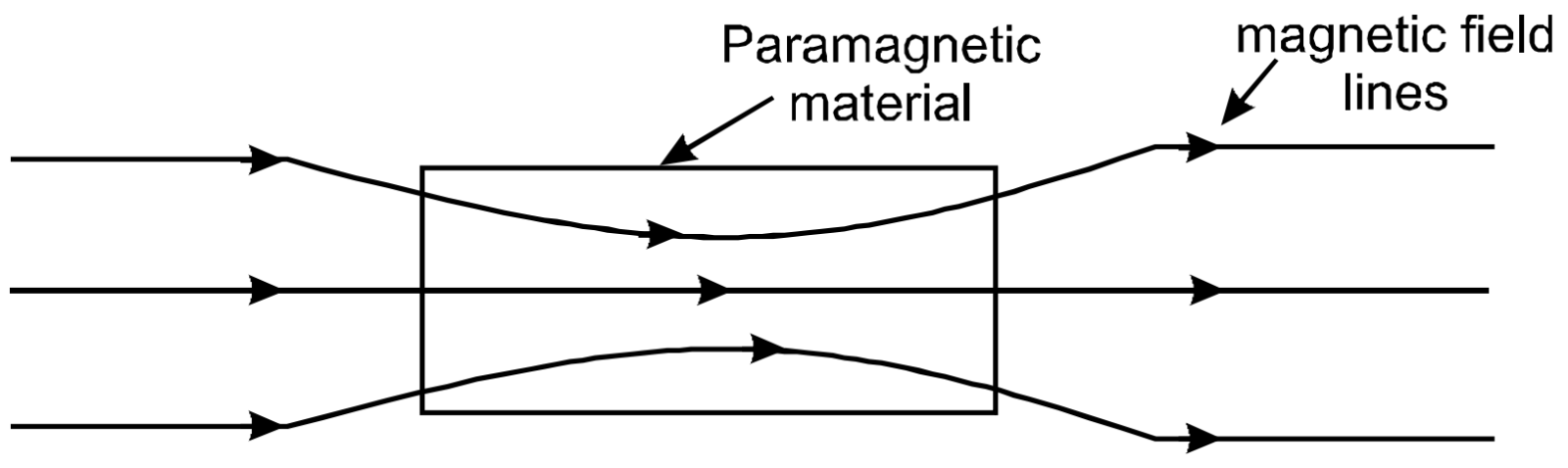
The susceptibility of a magnetic material is 0.9853. Identify the type of magnetic material. Draw the modification of the field pattern on keeping a piece of this material in a uniform magnetic field.
Answer
$\chi_\text{m} = 0.9853$The given magneticmaterial is paramagnetic in nature.
View full question & answer
Question 281 Mark
Can we have a single north pole? A single south pole?
Answer
No we cannot have single pole magnet.A magnet always has two poles.
View full question & answer
Question 291 Mark
Do two distinct poles actually exist at two nearby points in a magnetic dipole?
Answer
No, in a magnetic dipole there are only two distinct poles that are at the ends.
View full question & answer
Question 301 Mark
Magnetic scalar potential is defined as$\text{U}(\overrightarrow{\text{r}_2})-\text{U}(\overrightarrow{\text{r}_1})=-\int\limits^{\vec{\text{r}}_2}_{\vec{\text{r}_1}} \vec{\text{B}}.\text{d}\vec{\text{l}}.$
Apply this equation to a closed curve enclosing a long atraicht wire. The RHS of the above equation is then $-{\mu}_\text{o} \text{ i}$ by Ampere's law. We see that $\text{U}(\vec{\text{r}_2})\neq\text{U}(\vec{\text{r}_1})$ even when $\vec{\text{r}_2}=\vec{\text{r}_1}.$Can we have a magnetic acalar potential in this case?
Answer
Yes we can have magnetic potential scalar in this case.
View full question & answer
Question 321 Mark
What are the factors which are considered for an electromagnet? Give an example.
Answer
For an electromagnet, the substance should have high retentivity but low coercivity. Soft iron is such a substance.
View full question & answer
Question 331 Mark
State with reason, whether the following statement is true or false? "The product of magnetic susceptibility and absolute temperature χT is constant for a paramagnetic material".
Answer
Yes, According to Curie law, $\text{X}\propto\frac{1}{\text{T}}.\text{X}^{\text{T}}=$ constant is true for paramagnetic substances.
View full question & answer
Question 341 Mark
A bar magnet has magnetic moment M. It is divided into n- equal parts. Will each part be a magnetic dipole? What will be the magnetic moment of each part?
Answer
Yes, each part will be a magnetic dipole. The dipole moment of each part will be equal to $\frac{\text{m}}{\text{n}}.$
View full question & answer
Question 351 Mark
Which has larger susceptibility: Iron or copper?
Answer
Iron is a ferromagnetic substance while and copper is diamagnetic, the susceptibility of iron is much larger.
View full question & answer
Question 361 Mark
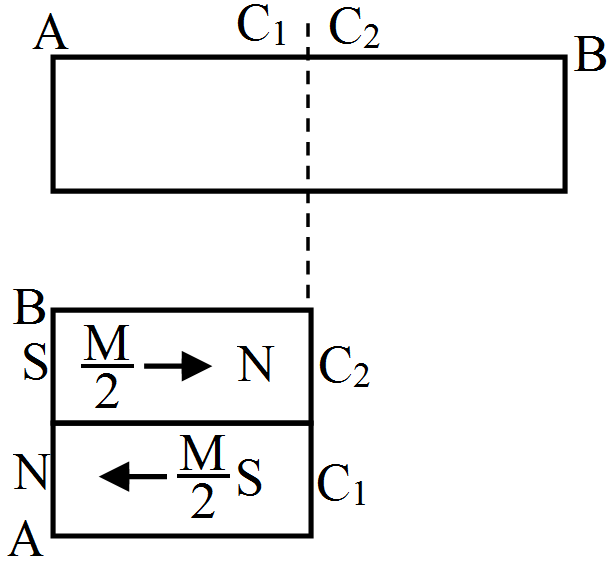
A hypothetical bar magnet (AB) is cut into two equal parts. One part is now kept over the other, so that the pole $C_2$ is above $C_1$. If M is the magnetic moment of the original magnet, what would be the magnetic moment of the combination, so formed?
Answer
The magnetic moment of each half bar magnet is $\frac{\text{M}}{2}$ but oppositely directed, so net magnetic moment of combination =$\frac{\text{M}}{2}-\frac{\text{M}}{2}$ (zero).
View full question & answer
Question 371 Mark
If the magnetic field outside a copper box is suddenly changed, what happens to the magnetic field inside the box? Such low-resistivity metals are used to form enclosures which shield objects inside them against varying magnetic fields.
Answer
Current on its surface changes but no magnetic feild passes through it as magnetic field inside the copper box is zero.
View full question & answer
Question 381 Mark
The coercive force for a certain permanent magnet is $4.0 × 10^4\ A/m.$Thia magnet is placed inside a long solenoid of 40 turns/cm and a current is passed in the solenoid to demagnetise it completely. Find the current.
Answer
$\text{B}=\mu_0\text{ni},\ \text{H}=\frac{\text{B}}{\mu_0}$
Given n = 40 turns/cm = 4000 turns/m
$⇒ H = ni$
$H = 4 × 10^4\ A/m$
$\Rightarrow\text{i}=\frac{\text{H}}{\text{n}}=\frac{4\times10^4}{4000}=10\text{A}.$
View full question & answer
Question 391 Mark
A long solenoid is fabricated by closely winding a wire of radius 0.5mm over a cylindrical nonmagnetic frame so that the successive turns nearly touch each other. What would be the magnetic field B at the centre of the solenoid if it carries a current of 5A?
Answer

r = 0.5mm,
i = 5A,
$\text{B}=\mu_0\text{ni}$ (for a solenoid)
Width of each turn $= 1 mm = 10^{-3}m$
No. of turns $\text{n}=\frac{1}{10^{-3}}=10^3$
So, $\text{B}=4\pi\times10^{-7}\times10^3\times5=2\pi\times10^{-3}\text{T}$
View full question & answer
MCQ 401 Mark
To measure the magnetic moment of a bar magnet, one may use:
  • A
    A tangent galvanometer.
     
  • B
    A deflection galvanometer if the earth's horizontal field is known.
     
  • C
    An oscillation magnetometer if the earth's horizontal field is known.
     
  • D
    Both deflection and oscillation magnetometer if the earth's horizontal field is not known.
Answer
  1. A deflection galvanometer if the earth's horizontal field is known.
  2. An oscillation magnetometer if the earth's horizontal field is known.
  3. Both deflection and oscillation magnetometers if the earth's horizontal field is not know.
Explanation:

Denial of (a):

Tangent galvanometer is an instrument used to measure electric current; it cannot be used to the measure magnetic moment of a bar magnet.

Justification of (b) and (c):

Deflection magnetometer is used to measure $\frac{\text{M}}{\text{B}_\text{H}}$ of a permanent bar magnet.

Similarly, oscillation magnetometer is used to measure M $B_H$ of a bar magnet. So, if earth's horizontal field, $B_H$, is known, then the magnetic moment of a bar magnet, M, can be measured.

Justification of (d):

Using deflection and oscillation magnetometers, we can calculate MBHMBH and M $B_H$, respectively. Therefore, if we multiply the result obtained from both the instruments, then $B_H$ cancels out as $\frac{\text{M}}{\text{B}_\text{H}}\times\text{MB}_\text{H}=\text{M}^2$. Thus, the value of $B_H$ is not required.

Therefore, we can use both deflection and oscillation magnetometers if the earth's horizontal field is not known.
View full question & answer
Question 411 Mark
Can the earth's magnetic field be vertical at a place? What will happen to a lreely suspended magnet at such a place? What is the value of dip here?
Answer
The magnetic lines of force at the poles of Earth are vertical due to which the magnetic needle becomes vertical. the needle dips vertically.
View full question & answer
Question 421 Mark
Consider the energy density in a solenoid at its centre and that near its ends. Which of the two is greater?
Answer
Energy density at center is greater than ends.
So as solenoid tries to reserve its energy at center thus it opposes any change in energy.
View full question & answer
Question 431 Mark
Is it possible for a current loop to stay without rotating in a uniform magnetic field? If yes, what should be the orientation of the loop?
Answer
Angle must be $\theta=0^\circ$ or $180^\circ$ between magnetic field and magnetic moment.
View full question & answer