Question
Answer the following:
What is the temperature of the triple-point of water on an absolute scale whose unit interval size is equal to that of the Fahrenheit scale?

Answer

We know,
Relation between the Fahrenheit scale and Absolute scale :
$\frac{\text{T}_{\text{F}}-32}{180}=\frac{\text{T}_{\text{K}}-273}{100}\ ...(1)$
For another set of $T'_F$ and $T'_K$
$\frac{\text{T}_{\text{F}}-32}{180}=\frac{\text{T}_{\text{K}}-273}{100}\ ...(2)$
Subtracting Equation (1) and (2):
$\therefore\text{T}_{\text{F}}-\text{T}_\text{F}=1.8(\text{T}_\text{K}-\text{T}_\text{K})$
For, $\text{T}_\text{K}-\text{T}_\text{K}=1\text{K}$
$\text{T}'_\text{F}-\text{T}_\text{F}=1.8$
For the triple point temperature = 273.16K, the temperature on the new scale = 1.8 × 273.16 = 491.688 Units.

Need a full question paper?

Generate a complete, print-ready paper with questions like this in minutes — across 16+ boards, with answer keys.

Start Generating Free

Similar questions

A cubical metal block of edge 12cm floats in mercury with one fifth of the height inside the mercury. Water is poured till the surface of the block is just immersed in it. Find the height of the water column to be poured. Specific gravity of mercury = 13.6.
A bullet of mass m moving with a velocity v is embedded into a block of mass M suspended by a thread. As a result of this collision, the block along with the bullet rises to a height h. Prove that velocity of bullet was $\big(\frac{\text{m}+\text{M}}{\text{m}}\big)\sqrt{2\text{gh}}$.
Define moment of inertia of a body. Give its units and dimensions. What is the physical significance of moment of inertia?
A rigid bar of mass $15kg$ is supported symmetrically by three wires each $2.0m$ long. Those at each end are of copper and the middle one is of iron. Determine the ratios of their diameters if each is to have the same tension.
A marble rolls along a table at a constant speed of $1.00m/ s$ and then falls off the edge of the table to the floor $1.00m$ below.
  1. How long does the marble take to reach the floor?
  2. At what horizontal distance from the edge of the table does the marble land?
  3. What is its velocity as it strikes the floor?
What is the excess pressure inside a bubble of soap solution of radius 5.00 mm , given that the surface tension of soap solution at the temperature $\left(20^{\circ} \mathrm{C}\right)$ is $2.50 \times 10-2 \mathrm{Nm}^{-1}$ ? If an air bubble of the same dimension were formed at depth of 40.0 cm inside a container containing the soap solution (of relative density 1.20 ), what would be the pressure inside the bubble? ( 1 atmospheric pressure is $1.01 \times 105 \mathrm{~Pa})$.
Separation of Motion of a system of particles into motion of the centre of mass and motion about the centre of mass: Show $\text{L}=\text{L}'+\text{R}\times\text{MV}$ where $\text{L}'=\sum\text{r}'_\text{i}\times\text{p}'_\text{i}$ is the angular momentum of the system about the centre of mass with velocities taken relative to the centre of mass. Remember $\text{r}'_\text{i}=\text{r}_\text{i}-\text{R},$ rest of the notation is the standard notation used in the chapter. Note: $\text{L}'$ and $\text{MR}\times\text{V}$ can be said to be angular momenta, respectively, about and of the centre of mass of the system of particles.
A 50-turn circular coil of radius 2.0cm carrying a current of 5.0A is rotated in a magnetic field of strength 0.20T.
  1. What is the maximum torque that acts on the coil?
  2. In a particular position of the coil, the torque acting on it is half of this maximum. What is the angle between the magnetic field and the plane of the coil?
A great physicist of this century (P.A.M. Dirac) loved playing with numerical values of Fundamental constants of nature. This led him to an interesting observation. Dirac found that from the basic constants of atomic physics (c, e, mass of electron, mass of proton) and the gravitational constant G, he could arrive at a number with the dimension of time. Further, it was a very large number, its magnitude being close to the present estimate on the age of the universe (~15 billion years). From the table of fundamental constants in this book, try to see if you too can construct this number (or any other interesting number you can think of). If its coincidence with the age of the universe were significant, what would this imply for the constancy of fundamental constants?
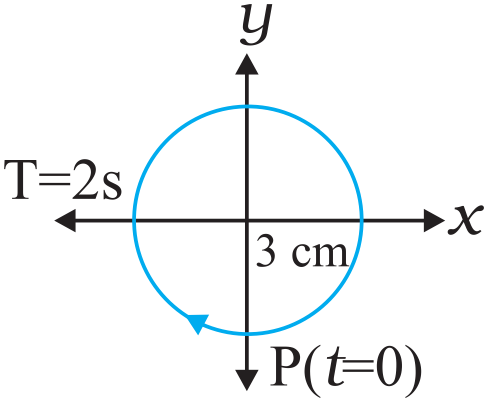
Figures correspond to two circular motions. The radius of the circle, the period of revolution, the initial position, and the sense of revolution (i.e. clockwise or anti-clockwise) are indicated on each figure.

Obtain the corresponding simple harmonic motions of the x-projection of the radius vector of the revolving particle P, in each case.