Question
Antiparticle of electron is

Answer

(c) Antiparticle of electron $_{-1} e^{0}$ is positron $_{+1} e^{0}$

Need a full question paper?

Generate a complete, print-ready paper with questions like this in minutes — across 16+ boards, with answer keys.

Start Generating Free

Similar questions

A tank is filled with benzene to a height of $120 \,mm$. The apparent depth of a needle lying at a bottom of the tank is measured by a microscope to be $80\, mm$. The refractive index of benzene is
Parallel rays are incident on a transparent sphere along its one diameter. After refrection these rays converge at the other end of this diameter the refractive index of the sphere is
Two planets have the same average density but their radii are ${R_1}$ and ${R_2}$. If acceleration due to gravity on these planets be ${g_1}$ and ${g_2}$ respectively, then
In a ferromagnetic material, below the curie temperature, a domain is defined as:
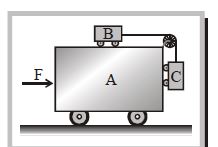
A frictionless cart $A$ of mass $100\  kg$ carries other two frictionless carts $B$ and $C$ having masses $8\  kg$ and $4\  kg$ respectively connected by a string passing over a pulley as shown in the figure. What horizontal force $F$ must be applied on the cart so that smaller cart do not move relative to  it .......... $N$
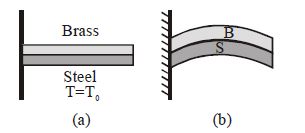
In figure which strip brass or steel have higher coefficient of linear expansion
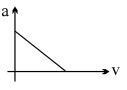
Acceleration versus velocity graph of a particle moving in a straight line starting from rest is as shown in figure. The corresponding velocity-time graph would be
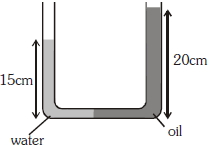
In a $U-$tube as shown in figure, water and oil are in the left side and right side of the tube respectively. The helghts from the bottom for water and oil columns are $15\; \mathrm{cm}$ and $20\; \mathrm{cm}$ respectively. The density of the oil is......$kg/{m}^{3}$

[take $\rho_{water} \left.=1000 \;\mathrm{kg} / \mathrm{m}^{3}\right]$
A diver at a depth of $12m$ in water ($\mu = 4/3)$ sees the sky in a cone of semi-vertical angle
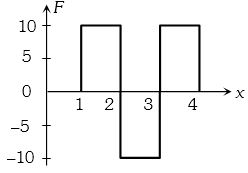
Figure shows the $F-x$ graph. Where $F$ is the force applied and $x$ is the distance coveredby the body along a straight line path. Given that $F$ is in newton and $x$ in metre, ........ $J$ is the work done.