Applying the principle of homogeneity of dimensions, determine which one is correct. where $\mathrm{T}$ is time period, $\mathrm{G}$ is gravitational constant, $M$ is mass, $r$ is radius of orbit.
JEE MAIN 2024, Diffcult


Download our appand get started for free
Experience the future of education. Simply download our apps or reach out to us for more information. Let's shape the future of learning together!No signup needed.*
Similar Questions
- 1View SolutionOne pico Farad is equal to
- 2Two full turns of the circular scale of a screw gauge cover a distance of $1\ mm$ on its main scale. The total number of divisions on the circular scale is $50$. Further, it is found that the screw gauge has a zero error of $- 0.03\ mm$. While measuring the diameter of a thin wire, a student notes the main scale reading of $3\ mm$ and the number of circular scale divisions in line with the main scale as $35$. The diameter of the wire is ....... $mm$View Solution
- 3If the measurement errors in all the independent quantities are known, then it is possible to determine the error in any dependent quantity. This is done by the use of series expansion and truncating the expansion at the first power of the error. For example, consider the relation $z=x / y$. If the errors in $x, y$ and $z$ are $\Delta x, \Delta y$ and $\Delta z$, respectively, thenView Solution
$z \pm \Delta z=\frac{x \pm \Delta x}{y \pm \Delta y}=\frac{x}{y}\left(1 \pm \frac{\Delta x}{x}\right)\left(1 \pm \frac{\Delta y}{y}\right)^{-1} .$
The series expansion for $\left(1 \pm \frac{\Delta y}{y}\right)^{-1}$, to first power in $\Delta y / y$, is $1 \mp(\Delta y / y)$. The relative errors in independent variables are always added. So the error in $z$ will be $\Delta z=z\left(\frac{\Delta x}{x}+\frac{\Delta y}{y}\right)$.
The above derivation makes the assumption that $\Delta x / x \ll<1, \Delta y / y \ll<1$. Therefore, the higher powers of these quantities are neglected.
($1$) Consider the ratio $r =\frac{(1- a )}{(1+ a )}$ to be determined by measuring a dimensionless quantity a.
If the error in the measurement of $a$ is $\Delta a (\Delta a / a \ll<1)$, then what is the error $\Delta r$ in
$(A)$ $\frac{\Delta a }{(1+ a )^2}$ $(B)$ $\frac{2 \Delta a }{(1+ a )^2}$ $(C)$ $\frac{2 \Delta a}{\left(1-a^2\right)}$ $(D)$ $\frac{2 a \Delta a}{\left(1-a^2\right)}$
($2$) In an experiment the initial number of radioactive nuclei is $3000$ . It is found that $1000 \pm$ 40 nuclei decayed in the first $1.0 s$. For $|x|<1$, In $(1+x)=x$ up to first power in $x$. The error $\Delta \lambda$, in the determination of the decay constant $\lambda$, in $s ^{-1}$, is
$(A) 0.04$ $(B) 0.03$ $(C) 0.02$ $(D) 0.01$
Give the answer or quetion ($1$) and ($2$)
- 4View SolutionThe dimension of the ratio of angular to linear momentum is
- 5The force $F$ is given in terms of time $t$ and displacement $x$ by the equation $F = A\,cos\,Bx + C\,sin\,Dt.$ The dimensional formulae of $D/B$ isView Solution
- 6Match List $I$ with List $II$.View Solution
List $I$ List $II$ $(A)$ Torque $(I)$ $Nms^{-1}$ $(B)$ Stress $(II)$ $J\,kg^{-1}$ $(C)$ Latent Heat $(III)$ $Nm$ $(D)$ Power $(IV)$ $Nm^{-2}$ Choose the correct answer from the options below.
- 7Unit of moment of inertia in $MKS$ systemView Solution
- 8The maximum error in the measurement of resistance, current and time for which current flows in an electrical circuit are $1 \%, 2 \%$ and $3 \%$ respectively. The maximum percentage error in the detection of the dissipated heat will beView Solution
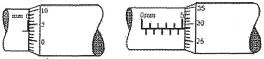
- 9Diagrams show readings of a screw gauge. figure $(i)$ shows the zero error reading when the screw gauge is closed, figure $(ii)$ the reading when the screw gauge is being used to measure the diameter of a ball-bearing. What is the diameter of the ball-bearing in $mm$? There are $50$ divisions on circular scaleView Solution
- 10The potential energy of a particle varies with distance $x$ from a fixed origin as $V = \frac{{A\sqrt x }}{{x + B}}$,whereView Solution
$A$ and $B$ are constants. The dimensions of $AB$ are