Unit of moment of inertia in $MKS$ system
Medium


Download our appand get started for free
Experience the future of education. Simply download our apps or reach out to us for more information. Let's shape the future of learning together!No signup needed.*
Similar Questions
- 1View SolutionEven if a physical quantity depends upon three quantities, out of which two are dimensionally same, then the formula cannot be derived by the method of dimensions. This statement
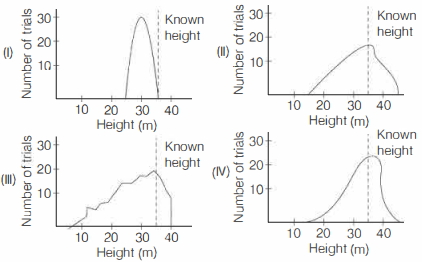
- 2View SolutionFour students measure the height of a tower. Each student uses a different method and each measures the height many different times. The data for each are plotted below. The measurement with highest precision is
- 3View SolutionWhich of the following is not a unit of self-inductance
- 4A public park, in the form of a square, has an area of $(100 \pm 0.2) m ^2$. The side of park is ......... $m$View Solution
- 5The vernier constant of Vernier callipers is $0.1 \,mm$ and it has zero error of $(-0.05) \,cm$. While measuring diameter of a sphere, the main scale reading is $1.7 \,cm$ and coinciding vernier division is $5$. The corrected diameter will be ........... $\times 10^{-2} \,cm$View Solution
- 6The $SI$ unit of magnetic permeability isView Solution
- 7A thin copper wire of length l metre increases in length by $ 2\%$ when heated through $10^o C$. ......... $\%$ is the percentage increase in area when a square copper sheet of length $l$ metre is heated through $10^o C$View Solution
- 8View SolutionWhich of the following quantities is dimensionless
- 9Resistance of a given wire is obtained by measuring the current flowing in it and the voltage difference applied across it. If the percentage errors in the measurement of the current and the voltage difference are $3\%$ each, then error in the value of resistance of the wire is ........ $\%$View Solution
- 10Which of the following equations is dimensionally incorrect?View Solution
Where $t=$ time, $h=$ height, $s=$ surface tension, $\theta=$ angle, $\rho=$ density, $a, r=$ radius, $g=$ acceleration due to gravity, ${v}=$ volume, ${p}=$ pressure, ${W}=$ work done, $\Gamma=$ torque, $\varepsilon=$ permittivity, ${E}=$ electric field, ${J}=$ current density, ${L}=$ length.