MCQ
Area bounded by the curvey $\text{y}=\text{x}+\sin\text{x}$ and its inverse function between the ordinates $\text{x}=0$ and $\text{x}=2\pi$ is:
  • A
    $8\pi\text{ sqp}.\text{units}$
  • B
    $4\pi\text{ sq}.\text{units}$
  • $8\pi\text{ sq}.\text{units}$
  • D
    $3\pi\text{ sq}.\text{units}$

Answer

Correct option: C.
$8\pi\text{ sq}.\text{units}$
Inverse function is the mirror image with respect to y = x
Then area bounded by $\text{x}+\sin\text{x}$ and its inverse function is
$=4\int\limits^\pi_0(\text{x}+\sin\text{x}-\text{x})\text{ dx}=8$

Need a full question paper?

Generate a complete, print-ready paper with questions like this in minutes — across 16+ boards, with answer keys.

Start Generating Free

Similar questions

Let $f(x) = x^3$ be a function with domain $\{0, 1, 2, 3\}$. Then domain of $f^{-1}$ is:
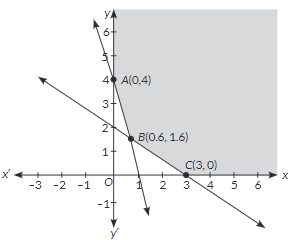
The corner points of the shaded unbounded feasible region of an LPP are $(0,4),(0.6,1.6)$ and $(3,0)$ as shown in the figure. The minimum value of the objective function $Z=4 x+6 y$ occurs at
Image
The equation of the normal to the curve $\text{y}=\text{x}+\sin\text{x}\cos\text{x}\text{ at }\text{x}=\frac{\pi}{2}$ is
Choose the correct answer out of the given four options.Let * be binary operation defined on R by a * b = 1 + ab ∀ a, b ∈ R. Then the operation * is:
Let $A=\left|\begin{array}{ll}1 & 1 \\ 0 & 0\end{array}\right|, $ then
If $f(x)=\left\{\begin{array}{ccc}\frac{1}{|x|} & ; & |x| \geq 1 \\ a x^{2}+b & ; & |x|<1\end{array}\right.$ is differentiable at every point of the domain, then the values of $a$ and $b$ are respectively
Corner points of the feasible region determined by the system of linear constraints are $(0, 3), (1, 1)$ and $(3, 0).$ Let $Z = px + qy,$ where $p, q > 0.$ Condition on p and q so that the minimum of $Z$ occurs at $(3, 0)$ and $(1, 1)$ is:
If the system of linear equations $x + y + z = 5$ ; $x = 2y + 2z = 6$ ; $x + 3y + \lambda z = u (\lambda \, \mu \in R)$, has infinitely many solutions then the value of $\lambda  + \mu $ is
If $\text{A}=\frac{1}{3}\begin{bmatrix} 1 & 1 & 2 \\ 2 & 1 & -2 \\ \text{x} & 2 & \text{y} \end{bmatrix}$ is prthogonal, than x + y =
If the Rolle's theorem holds for the function $f(x) = 2x^3 + ax^2 + bx$ in the interval $[-1, 1 ]$ for the point $c = \frac{1}{2}$ , then the value of $2a + b$ is