MCQ
Area bounded by the lines $y = x,\,\,x = - 1,\,\,x = 2$ and $x - $ axis is
- ✓$\frac{5}{2}\,\, sq. \,unit$
- B$\frac{3}{2}\,\, sq. \,unit$
- C$\frac{1}{2}\,\, sq. \,unit$
- DNone of these
$= \int_{ - 1}^0 {\,y\,.\,dx + \int_0^2 {y\,.\,dx = \frac{5}{2}} } \,\, sq. \,unit$.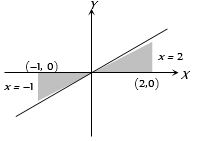
Generate a complete, print-ready paper with questions like this in minutes — across 16+ boards, with answer keys.
$1.$ One of the two boxes, box $I$ and box $II$, was selected at random and a ball was drawn randomly out of this box. The ball was found to be red. If the probability that this red ball was drawn from box $II$ is $\frac{1}{3}$, then the correct option$(s)$ with the possible values of $n_1, n_2, n_3$ and $n_4$ is(are)
$(A)$ $n_1=3, n_2=3, n_3=5, n_4=15$
$(B)$ $n_1=3, n_2=6, n_3=10, n_4=50$
$(C)$ $n_1=8, n_2=6, n_3=5, n_4=20$
$(D)$ $n_1=6, n_2=12, n_3=5, n_4=20$
$2.$ A ball is drawn at random from box $I$ and transferred to box $II$. If the probability of drawing a red ball from box $I$, after this transfer, is $\frac{1}{3}$, then the correct option$(s)$ with the possible values of $n_1$ and $n_2$ is(are)
$(A)$ $n_1=4, n_2=6$ $(B)$ $n_1=2, n_2=3$
$(C)$ $n_1=10, n_2=20$ $(D)$ $n_1=3, n_2=6$
Give the answer question $1$ and $2.$
$(A)$ $f^{\prime \prime}(x)$ exists for all $x \in(0, \infty)$
$(B)$ $f^{\prime}(x)$ exists for all $x \in(0, \infty)$ and $f^{\prime}$ is continuous on $(0, \infty)$, but not differentiable on $(0, \infty)$
$(C)$ there exists $\alpha>1$ such that $\left|f^{\prime}(x)\right|<|f(x)|$ for all $x \in(\alpha, \infty)$
$(D)$ there exists $\beta>0$ such that $|f(x)|+\left|f^{\prime}(x)\right| \leq \beta$ for all $x \in(0, \infty)$