MCQ
Area of the cross-section of a wire is measured using a screw gauge. The pitch of the main scale is $0.5 mm$. The circular scale has 100 divisions and for one full rotation of the circular scale, the main scale shifts by two divisions. The measured readings are listed below.

Measurement condition Main scale reading Circular scale reading
Two arms of gauge touching each other without wire $0$  division $4$ division
Attempt-$1$: With wire $4$  division $20$ division 
Attempt-$2$: With wire $4$ division $16$ division

What are the diameter and cross-sectional area of the wire measured using the screw gauge?

  • A
    $2.22 \pm 0.02 mm , \pi(1.23 \pm 0.02) mm ^2$
  • B
    $2.22 \pm 0.01 mm , \pi(1.23 \pm 0.01) mm ^2$
  • $2.14 \pm 0.02 mm , \pi(1.14 \pm 0.02) mm ^2$
  • D
    $2.14 \pm 0.01 mm , \pi(1.14 \pm 0.01) mm ^2$
Answer

Correct option: C.
$2.14 \pm 0.02 mm , \pi(1.14 \pm 0.02) mm ^2$
c
$\text { LC }=\frac{0.1}{100}=0.001 mm$

$\text { Zero error }=4 \times 0.001=0.004 mm$

$\text { Reading } 1=0.5 \times 4+20 \times 0.001-0.004=2.16 mm$

$\text { Reading } 2=0.5 \times 4+16 \times 0.001-0.004=2.12 mm$

$\text { Mean value }=2.14 mm$

$\text { Mean absolute error }=\frac{0.02+0.02}{2}=0.02$

$\text { Diameter }=2.14 \pm 0.02$

$\text { Area }=\frac{\pi}{4} d^2$

Need a full question paper?

Generate a complete, print-ready paper with questions like this in minutes — across 16+ boards, with answer keys.

Start Generating Free

Similar questions

A lift is moving downwards with an acceleration equal to acceleration due to gravity. $A$ body of mass $M$ kept on the floor of the lift is pulled horizontally. If the coefficient of friction is $\mu $, then the frictional resistance offered by the body is
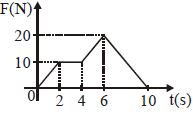
A particle of mass $2\, kg$ is initially at rest. A force acts on it whose magnitude changes  with time. The force time graph is shown below. The velocity of the particle after $10\, s$ is ......... $ms^{-1}$
In which of the following gas the root mean square velocity will be minimum (at const. temperature)
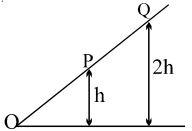
$A$ ball rolls down an inclined plane, figure. The ball is first released from rest from $P$ and then later from $Q$. Which of the following statement is/ are correct?

$(i)$ The ball takes twice as much time to roll from $Q$ to $O$ as it does to roll from $P$ to $O$.

$(ii)$ The acceleration of the ball at $Q$ is twice as large as the acceleration at $P$.

$(iii)$ The ball has twice as much $K.E$. at $O$ when rolling from $Q$ as it does when rolling from $P$.

Two waves of equal amplitude $A$ and equal frequency travel in the same direction in a medium. The amplitude of the resultant wave is:
A particle $P$ moving with speed $v$  undergoes a head -on elastic collision with another particle $Q$ of identical mass but at rest. After the collision
Which one of the following possesses potential energy?
One mole of an ideal gas passes through a process where pressure and volume obey the relation $P\, = {P_0}\,\left[ {1 - \frac{1}{2}{{\left( {\frac{{{V_0}}}{V}} \right)}^2}} \right]$.  Here $P_0$ and $V_0$ are constants. Calculate the change in the temperature of the gas if its volume change from $V_0$ to $2V_0$
Match Column $- I$ and Column $- II$ and choose the correct match from the given choices.
Column $- I$ Column $- II$
$(A)$ Root mean square speed of gas molecules $(P)$ $\frac{1}{3} \mathrm{n} m \bar{v}^{2}$
$(B)$ Pressure exerted by ideal gas $(Q)$ $\sqrt{\frac{3 \mathrm{RT}}{\mathrm{M}}}$
$(C)$ Average kinetic energy of a molecule $(R)$ $\frac{5}{2} \mathrm{RT}$
$(D)$ Total internal energy  of $1$ mole of a diatomic gas $(S)$ $\frac{3}{2} \mathrm{k}_{\mathrm{B}} \mathrm{T}$
Wax is coated on the inner wall of a capillary tube and the tube is then dipped in water. Then, compared to the unwaxed capillary, the angle of contact $\theta $ and the height $h$ upto which water rises change. These changes are