Question
Arjun keeps his books under Single Entry System. His Assets and Liabilities were as under.;
Particulars31.3.2017(₹)31.3.2018(₹)
Cash1,5001,000
Sundry Debtors30,00046,000
Stock35,00031,000
Plant and Machinery61,00075,000
Sundry Creditors15,00013,500
Bills Payable 4,000

During the year 2017-18 he introduced ₹ 15,000 as additional capital. He withdrew ₹ 2,500
every month for his private purpose.
Ascertain his Profit or Loss for the year ended 31st March 2018.
Answer

Get the step-by-step solution for this question inside the Vidyadip app.

Get the answer in the app

Need a full question paper?

Generate a complete, print-ready paper with questions like this in minutes — across 16+ boards, with answer keys.

Start Generating Free

Similar questions

Pass necessary Journal Entries for the following transactions and show Cash Account only.
2019
Mar. 1 Cash Balance ₹ 10,000.
6 Bought Goods ₹ 2,500.
7 Received from Sudhir ₹ 3,000.
10 Paid to Madhuri ₹2,000.
12 Cash Sales ₹7,000.
20 Paid Rent ₹ 3,500.
Mr. Morya keeps his books on Single Entry System and gives the following information:
Particulars31.3.2017(₹)31.3.2018(₹)
Cash at Bank10,00040,000
Sundry Debtors25,00042,000
Stock in Trade20,00035,000
Furniture30,00030,000
Machinery60,00060,000
Bills Payable4,0004,000
Sundry Creditors10,00015,000
Bank Loan@ 10% p.a.4,3004,300

Additional information:
1. Mr. Morya withdrew from business account ₹ 6,000 for personal use.
2. He introduced Additional Capital of ₹ 30,000
3. Depreciation is to be charged at 10% p.a. on Furniture and Machinery.
Prepare: 1) Opening and Closing Statement of Affairs
2) Statement of Profit or Loss for the year ended 31.3.2018

Record the following transactions in Purchase book, Sales book, Purchase Return book, Sales Return book of Kamal General Stores, Solapur.
DateDetails
2018 May 01Jaya Invoiced goods ₹ 15,000 at 9% T.D. as per invoice No. 23
3Purchased Computer from IBM Computers ₹ 55,000 as per invoice No. 86
4Invoiced goods to Priya for ₹ 20,000 at 4.5% T.D. as per invoice No. 34
7Sold goods to Sneha for ₹ 14,500 at 10% T.D. as per invoice No. 35
12Priya return goods ₹ 3,500 (Gross) for which we issued Credit Note No. 87
15Goods ₹ 4,500 (Gross) returned to Jaya & issued Debit Note No. 49
17Sold old Machinery to Bipin on credit ₹ 29,800.
20Sold goods to Amina for ₹ 26,650 as per invoice No. 36 & Purchased goods from
22her for ₹ 12,250 as per their invoice No. 455.
24Kailash Traders purchased goods from us ₹ 16,000 at 6% T.D. as per invoice
27Sweety supplieed goods to us ₹ 2,450 vide invoice No. 630.
29Return goods ₹ 460 to Sweety & issued debit note No 50
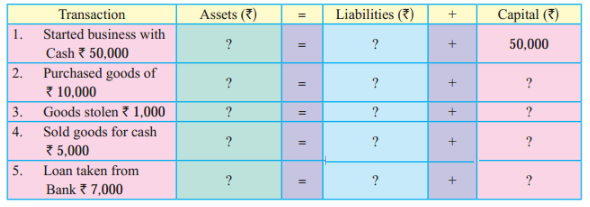
Show the accounting equation for the following transactions.
1) Rohit Sharma started business with cash ₹50,000.
2) Purchased goods from Dhoni on credit ₹10,000
3) Sold goods to Virat on credit ₹20,000.
4) Received Dividend ₹500.
5) Paid for Advertisement ₹500
Calculate the following: Purchased Motor Car from Tata & Company worth ₹ 2,00,000 at 18% GST. Find out GST amount.
Amar bought goods worth ₹20,000 from Rakesh at 10% trade discount.

Image
Prepare two columns Cash Book of Guru Dakshina Brothers. (Narrations not
required)
2019 March 1) Cash balance ₹ 13,000 and Bank Overdraft ₹ 18,000
2) Received from Neha cash ₹ 1,700 and bearer cheque ₹ 500.
7) Paid to Dhanraj ₹ 6,000 by cheque.
8) Cash Sales ₹ 6,545 and discount allowed ₹ 55
10) Cheque received on 2nd March 2019 deposited into Bank.
12) Deposited into Bank ₹ 5,000
13) Goods purchased from Prachi on credit ₹ 5,000
15) Cheque received from Neha returned dishonoured.
20) Purchased goods from Sweety ₹5,000 at 7% T.D. and paid half the amount
immediately.
22) Bank paid insurance premium ₹1,000 and collected interest on investment
₹1,650
24) Cheque issued to Dhanraj was dishonoured.
26) Gupta stores directly deposited into our Bank A/c ₹7,500
30) Deposited cash in excess of ₹3,920 in to Bank.
Calculate the following: Received cheque of ₹ 90,000 from Kiran in full settlement of his account ₹ 1,00,000/-. Calculate discount rate.

Image