MCQ
Aromaticity is present in
- A

- B

- ✓
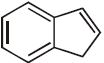
- D

Generate a complete, print-ready paper with questions like this in minutes — across 16+ boards, with answer keys.
$(A)$ $\left[ FeF _{6}\right]^{3-}$
$(B)$ $\left[ Fe ( CN )_{6}\right]^{3-}$
$(C)$ $\left[ MnCl _{6}\right]^{3-}$ (high spin)
$(D)$ $\left[ Mn ( CN )_{6}\right]^{3-}$
$(i)$ benzene $(ii)$ toluene
$(iii)$ chlorobenzene $(iv)$ phenol
Upon treatment with dilute alkaline $KMnO _4, P$ as well as $Q$ could produce one or more than one from $S , T$ and $U$.$Image$
$1.$ Compounds formed form $P$ and $Q$ are, respectively
$(A)$ Optically active $S$ and optically active pair $(T, U)$
$(B)$ Optically inactive $S$ and optically inactive pair $(T, U)$
$(C)$ Optically active pair $(T, U)$ and optically active $S$
$(D)$ Optically inactive pair $(T, U)$ and optically inactive $S$
$2.$ In the following reaction sequences $V$ and $W$ are respectively :$Image$
mcq $Image$
Give the answer question $1$ and $2.$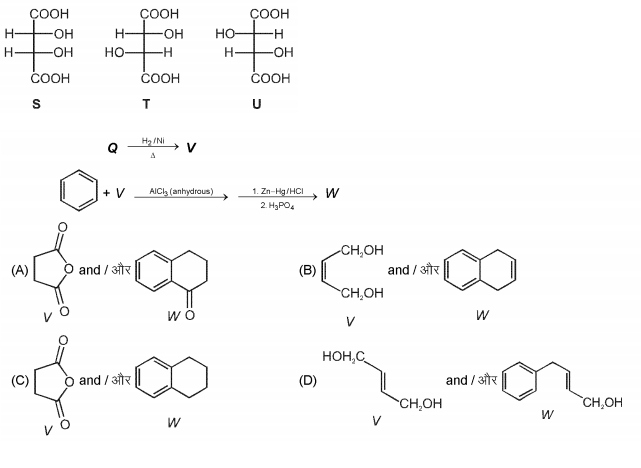
$I.$ In gaseous phase, the vapour pressure of $CH_3COOH$ is less than expected.
$II.$ In benzene, acetic acid dimerises.
$III.\, CH_3OH$ is more viscous than $H_2O.$
$IV.\, CH_3OCH_3$ is non-polar but soluble in water.
Select the correct set of codes using $T$ for true and $F$ for false statements in given sequence.
${C_2}{H_5}Br\xrightarrow{X}{\text{product}}\xrightarrow{{\text{Y}}}{C_3}{H_7}N{H_2}$