MCQ
As a wave propagates
  • A
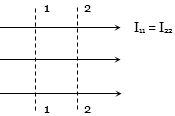
    The wave intensity remains constant for a plane wave
  • B
    Total intensity of the spherical wave over the spherical surface centered at the source remains constant at all times
  • C
    The wave intensity decreases as the inverse square of the distance from the source for a spherical wave
  • All of the above.

Answer

Correct option: D.
All of the above.
d
(d) For a travelling wave, the intensity of wave remainsconstant if it is a plane wave.
Intensity of wave is inversely proportional to the square of the distance from the source if the wave is spherical
$\left( {I = \frac{P}{{4\pi {r^2}}}} \right)$
Intensity of spherical wave on the spherical surface centred at source always remains same. Here total intensity means power $P$.

Need a full question paper?

Generate a complete, print-ready paper with questions like this in minutes — across 16+ boards, with answer keys.

Start Generating Free

Similar questions

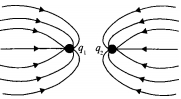
The given figure gives electric lines of force due to two charges $q_1$ and $q_2$. What are the signs of the two charges?
Magnification of a compound microscope is $30$. Focal length of eyepiece is $5\,\, cm$ and the image is formed at a distance of distinct vision of $25\,\, cm$. The magnification of the objective lens is
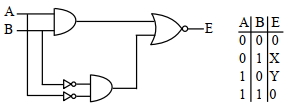
In the truth table of the above circuit the value of $X$ and $\mathrm{Y}$ are
Two springs of force constants $300\, N/m$ (Spring $A$) and $400\, N/m$ (Spring $B$) are joined together in series . The combination is compressed by $8.75\, cm$. The ratio of energy stored in $A$ and $B$ is  $\frac{{{E_A}}}{{{E_B}}}$.  Then $\frac{{{E_A}}}{{{E_B}}}$ is equal to
A long straight wire with a circular crosssection having radius $R$, is carrying a steady current $I$. The current I is uniformly distributed across this cross-section. Then the variation of magnetic field due to current I with distance $r\;( r < R )$ from its centre will be
A body of mass $m_1$ moving with an unknown velocity of $v_1 \hat i$ undergoes a collinear collision with a body of mass $m_2$ moving with a velocity $v_2 \hat i$ . After collision $m_1$ and $m_2$ move with velocities of $v_3 \hat i$ and $v_4 \hat i$ respectively. If $m_2 = 0.5\, m_1$ and $v_3 = 0.5\, v_1$ then $v_1$ is:
A physical quantity $P$ is given by $P= \frac{{{A^3}{B^{\frac{1}{2}}}}}{{{C^{ - 4}}{D^{\frac{3}{2}}}}}$. The quantity which brings in the maximum percentage error in $P$ is
The earth revolves round the sun in one year. If the distance between them becomes double, the new period of revolution will be
A brass rod of cross-sectional area $1\,c{m^2}$ and length $0.2\, m$ is compressed lengthwise by a weight of $5\, kg$. If Young's modulus of elasticity of brass is $1 \times {10^{11}}\,N/{m^2}$ and $g = 10\,m/{\sec ^2}$, then increase in the energy of the rod will be
Consider a long straight wire of a circular cross-section (radius a) carrying a steady current I. The current is uniformly distributed across this cross-section. The distances from the centre of the wire's cross-section at which the magnetic field [inside the wire, outside the wire] is half of the maximum possible magnetic field, any where due to the wire, will be