Question
As compared $^{12}C$ atom, $^{14}C$ atom has

Answer

(c) For $_6{C^{12}},$$p = 6,\;e = 6,\;n = 6$

For $_6{C^{14}},$$p = 6,\;e = 6,\;n = 8$

Need a full question paper?

Generate a complete, print-ready paper with questions like this in minutes — across 16+ boards, with answer keys.
Start Generating Free

Similar questions

The pair having the same dimensions is
An object is projected with a velocity of $20 m/s$ making an angle of $45^o$ with horizontal. The equation for the trajectory is $h = Ax -Bx^2$ where $h$ is height, $x$ is horizontal distance, $A$ and $B$ are constants. The ratio $A : B$ is ($g = 10 ms^{-2}$)
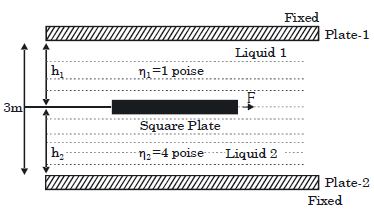
A thin square plate of side $2\ m$ is moving at the interface of two very viscous liquids of viscosities ${\eta _1} = 1$ poise and ${\eta _2} = 4$ poise respectively as shown in the figure. Assume a linear velocity distribution in each fluid. The liquids are contained between two fixed plates. $h_1 + h_2 = 3\ m$ . A force $F$ is required to move the square plate with uniform velocity $10\ m/s$ horizontally then the value of minimum applied force will be ........ $N$
The ratio of thermal conductivity of two rods of different material is $5 : 4$ . The two rods of same area of cross-section and same thermal resistance will have the lengths in the ratio
Equation of the progressive wave is given by : $y = a\sin \pi (40t - x)$ where $a$ and $x$ are in metre and $t$ in second. The velocity of the wave is  ..... $m/s$
body moves with constant angular velocity on a circle. Magnitude of angular acceleration
${g_e}$ and ${g_p}$ denote the acceleration due to gravity on the surface of the earth and another planet whose mass and radius are twice as that of earth. Then
When a train stops suddenly, passengers in the running train feel an instant jerk in the forward direction because
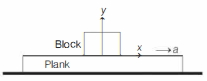
A plank is moving in a horizontal direction with a constant acceleration $\alpha \hat{ i }$. A uniform rough cubical block of side $l$ rests on the plank and is at rest relative to the plank. Let the centre of mass of the block be at $(0, l / 2)$ at a given instant. If $\alpha =g / 10$, then the normal reaction exerted by the plank on the block at that instant acts at
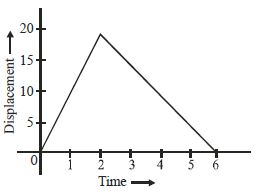
For the displacement-time graph shown in figure, the ratio of the magnitudes of the (constant) speeds during the first two seconds and the next four seconds is