Question
As the mass number A increases, the binding energy per nucleon in a nucleus:
  1. Increases.
  2. Decreases.
  3. Remains the same.
  4. Varies in a way that depends on the actual value of A.
Answer

  1.  Varies in a way that depends on the actual value of A.
Explanation:

Binding energy per nucleon in a nucleus first increases with increasing mass number (A) and reaches a maximum of 8.7MeV for A (50 - 80). Then, again it slowly starts decreasing with the increase in A and drops to the value of 7.5MeV.

Need a full question paper?

Generate a complete, print-ready paper with questions like this in minutes — across 16+ boards, with answer keys.

Start Generating Free

Similar questions

Taking into account of the slgnificant figures, what is the value of $9.99\, m -0.0099\, m ?$
Two rods of different materials having coefficient of thermal expansion $\alpha_1,\alpha_2$ and Young's modulus Y1, Y2, respectively are fixed between two rigid massive walls. The rods are heated such that they undergo the same increase in temperature. There is no bending of the rods. If $\alpha_1:\alpha_2=2:3,$ the thermal stresses developed in the two rods are equal provided Y1 : Y2 is equal to:
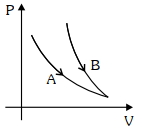
Choose the correct statement for processes $A$  & $B$ shown in figure.
If the length of a wire is made double and radius is halved of its respective values. Then, the Young's modules of the material of the wire will :
$28\,\, gm$ of $N_2$ gas is contained in a flask at a pressure of $10$ atm and at a temperature of $57^o$. It is found that due to leakage in the flask, the pressure is reduced to half and the temperature reduced to $27\,^oC$. The quantity of $N_2$ gas that leaked out is
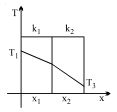
The temperature drop through each layer of a two layer furnace wall is shown in figure. Assume that the external temperature $T_1$ and $T_3$ are maintained constant and $T_1 > T_3$. If the thickness of the layers $x_1$ and $x_2$ are the same, which of the following statements are correct.
For an ideal gas the instantaneous change in pressure $'{p} '$ with volume $'v'$ is given by the equation $\frac{{dp}}{{dv}}=-{ap} .$ If ${p}={p}_{0}$ at ${v}=0$ is the given boundary condition, then the maximum temperature one mole of gas can attain is :

(Here ${R}$ is the gas constant)

A sparrow flying in air sits on a stretched telegraph wire. If weight of the sparrow is W, which of the following is true about the tension T produced in the wire?
The temperature at which the surface tension of water is zero
At constant pressure, the volume of the gas is proportional to the absolute temperature is called as: